Category Archives: disaster relief team

Mine clearance in Sri Lanka could take 10 years or more

IRIN News

Landmine clearance in Sri Lanka’s conflict-affected north could take more than a decade, experts say. “It is expected to take [in] excess of 10 years to fully mitigate all remaining contamination in Sri Lanka,” the Mine Action Project of the UN Development Programme (UNDP) [ http://www.undp.lk/What_We_Do/Pages/Mine_Action.aspx ] in Sri Lanka told IRIN, citing a lack of resources coupled with the difficult nature of the work.

Approximately 126 sqkm of land remains to be cleared in the island’s north at the end of 2011, according to data from the National Mine Action Centre (NMAC). Set up in July 2010, NMAC is the government’s lead agency in de-mining work in the country. As of 31 December 2011, the largest remaining area was in Mannar District (33.8 sqkm), followed by Mullaitivu (27.7 sqkm), Kilinochchi (23 sqkm), Vavuniya (15 sqkm) and Jaffna (5 sqkm) in the north. Smaller areas are in borderline districts of Polonnaruwa and Anuradhapura, along with some parts of the east.

Barrier to return: More than 6,700 conflict-displaced, mainly from Mullaitivu District, continue to live at Menik Farm [http://www.irinnews.org/report.aspx?reportid=89572 ] outside the town of Vavuniya, where more than 200,000 internally displaced persons (IDPs) once lived following the end of the war [ http://www.irinnews.org/printreport.aspx?reportid=89904 ] between government forces and the Liberation Tigers of Tamil Eelam (LTTE), which had been fighting for an independent Tamil homeland since 1983 [http://www.irinnews.org/printreport.aspx?reportid=84146].

According to the UN Office for the Coordination of Humanitarian Affairs (OCHA) [http://www.humanitarianinfo.org/srilanka_hpsl/Files/Situation%20Reports/Joint%20Humanitarian%20Update/LKRN057_JHERU_Nov-Dec_2011.pdf ], since 1 January 2009, more than 554 sqkm have been cleared of mines and UXO (unexploded ordnance) in the north and east of the country.

The humanitarian demining unit of the Sri Lanka Army, international organizations – Danish Demining Group (DDG), HALO Trust, Horizon, Mines Advisory Group (MAG), Sarvatra, and Swiss Foundation for Mine Action (FSD)] – and two national organizations – Delvon Assistance for Social Harmony (DASH) and the Milinda Moragoda Institute for Peoples’ Empowerment (MMIPE)] – are engaged in demining work.

The UN Children’s Fund (UNICEF) carries out mine risk awareness programmes in the north and east. The UNDP Mine Action Unit said most of the surveys to identify the mine risk areas had been completed, but the task of clearing the mines and UXO remains time-consuming and labour-intensive.

“It turns out there aren’t any fancy scanners or high-tech mine-removal gadgets that can compete with old-fashioned sweat, discipline, and patience when it comes to picking mines out of the ground,” US diplomat Emily Fleckner said during a December site visit to Kilinochchi, where some of fiercest fighting once took place. [ http://blogs.state.gov/index.php/site/entry/halo_trust_demining_site ].

Fleckner wrote in a blog post for the State Department that officials with HALO Trust told her the organization had removed more mines in Sri Lanka during its first year of operation than all its other de-mining work combined worldwide over the same period of time.

Funding questions: But it is the overall issue of funding that has people worried most almost two years since the war was officially declared over. UNDP’s Mine Action Project says the slow work of removing mines was “compounded by decreasing donor funding” for themselves and other mine clearance agencies.

On 22 January[http://reliefweb.int/sites/reliefweb.int/files/resources/F_R_570.pdf], DDG said in an update that it had been forced to reduce its capacity by 20 percent since late 2010 due to funding constraints. DDG doubled its clearing capacity soon after the war ended in May 2009. “[But], in late 2010/early 2011 this was followed by an unheralded decrease in funding, especially amongst our major donors who reviewed their strategies globally and in particular towards Sri Lanka.”

The group has since warned of further reductions if funding constraints persist. NMAC estimates it will cost more than US$100 million to demine the last 126 sqkm.

Meanwhile, for those who have returned to their places of origin, the need to remain vigilant continues. “We know they are still around,” Mathiyavaratham Manivannan, a 32-year-old farmer in Mullaitivu District said, noting that mine-awareness programmes had made it easier for him to identify mines and UXO. “We don’t find them that often now, but we do come across them, especially when we clear new land.”

According to UNICEF, mine-related incidents were on the decline due to intense awareness programmes [ http://irinnews.org/report.aspx?reportid=90899 ]. More than 23,000 returnees took part in such programmes in December 2011 alone, with mine risk education continuing in both the north and east of the country, OCHA reported. In 2011, only 17 mine-related incidents were reported, down from 27 a year earlier. The casualty rate also dropped from 47 to 24.

This report online: http://www.irinnews.org/report.aspx?reportID=94798

1 Comment

Filed under disaster relief team, IDP camps, law of armed conflict, life stories, LTTE, NGOs, population, rehabilitation, Sinhala-Tamil Relations, sri lankan society, Tamil civilians, tamil refugees, world events & processes

Hambantota after the Tsunami: Then and Now

Padraig Colman, in the Sunday Island, 17 December 2013

On 26 December 2011 it will be seven years since 36,000 to 50,000 people (the numbers of dead vary depending on the source) died inSri Lankain the 2004 tsunami. On Christmas Day 2004, we had heard news that our local government veterinarian, whom we knew well, was looking forward to going on a trip toGallewith a party of about 20 people. He and 16 others died. His wife and one child survived because they went back to the hotel for a newspaper. A strange phenomenon was noted in Yala National Park. Few of the animals seemed to have perished because they moved to higher ground before the wave hit. Was this because they sensed the tremors?

A local relief effort that got underway almost immediately is generally agreed to have been a success. Even in the poorest, most remote areas, people flocked to the roadside to hand over money, clothes, bottles of water and bags of rice and lentils.

There are complaints today about militarisation. Seven years ago, 20,000 soldiers were deployed to assist in relief operations and maintain law and order. An effective, spontaneous immediate response was organised locally, followed by the government and international agencies. Temporary shelter for the displaced was provided in schools, other public and religious buildings. Communities and groups cooperated across ethnic and religious differences.

Eye Witness: One month after the tsunami, my wife and I visited Hambantota. We visited again, to take some supplies for the three months dane. Back in 2005, just outside the town of Hambantota, plastic chairs were stranded on the banks above the stained salt in the lagoons of the Lanka Salt Company. Fishing suffered because of fear that fish were contaminated by corpses. Apparently, there was a greater danger of corpses contaminating the salt. Continue reading

Leave a comment

Filed under citizen journalism, disaster relief team, island economy, life stories, population, rehabilitation, sri lankan society, welfare & philanthophy

From Tsunami Medical Logistics to IDP Camp Medical Aid, 2004-09; Q and A with Dr Herath

From Tsunami Medical Logistics to IDP Camp Medical Aid, 2004-09

Speaking at Adelaide Universityon one occasion the Australian Ambassador, French, stressed that an experienced disaster relief team from Australia played a critical role in coordinating information and logistics for the massive task of relief and recovery in Sri Lanka after the tsunami of 26 December 2004. I do not have those details. But I can now reveal to those interested how a central coordinating unit of medical personnel played a critical role in organising the medical relief work in the coastal regions of the southwest, south and east that were hit by the tsunami and thereafter directed the tasks associated with re-building the institutions and other medical services that had been destroyed by the waters.

Dr. Hemantha Herath was assigned to the Health Desk of the Disaster Preparedness and Response Division (DPRD) of the Ministry of Health on 28 December 2004, while the Tsunami Rehabilitation Unit was also set up at about the same time with Dr. Thushara Ranasinghe as Coordinator, Planning) and Dr. Eeshara Vithana as Coordinator, Operations. The DPRD and TRU together directed the tsunami relief and re-establishment tasks. Their duties were extended in 2007-09 to handling the logistical requirements of drugs and equipment for the medical aid that was being provided to the Tamil refugees in the Eastern Province by personnel by local and foreign NGOs.

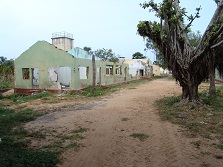
Kattankudy district hospital completely destroyed

Setting up a Field Hospital, Zone 2, 21 April 2009  –Pic by Donnie Woodyard

For a number of reasons Herath delayed his sabbatical leave till late 2008 when he eventually proceeded to UK. The unit was still functioning however (now downsized and housed within the offices of the Ministry of Health). The central point is that an experienced team of co-ordinators was at hand when the issue of Tamil IDPs from the north developed in late 2008/early 2009 after a large mass of people were assembled in the Menik Farm camps near Chettikulam over a period of time and especially in April-May 2009. They undertook the duties of (a) marshaling and organizing the erection of temporary health centres within the camps; (b) selecting and assigning doctors, nurses and other staff to service the camps; (c) distributing the equipment and drugs required for the medical centres; and (d) bolstering the pre-existing medical services within Vavuniya District so that they could assist the IDP camps in the handling of more serious cases. Continue reading

7 Comments

Filed under australian media, disaster relief team, IDP camps, life stories, Rajapaksa regime, reconciliation, rehabilitation, Sinhala-Tamil Relations, sri lankan society, Tamil civilians, Tamil migration, tamil refugees, unusual people, welfare & philanthophy, world events & processes