Category Archives: architects & architecture

Leonard Woolf in Ceylon: A Pictorial Excursion

A Collection derived from Digital internet sources  and with special thanks to Hugh Karunanayake in Melbourne for some great finds, including the shot of the New Oriental Hotel in Galle Fort in the 1910s, the dhony and the coastal steamers plying the island’s coasts.

Young Leonard Woolf    …. & then a mustachioed Woolf


Woolf and his dogs in Jaffna


Continue reading

4 Comments

Filed under architects & architecture, art & allure bewitching, authoritarian regimes, British colonialism, cultural transmission, ethnicity, heritage, historical interpretation, island economy, landscape wondrous, life stories, literary achievements, politIcal discourse, self-reflexivity, sri lankan society, Tamil civilians, transport and communications, travelogue, unusual people, working class conditions, world events & processes

The Galoya Valley Scheme & the People who made it a Reality

KK De Silva, who was an employee of the RVDB from 1967-1979


Introduction

 Sir James Emerson Tennent, Colonial Secretary from 1845 to 1850, at page 432 of his book, Account of the Island of Ceylon ….. Vol. II says that on a visit to the Horra-bora Tank (Soraborawewa ), then in ruins, he was so impressed with its magnificense & potential for rice cultivation that after subsequent inspections of other ancient tanks in the Northern Division , he proposed in 1848 that measures be taken to restore important ancient reservoirs by legislative action; his proposal was approved, but action delayed due to unavoidable circumstances, possibly the 1848 uprising, & legislation was introduced later, when Sir Henry Ward was Governor, by way of the Irrigation Ordinance No. 9 of 1856 . Soraborawewa was restored in 1876. (Arumugam,1969).

Continue reading

4 Comments

Filed under accountability, architects & architecture, British colonialism, centre-periphery relations, demography, economic processes, heritage, historical interpretation, island economy, landscape wondrous, life stories, patriotism, politIcal discourse, rehabilitation, Sinhala-Tamil Relations, sri lankan society, transport and communications, unusual people, working class conditions, world events & processes

A Requiem For Barbara Sansoni: From 1962 ….

Somasiri Devendra, ** whose chosen title is “A wooden bridge, an iron house, and Barbara then ….”

.………… of such are memories made, writes Somasiri Devendra

So, Barbara has ridden off into the sunset, on her white horse, after “a hard day’s night” leaving behind memories of the times when she was a person, not an icon, and very good company indeed. Those memories reach back 60 years.

 Barbara and Hildon Sansoni in 1958


Continue reading

2 Comments

Filed under architects & architecture, art & allure bewitching, cultural transmission, heritage, historical interpretation, landscape wondrous, life stories, meditations, nature's wonders, paintings, performance, photography, self-reflexivity, sri lankan society, the imaginary and the real, travelogue, unusual people, world events & processes

An Outstanding Mansion: “Regina Walauwwa” become “College House”

Yomal Senerath-Yapa, in Sunday Times, 8 May 2022, where the title runs thus: “Enduring Symbol of Colombo University” … with a sub-line reading “A new coffee-table book maps the beginnings of the country’s academia in 1921

The majestic College House down Thurstan Road –  a whimsical marriage between an English country house and a Maharajah’s haveli with its conical roofs, turrets and slender carved wooden columns, is for the historian a relic of a bygone age. Originally called ‘Regina Walawwa’, in time the house would be renamed College House and become the icon of the Colombo University.

Continue reading

2 Comments

Filed under architects & architecture, art & allure bewitching, cultural transmission, education, heritage, historical interpretation, island economy, landscape wondrous, life stories, modernity & modernization, patriotism, photography, sri lankan society, unusual people, world events & processes

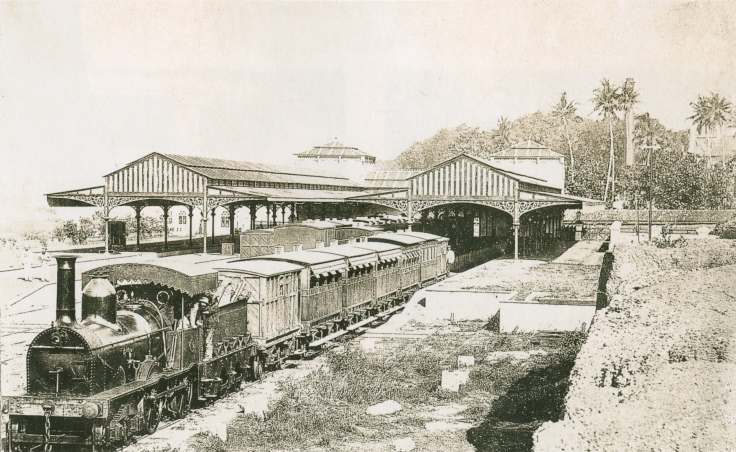
A History of the Colombo Railway Station via Familial Lore

Vinodh Wickremeratne 

The Colombo railway station opened for operations officially on 2nd October 1865 when a Revenue Train was despatched to Henerath-godde. The Colombo Railway Station had been planned and constructed with passenger friendly facilities (Ladies’ waiting rooms etc).

The Colombo Railway Terminus, 1867, Skeen & Co (see Ismeth Raheem & Percy Colin-Thome, Images of British Ceylon, p. 93) Continue reading

4 Comments

Filed under architects & architecture, British colonialism, centre-periphery relations, economic processes, heritage, historical interpretation, island economy, landscape wondrous, life stories, modernity & modernization, sri lankan society, transport and communications, world events & processes

A Quaint Catholic Church within the Fort of Galle

St. Josephs Chapel featured at https://www.google.com/url?sa=t&rct=j&q=&esrc=s&source=web&cd=&ved=2ahUKEwizvIeNvL_3AhUQ7XMBHcasCGwQFnoECAwQAQ&url=https%3A%2F%2Fwww.trulysrilanka.com%2Fattractions%2Fst-josephs-chapel.html&usg=AOvVaw1SsgUEFkNvvWOYjQdlKGkb

Sri Lanka is a country with a long and storied colonial history and heritage. For centuries the island had significant interactions and conflicts with the sea-faring Europeans who had begun to colonise all over Asia. Sri Lanka has now been independent for more than seven decades, but the legacy and impact of its colonial overlords is still apparent if you take a look around its most important cities. For example, colonial influences are apparent all throughout the coastal city of Galle – from the iconic Galle Fort to the Colonial History Museum. But one attraction that might fly under your radar is the St Joseph’s Chapel – a quaint little Roman Catholic Church that’s nestled away amidst the sleepy streets of the city.

Continue reading

8 Comments

Filed under architects & architecture, art & allure bewitching, British colonialism, cultural transmission, heritage, historical interpretation, landscape wondrous, life stories, religiosity, sri lankan society, world events & processes

Vihares and Verandas: Barbara Sansoni’s Magnum Opus

Most versions of this set of amateur reproductions are due to the work done by David Sansoni on amateur mobile-camera pictures taken by Michael Roberts; but the first ‘snap’ of the lion frieze is by Roberts at his Thuppahi worst.

Exif_JPEG_420 ………. “Lions from inner wall of PADENIYA TEMPLE” …. 


Continue reading

4 Comments

Filed under architects & architecture, art & allure bewitching, Buddhism, cultural transmission, education, heritage, historical interpretation, landscape wondrous, life stories, patriotism, performance, photography, self-reflexivity, sri lankan society, the imaginary and the real, travelogue, unusual people

Always Ahead of the Present: Farewell Barbara Sansoni

Nazreen, Anjalendran & Ismeth farewell Barbara Sansoni —https://thuppahis.com/wp-admin/post-new.php?post_type=post&calypsoify=1

ONE; Nazreen Sansoni, ……… Barbara Sansoni, the well-known Sri Lankan artist and designer, passed away on April 23rd at around 1.10 a.m., just one hour after her 94th birthday. Dominic, her devoted son and Kavi, her faithful right hand, were by her side – Simon, her eldest, could not make it as he was in London.

Continue reading

1 Comment

Filed under accountability, architects & architecture, art & allure bewitching, British colonialism, centre-periphery relations, cultural transmission, heritage, historical interpretation, Indian traditions, landscape wondrous, life stories, paintings, patriotism, performance, self-reflexivity, sri lankan society, the imaginary and the real, unusual people, world events & processes

Chance Events in the Making of the Four-Volume Documents of the Ceylon National Congress

Michael Roberts

 In 1977 a sizeable stock of historical manuscripts was made available to the public by the Department of National Archives in four volumes entitled Documents of the Ceylon National Congress and Nationalist Politics in Ceylon, 1929-1950. This outcome was the result of a substantial body of work. It was also the outcome of several fortuitous encounters.

Continue reading

2 Comments

Filed under architects & architecture, British colonialism, communal relations, cultural transmission, education policy, ethnicity, heritage, historical interpretation, language policies, Left politics, life stories, nationalism, patriotism, politIcal discourse, power politics, self-reflexivity, Sinhala-Tamil Relations, sri lankan society, unusual people, world events & processes

Buddhist Temples in Lanka: Evocative Thoughts

Uditha Devapriya, in The Island, 9 April 2022, … With input from and photographs by Manusha Lakshan … & bearing this title  “Some reflections on the temples of the South”

The social and cultural history of Buddhist temples in Sri Lanka has been the object of study for well over a century. Far from receding into a world of their own, these temples occupied a prominent place in the world around them. Buddhist monks lived under a code of piety and self-denial, and they operated under their own rules and customs. Yet despite being cut off from mundane concerns, they were very much linked to the society they hailed from. Granted entire villages for their upkeep, the clergy made use of the social institutions of their time, most prominently caste, to maintain their hold.


 Ceityagiri, 

Dharmasalava, Pushparama Continue reading

4 Comments

Filed under ancient civilisations, architects & architecture, art & allure bewitching, authoritarian regimes, British imperialism, Buddhism, centre-periphery relations, cultural transmission, economic processes, ethnicity, heritage, historical interpretation, Indian religions, Indian traditions, island economy, landscape wondrous, life stories, meditations, nationalism, paintings, patriotism, performance, pilgrimages, politIcal discourse, Portuguese imperialism, power politics, religiosity, religious nationalism, self-reflexivity, travelogue, world events & processes