Category Archives: Al Qaeda

Rapier Defence for London Olympics?

Rapier SAMs on Blackheath Commons in London, apparently installed to protect the London Olympics. They were last used in the Falklands in 1982, where their performance was, frankly, pretty poor. Perhaps they’ve been upgraded. But what will arrest Al Qaida, and its rhizomic offshoots, with or without Osama bin Laden?

Leave a comment

Filed under Al Qaeda, military strategy, terrorism, Uncategorized, war crimes, world events & processes

Porn Files Reveal Al-Qaeda Plan To Terrorize Europe

RT, courtesy of the Eurasia Review, 1 May 2012

News has emerged of a German police seizure of a large cache of Al-Qaeda’s internal documents disguised as pornography. They outline the terrorist network’s plans for possible attacks in Europe, including hijacking a cruise liner.

The documents were found by the German Federal Criminal Police in mid-March 2011 after they arrested a man called Maqsood Lodin. Investigators suspect that the Austrian received training in a terrorist camp in Pakistan and was planning to establish a sleeper cell in Germany. The man had several memory cards hidden in his clothes, when he was being detained. Among the files on them was a pornographic movie called “Kick Ass” and a file named “Sexy Tanja” the German newspaper Die Zeit reports.

The files, however, had a massive amount of data hidden under their apparent content. There were more than 100 documents apparently used by Al-Qaeda terrorists in their activities. Of particular interest to German investigators were three text files, which outline the network’s assessment of its past operations and plans for future attacks.

The documents’ author remains unknown, but it is probably someone from Al-Qaeda’s inner circle of leadership. They were penned between 2008 and 2009, the Germans believe, but are still of great value to law enforcement agencies today.

Apparently the leadership of the terrorist network is unhappy with its inability to perform a major attack in the West over recent years. The documents indicate that the case of Lodin and another man, Yusuf Ocak, who allegedly received the same training in the same camp and was returning to Europe with Lodin, is part of a strategy to change that.

They and many others were to form a number of sleeper cells in Europe which would be available for eventual attacks. Al-Qaeda envisioned a twofold action plan, with a number of small terrorist attacks launched one after another to distract law enforcers and keep them pre-occupied. While this happened, a large-scale operation would be in the works unnoticed by the authorities.

The documents, called “Future Works”, outline a number of possible ways a major terrorist attacks could be carried out. One idea is to seize a cruise liner, take the crew and passengers hostage and start shooting prisoners in front of cameras unless the terrorists’ demands are met. The approach is referred to as “taking jihad to the sea” in the roadmap.

The exact value the intelligence has in fighting against Al-Qaeda is yet to be seen. It does not state any dates or targets of possible attacks. Nevertheless it provides a unique insight into the internal workings of Al-Qaeda.

The cache may be as precious a piece of evidence as the archive of Osama Bin Laden, captured by US Navy SEALs after the raid on his compound a year ago. The US announced that it will publish some of that booty soon.

It is unlikely that Bin Laden’s fabled porn collection would be among the data made public, but the news indicates that it may have had a sinister purpose behind it.

Web Editor’s Notethis is May 1st not April 1st so i presume this is no joke!

Leave a comment

Filed under Al Qaeda, terrorism, world events & processes

Osama’s compound rubble as metaphor for several strained relationships

Amanda Hodge, in The Australian, 2 May 2012 where it was presented under a different title

A FUNNY thing happened at the site where Osama bin Laden’s house once stood the other day. Three Chinese businessmen, arrested for entering the Abbottabad neighbourhood where the al-Qa’ida chief lived a life of secret mediocrity, tried to cut a deal with police to sell “genuine bin Laden rubble” over the internet.

The story is as notable for its slapstick value as it is for the fact that residents of Bilal Town can finally – after a year of fear and intrusion – see something to laugh about. Continue reading

1 Comment

Filed under Afghanistan, Al Qaeda, american imperialism, australian media, fundamentalism, historical interpretation, life stories, military strategy, terrorism, world events & processes

“When Suffering becomes infotainment–just another commodity” — Susan Moeller

Two Reviews of  Susan Moeller’s Compassion Fatigue: How the Media Sell Disease, Famine, War, and Death (Routledge, 1999) 392 pp

ONE by Carl Sessions Stepp  in American Journalism Review

Here’s one of the perverse conundrums of journalism: If you fail to cover a story, you do wrong; but if you cover it, you can go wrong, too. That is an exaggerated and unfair rendering of Susan Moeller’s point in “Compassion Fatigue,” but it gets at the nature of the problem. Moeller argues that the volume and character of disaster coverage can lull audiences into a “compassion-fatigue stupor” and damage prospects for remedy and recovery.

A former journalist who teaches at Brandeis, Moeller examines coverage of a range of calamities, from Ebola in Zaire and famine in the Sudan, to assassination in Israel and war in Iraq. Almost always, she concludes, news coverage is formulaic and sensationalized. Stories “all sound alike”; causes and solutions are oversimplified; and characters must “fit into the parts of victim, rescuer and villain.” As one crisis bleeds into the next, “it takes more and more dramatic coverage to elicit the same level of sympathy as the last catastrophe.” Continue reading

Leave a comment

Filed under Al Qaeda, arab regimes, politIcal discourse, propaganda, truth as casualty of war, world events & processes

Gaddafi killed … in the line of Osama and Pirapāharan

Michael Roberts

The reports and images attending the killing of Colonel Gaddafi  in the Libyan battlefront brings to mind the killing of Pirapāharan in  the swamplands of Nandikadal Lagoon during the final stages of Eelam War IV and, in between these events the US assassination-raid that killed Osama bin Laden in Pakistan. There are both similarities and differences in these operations and contexts; and more differences will emerge in the way in which the western media organises its presentation of the latest event.

Pic from Daily News

What I wish to mark here is the manner in which the corpse is likely to be displayed …or not displayed. So please note the previous thuppahi items on this topic [click on name]: namely, Death and Eternal Life: contrasting sensibilities in the face of corpses by Michael Roberts, 29 June 2011

…. and Poetic Musings on the Fate of the Pirapāharan Family by Shelagh Goonewardene, 24 July 2011 Continue reading

1 Comment

Filed under Al Qaeda, arab regimes, cultural transmission, life stories, LTTE, terrorism, world events & processes

Hitchens on “rules for treason”

Christopher Hitchens. courtesy of The Australian, 18 October 2011

THE first thing to say, when reviewing the question of what the US should do about those of its citizens who advocate the murder of random numbers of its civilians is that it is flat-out astonishing to see the debate being conducted at all.  Faced with jeering, sniggering, vicious saboteurs who hide from the daylight and pop up on blogs and cheap CDs, calmly awarding religious permission for the capricious taking of life, what do we imagine Vladimir Putin would do? Or the police and security forces of the People’s Republic of China? Or Israel or Saudi Arabia? To ask the question is to answer it.

Pic from WireImage

The US happens also to be almost uniquely generous in conferring citizenship: making it available to all those who draw their first breath within its borders. For comparison purposes, try looking up what it takes for a subject of the “commonwealth” in establishing that he or she has the right of residence in Britain. Continue reading

Leave a comment

Filed under accountability, Al Qaeda, atrocities, fundamentalism, life stories, martyrdom, war crimes, world events & processes

“Just Yesterday” … 9/11 was JUST YESTERDAY

“Just Yesterday” … said several fireman from the New York Fire services when interviewed recently … …  as revealed in the Channel Nine film on 9/11 last Sunday, where remarkable footage by the Frenchmen Jules and Gideon Naudet was shown as they filmed the firemen in the foyer of the World Trade Centre and its environs.

Since this tragedy occurred in the BIG APPLE and in Big America, it is, of course, BIG NEWS …. and may well overshadow the scenes on 26 December 2004

 along the coast of Acheh…..

 … and Arugam Bay and Kalmunai inSri Lanka

 …. and Phi Phi and Phuket inThailand.

The world scale in media power is determined by the world scale of super power……So we must be thankful for AL- JAZEERA

ALSO SEE http://www.flixxy.com/japanese-tsunami-viewed-from-a-car.htm

Leave a comment

Filed under Al Qaeda, american imperialism, suicide bombing, terrorism, unusual people, world events & processes

The Strategy of 9/11

Gwynne Dwyer, in the Island, 7 September 2011 — also in http://arabnews.com/opinion/columns/article497944.ece

Writing recently in The Washington Post, Brian Michael Jenkins, a senior adviser at the Rand Corporation think tank, claimed that the 9/11 attacks ten years ago were not a strategic success for al-Qaeda. He’s right. Osama bin Laden’s strategy did fail, in the end – but not for the reason that Jenkins thinks.

Jenkins argues that Osama bin Laden believed the US was a paper tiger because it had no stomach for casualties. Kill enough Americans, and the United States would pull out of theMiddle East, leaving the field free for al-Qaeda’s project of overthrowing all the secular Arab regimes and imposing Islamist rule on everybody.

In bin Laden’s 1996 fatwa declaring war onAmerica, Jenkins pointed out, he claimed that theUSwould flee the region if attacked seriously. Indeed, bin Laden gave the rapid US military withdrawal from Lebanon after the bombing of the Marine barracks inBeirutin 1983, and the equally rapid retreat of American forces from Somalia in 1993 after 18 US soldiers were killed inMogadishu, as examples of American cowardice. Continue reading

Leave a comment

Filed under Afghanistan, Al Qaeda, american imperialism, arab regimes, historical interpretation, military strategy, propaganda, Taliban, terrorism, truth as casualty of war, world events & processes

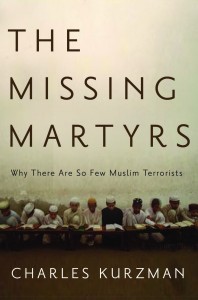
Charles Kurzman’s “The Missing Martyrs”

Marshal Zeringue

Charles Kurzman is a professor of sociology at the University of North Carolina at Chapel Hill. His books include Liberal Islam: A Sourcebook, Modernist Islam, 1840-1940: A Sourcebook, The Unthinkable Revolution in Iran, and Democracy Denied, 1905-1915: Intellectuals and the Fate of Democracy. He applied the “Page 99 Test” to his latest book, The Missing Martyrs: Why There Are So Few Muslim Terrorists, and reported the following:

Page 99 of The Missing Martyrs looks back at Islamic debates of one century ago, when constitutionalism and democracy first became mass movements in Muslim societies. In the Ottoman Empire, the sultan’s proclamation of the constitution in 1908, after a mutiny by pro-democratic officers, was greeted with huge celebrations. On Page 99, the governor of Jerusalem describes one such event: “The voices of joy in the city of Jerusalem, which has no equal in the world to the contrast of religions, sects, and races in it, were raised to the heavens in a thousand languages and styles. Speeches were given. Hands were shaken. Pleasant tunes were played. In short, the proper things were expressed for the honor of liberty.” But liberty had its opponents, too. Despots and authoritarian Islamic movements schemed to thwart democratization, and to undermine the new democracies before they grew too strong.

This debate continues today in Muslim societies. Pro-democracy movements remain hugely popular among Muslims, as we have seen this year in Tunisia, Egypt, and elsewhere. Yet this unmet demand for democracy faces resistance from despots and from authoritarian Islamic movements, Continue reading

Leave a comment

Filed under Al Qaeda, american imperialism, authoritarian regimes, cultural transmission, fundamentalism, historical interpretation, martyrdom, military strategy, suicide bombing, terrorism, truth as casualty of war, war crimes, world events & processes

Countering Terrorism for USA: ‘Kill Osama, Break Cycle of Regeneration’ says Bruce Hoffman in March 2011

Hoffman’s Interview in March 2011 with Nick Rugoff and Christopher Howell, posted in The Politic on 15 March 2011

There was a measure of prescience in the emphasis brought to this discussion by Bruce Hoffman, Director of the Center for Peace and Security Studies at Georgetown University, who has also been for many years  the Editor of the vibrant journal Studies in Conflict & Terrorism. More details re his credentials are inserted at the end of this post. Web Editor

NR: How do the recent Middle East uprisings affect al-Qaeda?

I think it’s too soon to tell. Al-Qaeda, like foreign ministries and state departments across the world, is still assessing and taking in what is happening in the Middle East and North Africa and trying to fashion a response to rapidly unfolding events. I don’t think they’ve quite divined what that response will be, but I don’t think we should assume that just because they have been silent and don’t seem to be taking an active part means that they’re neither following it nor seeking to identify opportunities to assert themselves.

CH: In your book you talk about the controversy and disagreement surrounding the definition of terrorism. Do you think we have come any closer to sufficiently defining terrorism?

I stand by the definition that I had in the revised 2006 edition of the book: “the deliberate creation and exploitation of fear through violence, or the threat of violence, in pursuit of political change.” But as far as the international community goes, I don’t think we’ve come any closer. Unfortunately, I actually think we’ve moved backwards. This may be one of the Continue reading

Leave a comment

Filed under Al Qaeda, historical interpretation, life stories, military strategy, suicide bombing, terrorism, world events & processes