
Author Archives: thuppahi

About thuppahi

Sri Lankan and Australian nationality; student of Sri Lankan society and politics; sociology of cricket;

Sarath Fonseka in filibustering mode

 Pic by Reuters

Dean Nelson, in Daily Telegraph, 9 July 2012, with different title: “I will lead an uprising, says General

Outlining his return to active politics after he was released from jail in May following pressure from the United States, Gen Fonseka sought to scotch speculation he had struck a deal with the government to keep a low political profile. Instead he launched a bitter attack on President Rajapaksa, whom he accused of persecuting his family and terrorising opponents, and pledged a new campaign to topple his government. “I’m definitely asking people to rise up,” and “overthrow the government by democratic methods,” he said. Continue reading
1 Comment

Filed under life stories, military strategy, politIcal discourse, power politics, prabhakaran, Rajapaksa regime, reconciliation, Sinhala-Tamil Relations, sri lankan society, truth as casualty of war, world affairs

A critical analysis of Sri Lanka’s political structure

Basil Fernando for The Asian Human Rights Commission in essay entitled Sri Lanka – Democratic Solutions, Undemocratic Structures, A Review On The Basis Of Principles Formulated By John Rawls, courtesy of Scoop Media, 10 July 2012

For many decades since 1978 there has been talk about many reforms. The basic justification for 17th Amendment to the Constitution was that it promised basic reforms with the view to enable working of the democratic process. There had also been suggestions for reforms to ensure the rights of minorities, particularly the Tamils. The 13th Amendment to the Constitution was an outcome of that debate. Then the latest is the recommendations of the commissions for the lessons learned (LLRC), which suggests several other reforms and this now has the backing of the resolution from the UN Human Rights Council. Continue reading

1 Comment

Filed under authoritarian regimes, democratic measures, politIcal discourse, power politics, power sharing, propaganda, Rajapaksa regime, Sinhala-Tamil Relations, sri lankan society, world events & processes

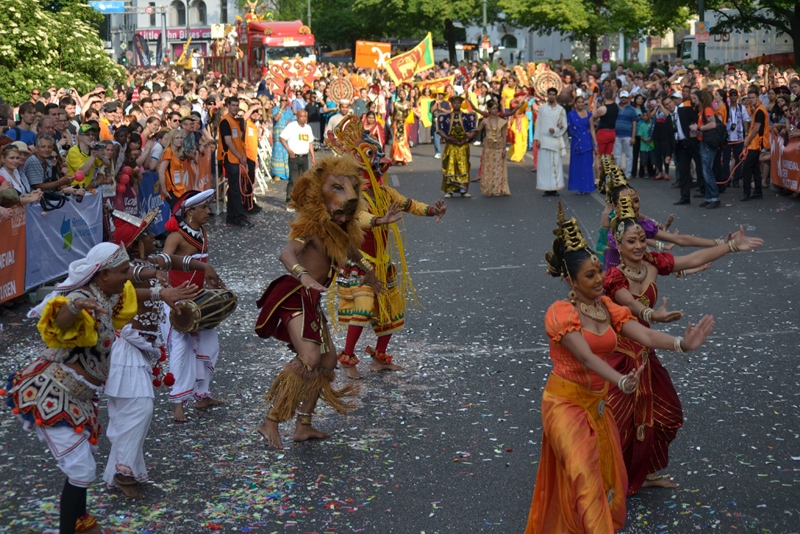
Sri Lanka bags top prize at Carnival of Cultures in Berlin

Press Release from the SL Embassy in Berlin

Sri Lanka won the first place for Ensemble out of more than 5000 dancers, drummers and musicians took part from more than 100 countries at the 17th Carnival of Cultures in Berlin on Sunday, 27th May 2012. Sri Lankan  pageants led by the renowned Channa Upuli Dance Group and members of the Sri Lankan community in Berlin representing ethnic Sinhala, Tamil and Muslim presented a colourful and impressive formation in the parade. This is the first time that Sri Lanka has participated at this event since 2007. Continue reading

Leave a comment

Filed under cultural transmission, sri lankan society, world affairs

Terrorist threat hangs over Olympic Games? Two news reports

I: “UK police arresting ‘marginal’ terror suspects to ‘clear decks’ ahead of Olympics” — ANI report

London, July 9 (ANI): British police is arresting ‘marginal’ terror suspects in a bid to ‘clear the decks’ ahead of the Olympics, the terrorism watchdog has said. According to The Telegraph, David Anderson, the independent reviewer of terror legislation, said the Games are a ‘major target’ for terrorists, and police is intervening in cases than they would normally do. Anderson said: “The Olympics are potentially a major target and you are seeing the police, perhaps in a marginal case what they might do is decide to intervene a little bit earlier.” Continue reading

Leave a comment

Filed under fundamentalism, life stories, terrorism, world events & processes

Collections of History: The Search for Old Photographs from British Ceylon, 1850-1915

Benita Stambler, The John and Mable Ringling Museum of Art, Sarasota, Florida, USA, benita.stambler@ringling.org

It began as just a typical research task, but has turned into a worldwide search for old photographs of Sri Lanka.  The John and Mable Ringling Museum of Art, where I work, has been promised a gift of more than 700 old photographs of Asia with virtually no documentation.  Almost half of these photos were taken in Ceylon in the late 19th century.  I’ve been trying to identify these 300+ photos by matching them to photos in collections around the world.  That search has turned into another project, for the American Institute for Sri Lankan Studies, to document collections of photographs of Ceylon taken between 1850 and 1915.  I have so far identified collections mostly in the U.S. and England (close to forty at the moment), and will be in Sri Lanka beginning August 27, 2012 for a few weeks to try to add to my list.  If you know of any collections of photographs, please let me know, at the e-mail address above.

2 Comments

Filed under cultural transmission, historical interpretation, life stories, sri lankan society

Uyangoda’s pessimistic review of the political situation in Lanka

Jayadeva Uyangoda, courtesy of the Colombo Telegraph where the ttile reads ” A Victor’s Peace

The total defeat of the LTTE has allowed the Sri Lankan government to ignore the political rights of the country’s ethnic minorities. Three years after the Sri Lankan government successfully concluded its military campaign against the secessionist insurgency led by the Liberation Tigers of Tamil Eelam (LTTE), the country has done little to address the root causes of the ethnic conflict. Continue reading

2 Comments

Filed under accountability, communal relations, ethnicity, historical interpretation, island economy, LTTE, politIcal discourse, power politics, power sharing, Rajapaksa regime, world affairs

The cut and thrust of political wrangling and some progress with the LLRC recommendations

Rajiva Wijesinha in talk at ICES, Colombo, 18 June 2012

One of the saddest aspects of the last three years has been the corrosive distrust between all political players. This is almost relentlessly exacerbated by several factors. The first, and perhaps the most worrying, is what I term a failure of rationalism, the practice of judging situations not in terms of evidence but rather through emotions. This contributes to a tendency to interpret ambiguities in line with fears rather than hopes. Continue reading

Leave a comment

Filed under democratic measures, politIcal discourse, power sharing, propaganda, Rajapaksa regime, reconciliation, rehabilitation, Sinhala-Tamil Relations, sri lankan society, Tamil civilians, truth as casualty of war, welfare & philanthophy, world events & processes

Jehan Perera reviews government policy in the north after a recce visit

Jehan Perera, mid-June 2012 in an essay thatappeared ins everal sites under the heading: “Dispelling perceptions of uncaring government in the North”

Those who travel from Colombo to the north, be they nationals of Sri Lanka or foreigners, are likely to be impressed by the developments that they see when they travel by road. The view on the A9 Highway, once called the Highway of Death due to the scores of lives lost in fighting to control it, is a constantly improving one. The journey now takes around ten hours, down considerably from what it used to be. The well-constructed roads make travel most comfortable and the main source of concern would be traffic police waiting in the shadows to catch speeding drivers. The roadside restaurants are numerous and more and more of them offer clean restrooms that were rare in the past. At journey’s end there are a range of hotels to choose from, some even equipped with swimming pools. These developments that are visible and earn the praise of nationals and foreigners alike are a result of the macro-economic policies of the government. Continue reading

Leave a comment

Filed under accountability, citizen journalism, communal relations, female empowerment, island economy, life stories, politIcal discourse, power sharing, Sinhala-Tamil Relations, sri lankan society

Is the Egyptian Spring Waning?

Courtesy of IRIN NEWS where a different title was deployed

Briefing: The Egyptian revolution undone?

Mohamad Morsi of the Muslim Brotherhood’s Freedom and Justice Party (FJP) has been declared the official winner of the first free Egyptian presidential elections. Cheers broke out both inside the briefing room and on Cairo’s Tahrir Square where protesters had been gathered since 22 June to protest what many had seen as a recent power grab by the ruling Supreme Council of the Armed Forces (SCAF)[ https://www.facebook.com/ElShaheeed ] Continue reading

Leave a comment

Filed under authoritarian regimes, fundamentalism, historical interpretation, politIcal discourse, power politics, religious nationalism, world events & processes

Extremist Tamil statements from Sampanthan and GTF raise concerns: a measured review by Laksiri

Laksiri Fernando, 15 June 2012, courtesy of the Sri Lanka Guardian, where it appeared under a different title

It is difficult to believe that President Rajapaksa or his advisors did not anticipate protests in London or possible cancellation of his address to the Commonwealth Economic Forum in connection with his participation in the Queen’s Diamond Jubilee celebrations. It was a repetition of what happened in December 2010 when he was supposed to address the Oxford Union Debating Society. The only difference was that the cancelation of his speech, of course under pressure, this time was decided by an inter-national organization, the Commonwealth Business Council, created by none other than the Commonwealth Heads of Government in 1997, unlike the first one being a mere university student organization, however prestigious that one might be. Continue reading

Leave a comment

Filed under accountability, authoritarian regimes, citizen journalism, democratic measures, historical interpretation, LTTE, politIcal discourse, power politics, power sharing, Rajapaksa regime, reconciliation, Sinhala-Tamil Relations, sri lankan society, Tamil migration, world events & processes