
Dr Tony Donaldson
Published in 1962, W. B. Makuloluwa’s Hela Gee Maga (The Way of Hela Music) is as defined by its omissions as by its contributions. Celebrated as a pioneering folk specialist, Makuloluwa argued that a truly national Sri Lankan musical tradition must be extracted exclusively from local folk music. In setting out to free Sri Lankan music from Indian classical hegemony, he built a new cage: one in which popular music—the very medium through which a democratic national sound was being forged—simply did not exist. Beneath the text’s anti-Hindustani intent lie the foundational flaws and ideological blind spots characteristic of mid-20th-century cultural nationalism. The book is not without merit. It is an in-depth study, much of it well-researched and valuable. But his ideological framework — biased in favour of folk music to the exclusion of all other categories — constitutes the book’s central weakness.


Hela Gee Maga (1962). Cover illustration: a thammattama drum and a hakgediya…. W. B. Makuloluwa
 The Santha Divergence
Makuloluwa and Sunil Santha shared a conviction: Hindustani music was not the mandatory template for a Sri Lankan national idiom. Makuloluwa respected raga as a sophisticated art form but opposed its use as a compositional model, dismissing the assumption that a Sri Lankan musical language required direct reference to India. Their alignment ended here. In practice, their approaches diverged.
Santha was explicit about what he was rejecting: the dominance of Hindustani raga as the template for Sri Lankan composition. “Bambawa[1] was the music that filled every nook and corner of our country at that time. That music, based on Hindustani raga and tala, was limited only to a certain section of the country. It was not in a state that educated people could listen to; instead, it was associated with liquor, ganja, and vice. My objective was to eliminate that stench and establish an indigenous musical tradition from humble huts to grand palaces—one that could be listened to by everyone: young, old, wise, and uneducated alike, and even by a virtuous Buddhist monk, without any shame or discomfort.” — Sunil Santha, Indigenous Music, unpublished note, 1975 (found among his papers after his death).

 Because Makuloluwa recognised only classical raga and folk music as valid categories, any new national music must, in his framework, be built from local folk traditions alone. The consequence was the erasure of the very figures who had already defined that sound. By 1962, Samarakoon’s Geetha Sahitya and Santha’s innovative Hela melodies had already defined the sound of independent Sri Lanka. In rendering popular music invisible, Makuloluwa ignored the music that citizens were actually choosing to live by. Sunil Santha was planting banana trees in the garden.
The Sarachchandra Contradiction
The only contemporary figure Makuloluwa references in the text is Ediriweera Sarachchandra, whom he praises unreservedly. The choice is revealing: Sarachchandra was steeped in the Shantiniketan tradition and classical Indian dramaturgy, viewing local forms through an Indian classical lens in which raga-based composition was integral to dramatic performance. For Makuloluwa to reject raga music as a basis for national identity while unconditionally endorsing the very intellectual who institutionalised those same Indian aesthetic models in Sri Lanka exposes a curious lack of self-awareness.
The Ratanjankar Revision
 Makuloluwa cites S. N. Ratanjankar to lend his folk-music thesis the authority of an Indian musicologist who endorsed Sri Lankan folk traditions as the foundation for a national style. He recounts the 1952 visit in glowing terms: Ratanjankar, the Principal of the Bhatkhande College of Hindustani Music, was invited by the government to grade Radio Ceylon artists, and during his stay he observed the country’s “diverse regional folk styles, traditional chants, and local vocalizations,” delivering a lecture at the Royal Asiatic Society that praised the “ancient values embedded within our native folk singing styles.” What Makuloluwa omits is that the grading was applied to all Radio Ceylon recording artists—not only folk singers from the provinces—and that it operated on Hindustani parameters. The consequence was concrete: artists who did not conform to those parameters, most notably Sunil Santha, were downgraded or struck from the register. To invoke Ratanjankar’s words for nationalist legitimacy while omitting the damage his classification regime inflicted on the local music scene is an act of historical revision.
 N. Ratanjankar.

The Matra Question
Makuloluwa’s theory is so rigid that he privileges the matra count of each verse line over the laghu-guru pattern of syllable weights as the defining marker of Sinhala identity—a system he dismisses as an Indian imposition. In classical Sanskrit and Hindustani prosody, a meter is defined precisely by that sequence—which syllables are long, which are short, and in what order. Makuloluwa rejects this on page 3, arguing that forcing a spoken language like Sinhala to conform to fixed syllable-weight patterns is unnatural and un-Sinhala. His claim that the moraic system is “the only system truly native and organic to Sri Lanka” rests on a false exclusive: syllable weight is a universal feature of human phonology, built into the spoken cadence, vowel lengths, and consonant clusters of Sinhala itself. The Dalada Kavi tradition, which predates any contact with Indian classical prosody, employs laghu-guru patterns, and Sunil Santha’s compositions—where laghu-guru patterning and matra count worked together to shape each line—were universally received as authentically Hela.
Ranade’s Framework
Makuloluwa lacked the theoretical insight of the Indian musicologist Ashok Ranade. Based in Mumbai, Ranade built a taxonomy that placed folk, popular, and tribal music on equal footing with classical (art) music, refusing the reductive binary that treated classical traditions as inherently superior. His model rests on a fundamental principle: popular music operates on its own logic of mass appeal and emotional directness. Had Makuloluwa encountered this framework, Sunil Santha’s quest for an indigenous popular music would have been validated rather than rendered invisible. The classical/folk binary that both Sarachchandra and Makuloluwa accepted—Sarachchandra building from the classical side, Makuloluwa from the folk side—would have been recognised as one hierarchy among many, not the only one.
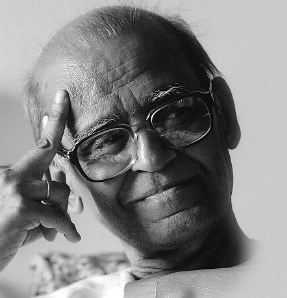 Ashoke Ranade
Ranade’s six-category taxonomy—tribal, folk, classical (art), devotional, popular, and confluence—granted each system equal aesthetic standing, a principle that extends across South Asia, including Sri Lanka. This taxonomy reveals the structure of Makuloluwa’s framework as an early post-independence project that sought to break free from one hegemony (North Indian classical) while trapping itself in another (the rigid classical/folk binary). The scholar who gave popular music that standing was Indian. The gatekeepers were Sri Lankan nationalists who had adopted the Indian hierarchy as their own.
I met Ranade in Mumbai in 1997, and we discussed at length the categorical framework he had developed for South Asian musical practice. I came to his work through that conversation, particularly his writings on the decolonisation of Indian music, in which the taxonomy is fully articulated. Those writings matter for both India and Sri Lanka: they dismantle the ideological constraints that shaped mid-20th-century nationalist thought.
The extensive historical coverage and acclaim Hela Gee Maga received are perhaps less surprising than they first appear. Its success maps directly onto the anxieties of the 1950s to 1970s and the assumptions of the cultural elite. Makuloluwa’s unexamined belief that a modern national musical tradition could be extracted exclusively from rural folk sources aligned with a post-independence bureaucracy desperate for a pristine, uncomplicated heritage. The result was a recurring structural pattern in Sri Lankan history: the systematic erasure of pivotal popular figures such as Sunil Santha and Ananda Samarakoon. Within the book, they simply do not matter, because they did not fit a curated narrative.
Makuloluwa’s historical prominence stems largely from the state apparatus itself. As Director of Aesthetic Education, his purist, folk-based theories became institutionalised in school curricula, shaping how generations of Sri Lankans understood their musical heritage. It was far easier for a post-independence bureaucracy to endorse a curated folk heritage than to grapple with the commercial, cross-cultural, and politically charged nature of popular music.
Hela Gee Maga was published in 1962, the year of Ananda Samarakoon’s death. Makuloluwa omits both Samarakoon and Sunil Santha. Within his theoretical framework, these foundational figures simply do not exist—and do not matter. This omission is the central weakness of the book, rendering his thesis on Sri Lankan national music lopsided.
Bibliography
Abeysekara, Tissa. 2007. Roots, Reflections and Reminiscences. Nugegoda: Sarasavi Publishers.
Donaldson, Tony. 2001. The Kavikāra Maduva: Ritual Singers in the Daladā Māligāva (Temple of the Tooth), Kandy. PhD thesis, Monash University.
——— 2015. ‘There will never be another “Olu Pipila.”‘ The Sunday Times, 12 April. Republished under the title ‘Sunil Santha: too brilliant for his times’ in the first birth centenary concert booklet, Bandaranaike Memorial International Conference Hall, 18 April.
——— 2016. Sunil Santha: The man who invented Sinhala music for a modern age. Sunil Santha Samajaya.
——— 2019. ‘Sunil Santha – Composer and Photographer.’ Lecture for the National Trust, Colombo, 28 February.
Ekanayaka, Ruwan. 2017. සුනිල් සාන්ත සංගීතයේ සිංහලත්වයට පාදක වූ මාත්රා වින්යාසය හා තාන ව්යුහය පිළිබඳ මූලික විමර්ශනයක් [A preliminary investigation into the rhythmic configuration (Matra Vinyasaya) and tonal structure (Thana Vyuhaya) that formed the basis of ‘Sinhala-ness’ in Sunil Santha’s music]. Sunil Santha Samajaya.
Makuloluwa, W. B. 1962. Hela Gee Maga. Maharagama: Saman Publishers.
Ranade, Ashok. 1985. ‘Categories of Music.’ Published in the NCPA (National Centre for the Performing Arts, Mumbai) journal, Volume 14, Issue 4, 1 January 1985.
——— 1992. Indology and Ethnomusicology: Contours of Early Indo-British Relationship. New Delhi: Promilla & Co.
Ratanjankar, S. N. 1944. Letter certifying Sunil Santha’s qualifications in vocal and instrumental music, Marris College of Music, Lucknow, 7 December.
——— 1952. ‘Folk Songs and Music.’ Journal of the Royal Asiatic Society (Ceylon) 2 (New Series), 103–122.
Santha, Sunil. 1950. Songs of Lanka. Jaela.
——— 1975. Desheeya Sangetta [Indigenous Music]. Unpublished manuscript.
Senaratne, Vijith Kumar. 2009. Sunil Santha: Hela Giye Mudun Mul Sara [Sunil Santha: The keynote of Hela music]. Surasa.
——— 2013. Sada Midule Ran Meewitha [The golden mead in the moonlit courtyard]. Agahas Prakashana.
*****************
[1] “Bambawa” is a derogatory term for the degraded street-level adoption of Hindustani raga music in Sri Lanka. It was the sound Sunil Santha set out to replace.

