
Michael Roberts
Over the centuries powerful european nations reached out and established colonial empires all over the world …at considerable cost to the peoples conquered. Nationalist movements in recent centruies succeded in evicting/displacing foreign rule. A few colonial outposts still remain. One spot is the enclave in Morocco’s north western coastal belt known as CEUTA. During the past few days SPAIN had to cope with thousands of Moroccan personnel (all males it sems0 streaming into Ceuta. CHEERS !
Chad de Guzman, Tiago Ventura and Olivia-Anne Cleary
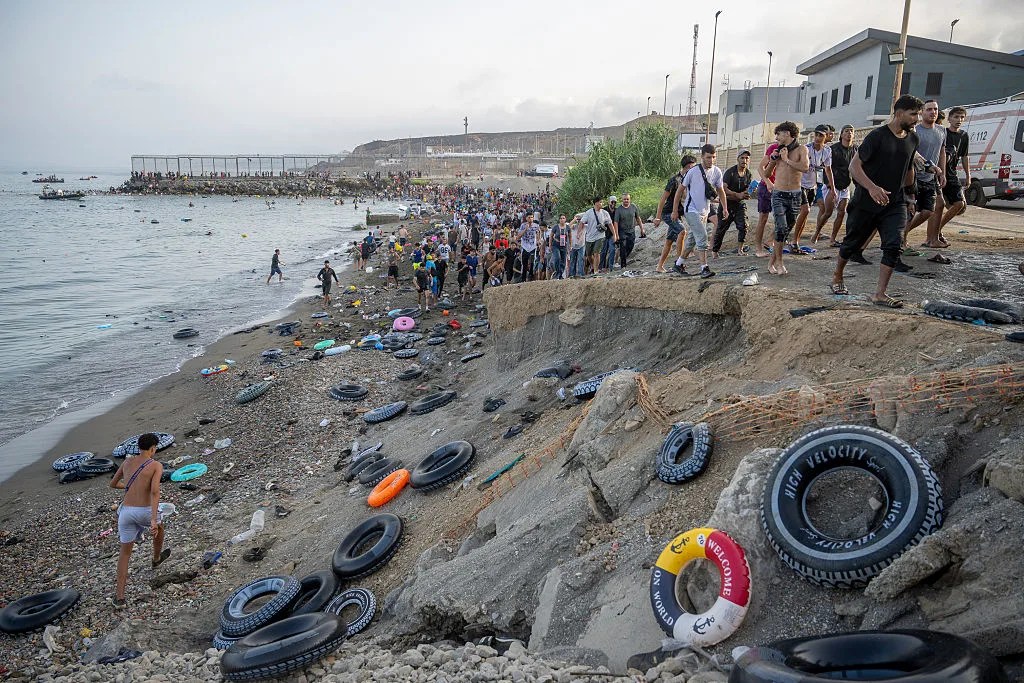
A Spanish territory in northern Africa was left experiencing a humanitarian crisis on Friday after thousands of migrants swam across the border from Morocco, with at least 57 dying in the chaos. Ceuta has long been considered a gateway for migrants seeking better lives in Europe, and the city has progressively fortified its border in response to perennial illegal border crossings.
Ceuta migrant crisis sparks strong reactions from all over Europe – Yahoo News Australia
Yet Spain’s Interior Ministry on Friday said close to 50,000 migrants had rushed into Ceuta since Thursday morning. In an update shared later in the day, the ministry said more than 48,300 migrants had already returned to Morocco.
Centers that receive migrants had been overwhelmed after the surge, while parks and streets were crowded with people from across the border. Footage and images showed scores of people, many of whom appeared to be young men, bypassing the Tarajal border fence between Morocco and the Spanish exclave of Ceuta.
Juan Jesús Vivas, Ceuta’s President, called the crisis “a situation of absolute humanitarian and social emergency.” Spain called in its military to assist law enforcement in Ceuta, Agencia EFE reported.
Prime Minister Pedro Sánchez, in a social media post, vowed his government is working with Moroccan and international authorities “to restore normalcy as soon as possible.”

What is Ceuta?
The city of Ceuta, a peninsular region covering 19.9 sq. km (7.7 sq. mi) on Africa’s northern coast, is one of two Spanish exclaves on the continent, along with Melilla, which is about 220 km (140 mi) southeast. The two Spanish autonomous cities represent the European Union’s only land borders with Africa. Spain has possessed Ceuta, which is separated from mainland Spain by the Strait of Gibraltar, since 1580.
But Morocco, which largely surrounds the two exclaves, still treats them as occupied lands and challenges Spain’s sovereignty, citing history dating back to the Islamic conquests during the 8th century.
Over the years, Rabat, the political seat of the African nation, has triggered diplomatic incidents as part of the dispute. In 2002, Morocco and Spain had a standoff after both sent forces to a small uninhabited island off Ceuta. And in May 2021, amid a deepening diplomatic spat over the disputed Western Sahara region, the Moroccan government loosened its border controls, resulting in nearly 8,000 people from Morocco and sub-Saharan countries pouring into Ceuta in just two days. Some of the migrants eventually returned, but the diplomatic rupture was only repaired when Spain backed Morocco’s autonomy plan for Western Sahara in 2022.
What are authorities saying about the spike in migrant crossings?
Thursday’s events did not begin without warning. Vivas, speaking to Cadena SER, said arrivals from across Morocco have overwhelmed the city’s social services and security apparatuses over the past few days, with more than 300 people per day.
“To give you an idea of the scale, for the rest of Spain, this is equivalent to 2% of Ceuta’s entire population. It’s like a million people entering Spain irregularly,” Vivas told the broadcaster.
The crisis in Ceuta bucks the trend for the rest of Spain, where irregular arrivals fell from 17,990 in the first six months of 2025 to 12,138 in the same period in 2026, according to Interior Ministry statistics. For Ceuta, there were 2,582 land arrivals, compared with 978 during the same period of 2025—an increase of 164%.
Spain’s Interior Ministry argued an earlier court ruling is behind the latest influx, stating it “believes that human trafficking networks are exploiting a court ruling to encourage the flow of undocumented migrants, mostly young people.”
A June 29 ruling by the Spanish Supreme Court stopped authorities from summarily returning migrants who arrive in Ceuta and Melilla by sea, at least not without due process. While it did not legalize irregular entry or guarantee that those swimmers could remain in Spain, Spanish broadcaster RTVE reported on Thursday that the ruling spread on Moroccan social media, reportedly prompting people to try to enter Spain by swimming to Ceuta.
What has the response been?
The crisis in Ceuta has garnered worldwide attention, with U.S. President Donald Trump saying the incident looks like an “invasion.” “I saw Spain yesterday, and I watched the catastrophe that took place. It looks like an invasion of a country… that same thing is going to happen to us if the Republicans don’t get elected [again], except worse,” he claimed during a Cabinet meeting at Camp David on Friday.
Closer to home, Spain’s right wing figures targeted Sánchez’s leftist, pro-migrant government when discussing the matter. Sánchez has planned to give 500,000 undocumented migrants in Spain a path to legal status. More than a million have applied to that program.
“Pedro Sánchez, with his mass regularization, has provoked an invasion of our border, which is being experienced first and foremost by the Spaniards of Ceuta,” said Santiago Abascal, who leads the far-right party Vox. Alberto Núñez Feijóo, the leader of the conservative Popular Party, said in a video on X that Sánchez’s government “refuses to acknowledge that we are facing a serious national security problem.”
The Schengen Area allows passport-free travel across 29 European countries, but member states can temporarily reintroduce border controls for security or public-order purposes.
French Minister of the Interior Laurent Nuñez gave instructions “to immediately strengthen the controls at the Spanish border” upon learning of the sudden influx of people. European Commission president Ursula von der Leyen insisted the “images coming from Ceuta are unacceptable.”
“We cannot allow anyone to come to our Union without abiding by our rules,” she said. “Dangerous crossings must stop immediately. Smuggling networks must be dismantled. And returns must be swift, as our rules allow.”

