

EXTRACTS From The DIARIES Of DONALD FRIEND, Volume 3** …. The Ceylon Diaries cover the period 25th January 1957 to 22nd July 1962 and run into 180 pages in small print. During this period Donald Friend, the gifted Australian artist, based himself at Bevis Bawa’s ‘Brief’, Bentota.
“His diary entries are pithy, sarcastic, self-critical and wonderfully observant of people, places and events. I dare say he was a better writer than a painter. One can only look on aghast at how little things have changed in Sri Lanka in nearly 50 years of turmoil. ….” .… (the author of this ASSESSMENT remains unclear; while the highlights are interventions on my part: Michael Roberts).
26th January 1957: Time drifts through all this…. carrying on his back, like a turtle, a weight of the idiotic likes and dislikes….
4th February: Who like Bevis, is a hypochondriac. They both make a fascinating hobby of pills and injections …
19th March: The horrid old guide jibbered on endlessly, telling whopping lies.
24th March: Ratnapura Resthouse – nauseatingly loud Americans and a rabble of Ceylon drunks.
11th April: Orientals fortunately regard madness as something allied to holiness.
18th April: They were all like a disturbed ants’ nest, buzzing with excitement and numerous contradictory stories.
i11July: Passports and permits and filling of documents and health certificates and all that paper nightmare that flurries on the frontiers of the world.
One can only look on aghast at how little things have changed in Sri Lanka in nearly 50 years of turmoil. Bold highlighting of DF’s phrases have been done by me.
Here then is Donald Friend the astute and prophetic Political Observer.
 15 March 1957:
Colombo: The town was full of strikers who threaded the streets in long processions, carrying banners and shouting slogans……. everyone is alarmed that the whole country under the present very mixed bag of a government is going rapidly communist.
30th May 1957:
The political situation here is becoming dangerous. The principal immediate trouble is over the government’s language policy- Sinhalese Only, which they are trying to impose hastily and in such a way as to victimise the Tamils, who, a racial minority, are concentrated around Jaffna, and are preparing a big campaign of Civil Disobedience to protest against this policy.
29th June 1957:
This nation’s politics are getting madder and more exciting every day- the outbreaks of Nationalism that are like the pimples of political adolescence: every day brings a variety of political
scandals,……………and of course the language business and the thunders of civil war…… They must compromise.
11th October 1957:
The political situation out here has been steadily worsening…. after the events of last week when Philip Gunawardena had truckloads of hired thugs to throw grenades, bottles and stones at a procession of UNP supporters; … the time seems just about right for political assassinations to start.
The government by threatening to nationalise the press has effectively muzzled the newspapers.·.. The events of the march were shockingly played down and misrepresented; the police were instructed not to protect the marchers..…Philip Gunawardene’s thugs were gathered in ambushes all along the road. Several days later – on the 8th – Buddhist priests addressed a huge meeting at Kandy to protest against the Language Pact with the Tamils and there was more rioting.
5th December 1957: Colombo was particularly hellish, with strikes, soldiers and armed police all over the place. While I was shopping in the Fort, bombs were thrown and people killed, and the town full of rumours and sabotage plots stank like a cesspool with great piles of rotting garbage and rubbish cluttering up the gutters.
26th December 1957: .. .I heard in Colombo, ran a theme of national disaster – of appalling floods inundating the country,….of the imminence of communists coming into power, of bankruptcy of the government, expectations of inflation.
29th December 1957: I have never seen anything so inert and flabby as the Ceylon bourgeoisie…… If they’d fight and show some guts I’d admire them still. But they won’t. They know, they see their present position, and are content to fade away in an excess of flabbiness.
The immolation- class suicide- which sheep-like they are preparing to undergo, with no more protest than a bleat …
13th April 1958: Although there is nothing about it in the newspapers, the trouble… has broken out again, brought on by stupid weakness of the Prime Minister – there have been killings and violence of various sorts. All along the road driving here today we saw huge scrawled signs in Sinhalese ‘Kill the Tamils; – and road signs defaced.
27th May 1958: … Bevis came back….. along roads where Tamil shops, a temple were ablaze, and gathering mobs were stopping cars and beating up the passengers. Yesterday he saw in Colombo the mob go mad, kill a man. Shops in the Pettah were set afire, and there were terrible scenes of mob rule. The a1my and navy have been called out. The radio gives none of this news, but a watery speech to the nation by the Prime Minister referring to ‘certain acts of violence’ and a warning against believing rumours …. ……………… the mob, intent at first on burning and looting Tamil shops, have since turned their attention to wrecking and robbing anybody and anything…
Later ……I drove down to Alutgama……. the streets had an odd empty look. I learned at the Police Station that things in Colombo are getting worse. And indeed as we came to the town we came suddenly on a mob of several hundred gathered in the main street, smashing open a Tamil shop – evidently the truckloads of professional thugs and agitators who the people had been awaiting, had arrived, and now all joined in.
28 May 1958: At 7.30 I waited for the radio to give the BBC news, but when the time came the announcer simply said ‘We must apologise …..we are not able to give you a relay of the BBC news’. Just that ……………………………….. The only news one can rely on is completely censored. When I went to Alutgama I found the same applied to the newspapers…..everywhere the smell of fear, greed, expectancy and more violence ……………………. Everyone talks of ‘They’. ‘They’ are going to murder such and such a man.
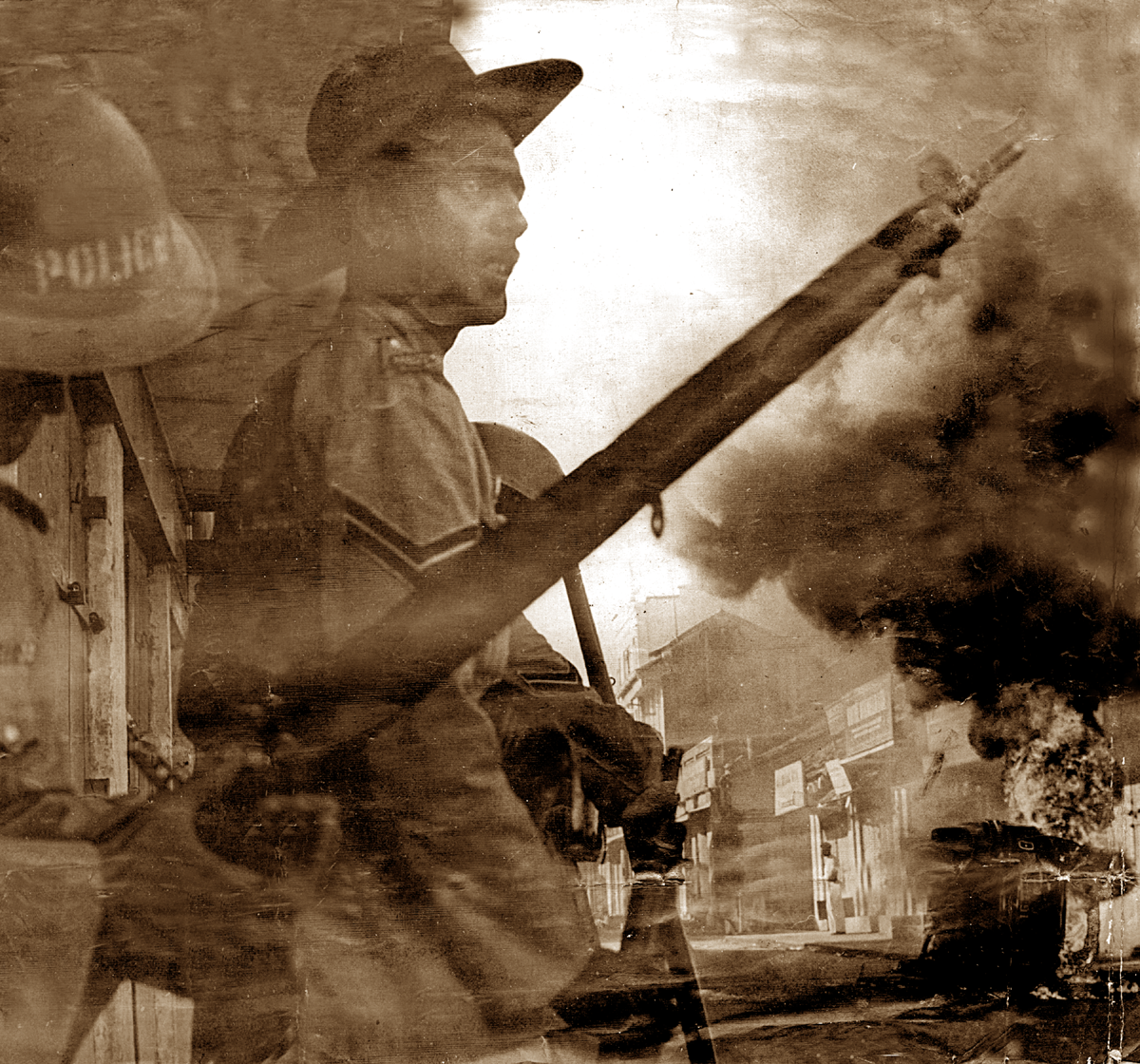
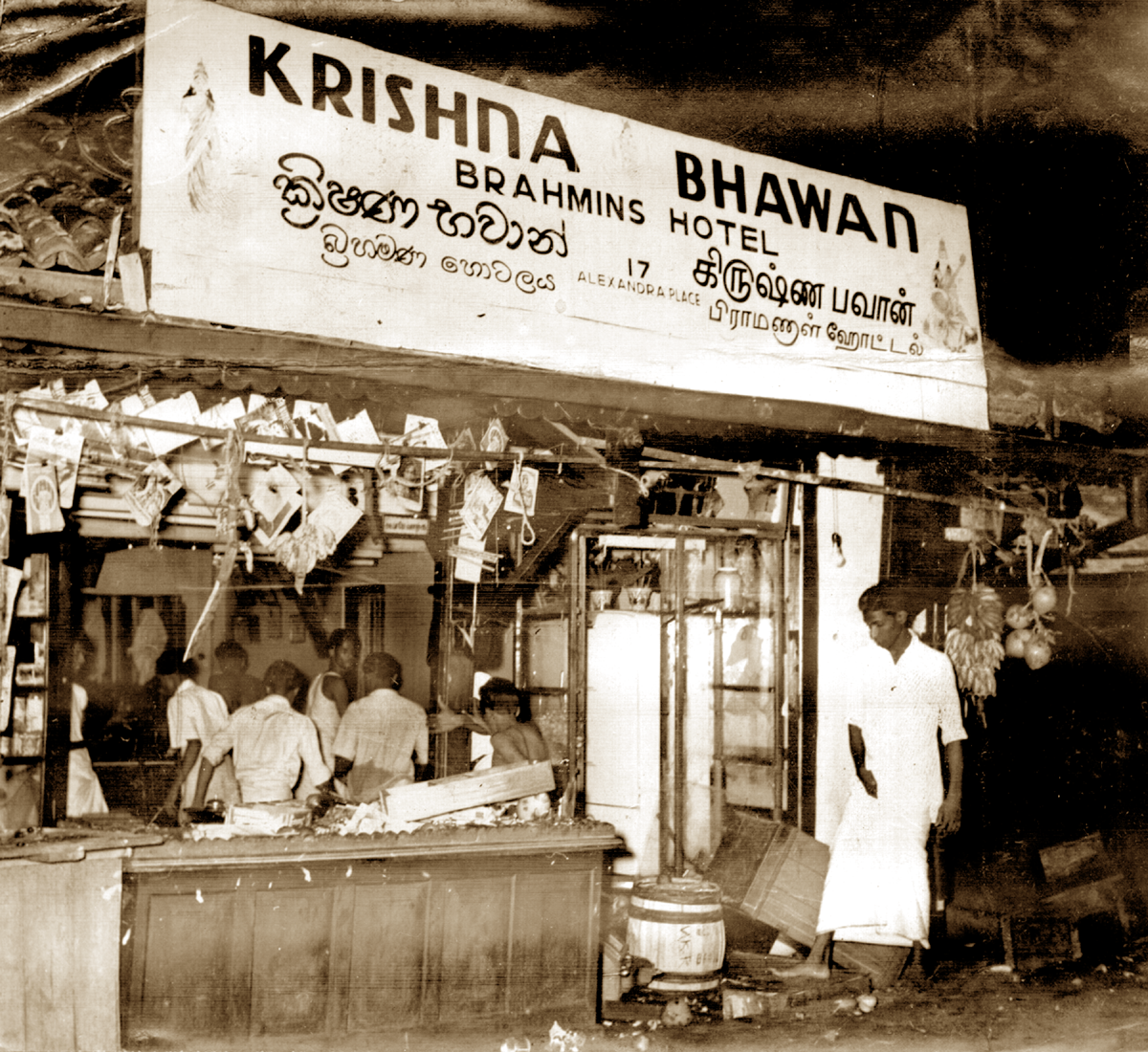

1st June 1958: I wish Christine would have enough sense to go home – what can keep a sightseer immobilised in a land where the people are all massacres massacres or spectators?
7th June 1958: … a dozen or so Tamil MPs who belonged to the prohibited Federalist Party, have been arrested. By which one must suppose the Tamils are stubbornly resisting the government and are now determined on setting up a separate state.
12th June 1958:
Every day the news broadcast says, ‘No incident occurred today in any part of the island’….. But all is not well. They are recruiting more soldiers. And the trouble seethes and bubbles. Illegally printed leaflets are distributed, warning all Tamils to leave this area by the 28th, or they well be murdered.
And so on, then….. 29th December 1958:
No petrol to be had and we got kerosene for the lamps only with great difficulty. The banks, stores and oil companies are all on strike. There is expectation of a general strike. N.M. Perera is rumoured to be planning it, starting with the Bus Transport, to bring the government down; Bandaranaike is dithering and saying it will all tum out for the best. The army is standing by, and Colombo packed with troops .….the Buddhist priest are growing very insistent that the government hand over to them all assisted schools – which are Catholic for the most part, and there is general agitation ofreligious intolerance. Ceylon look lovely, idle, useless and silly – intellectually a rotten stagnant pool, politically a cauldron of boiling poison.
2nd January 1959: The front page of today’s newspaper was largely filled with the news that the first line of the National Anthem is ungrammatical, and has been changed. The repeated singing of the ill constructed phrase, it is believed, has contributed largely to the chaotic condition of the country by setting up malignant magical vibrations.
8th January 1959: Today is the day of the one day Token General Strike, the brainchild of N.M. Perera… the aim of the strike is to protest against a new Public Security Bill to give the government additional powers to deal with strikes.
1ih April 1959: At last there are signs of reaction in Ceylon to the anti-communist rebellion in Tibet, that caused the Dalai Lama to escape to India, where Nehru, showing his usual extraordinary political wisdom, offered him the hospitality due to an honoured guest. Up until today the Ceylon Government has exhibited great cowardliness in keeping entirely silent- a Buddhist nation that will see the head of another Buddhist church and the whole religion of the country subject to arms, when even honourable words would do.
11th May 1959: It is some time since I have taken notice of the political fantasies of this island: at this moment (as at every moment of the year), there is a Political Crisis – but this one is more serious and absurd than most – A Cabinet Ministers strike.
25th September 1959: A man dressed as a Buddhist monk entered the Prime Minster’s residence this morning, pulled out a pistol, and shot four bullets into Mr. Bandaranaike’s stomach. He has been operated on and is still alive. The Governor General has declared a State of Emergency and called up the Anny Reserves. The surprising thing is that it has not happened long before in a country where murder is so common and many politicians and businessmen keep bands of thugs.
26th September 1959: So when this morning…. the radio suddenly left of its customary brassy rock n’roll inanities and suddenly switched to Chopin, I knew immediately without the announcer telling me that poor old Bandaranaike was dead.
27th September 1959: The new Prime Minister Mr. Dahanayake … did not intend to risk an election;
5th October 1959: There was an interview in today’s newspaper with the Public Executioner “Restoring capital punishment is the most sensible thing the government has done” he said.
9th October 1959: God knows what is really happening in the country. One almost suspects a coup of some sort. This morning instead of the BBC news the radio announced a ‘Political Notebook’, which is a dull but perfidious lecture in so schoolmasterly a style I suppose Dahanayake himself must have written it.
Since this censorship has been imposed, newspapers have all retaliated in a way to fill the politicians with rage and despair – they make no mention at all of affairs in Ceylon. The editorials are left blank except for the words ‘No Comment’ – whilst Collette, the political cartoonist………………………………………………………………………………………………………………. now simply signs an empty space.
Meanwhile, rumours multiply about the assassination. I stick industriously to my painting.
26th October: The Censorship continues, and the newspapers continue to ignore the government.
28th October: Mr. Bandaranaike… this man whose weakness and political folly led so logically to all the curious circumstances of his own murder
19th November: As for politics, Ceylon grows madder every day……. even expected that the new PM Dahanayake, would be arrested as participants in the plot to murder Bandaranaike.
23rd July 1960: Well, the elections are over. The campaign that led up to them was an epic of shit-slinging on both sides, accusations, righteous denials,; some methods decidedly picturesque – for instance, a great front page newspaper item, ‘Astrologer Predicts UNP Victor’ a detailed analysis of Senanayake’s lagna
….. The newspapers overplayed… The widow Bandaranaike is to be PM. It seems very peculiar.. she did not stand for Parliament and so is not even an MP but they’ve found some way ofjuggling the Constitution to fix it.
23rd December: Serious trouble has been brewing for quite a while and now at last is waking up to something very nasty. The cause is Mrs Bandaranaike’s government’s policies – the new ...heavy taxes …………………………………… ….. the old Tamil question, the National Language (Sinhalese), the just completed takeover of schools …. serious injustices that the Catholics are determined to resist.
Last night I went to Alutgama….. my old driver came up and told me there had been very bad trouble at Paiyagala, a Catholic centre about 10 miles away… in the streets there were little knots of people bubbling and spreading the news. . ..We drove to Beruwela (towards Paiyagala…. then ‘Listen – the church bells – and sure enough a tocsin of belles was ringing from several nearby churches.
People descending from buses excitedly distributed the news….. there had been a church meeting at which loudspeakers were used (against a new law) – police and army had tried to dismantle them. They were resisted and resorted to tear gas. The people replied with stones and hand bombs. The police fired on the crowd killing two…. the railway had been blown up.
.. ..Grenier… went to his house… he had a Christmas tree…. and the gramophone played carois and Christmas songs, whilst in the distance, in the night the church bells jangled out their alarm.
3rd January 1961: The Roman Catholic schools…..have resisted the government takeover…. were granted an order by the Chief Magistrate yesterday to deny entrance to all and sundry…. today the order was declared not binding and the government has been summoned to pass legislation to take over the schools. Now the fat is really in the fire. Sinhalese…. is now the official language.
18th April 1961: The Tamils have sustained their Satyagraha campaign with such success that the government has just now proclaimed a State of Emergency to try and enforce its policies
9th August 1961: The government has got madder and madder as they’ve been faced with rising cost of living, and unofficial inflation, and failure of expensive schemes, so new taxes have been devised…. ……………………. and now the lower-middle class has been taxed as well.
5th September 1961: So far, no assassinations – in fact the general uneasiness of all classes is about money, or lack of it. Business concerns, big and small, are collapsing for !ack of trade.
Mrs. Bandaranaike at Belgrade simply repeated with slight variations her incredible election-speech gimmick – ‘ Gentlemen. I am a widow. A widow and a mother. And I am sure that all over the world, mothers and widows will join me in deploring the crisis in Berlin. We widows must ensure the banning of the atom bomb.
That very day Russia let off a bomb and announced her intention of resuming atomic test.
12th December 1961: As we arrived, cars were queuing up for petrol at the bowsers, so we did too, and learning a petrol strike had already started, that the port was to strike this evening, and railways tomorrow ….
8th July 1962: Somarama, the monk who shot Bandaranaike was hanged yesterday. The goal was surrounded by police and troops.
11th July 1962: Fort…. in a state of the most utter chaos, with police lining the streets and causing tremendous traffic jams, because of the opening of Parliament. Outside the House of Representatives soldiers and sailors drawn up, and even artillery (God knows what the big obsolete guns are for) and crowds of sightseers.
&&&&&&&&&&&&
A STRAY NOTE from an UNKNOWN HAND, n. d.
Entertaining as they are to read, his diary entries are a fascinating Time Machine into Sri Lanka’s turbulent years when the rot really began to set in, less than ten years after ‘Independence’. Horrifyingly for the country, nearly 50 years after Donald Friend made these observations, politicians of a new generation, wearing the same colour of shirt, are firing up the rabble in an identical manner, as if the politicians and the people have learnt nothing from history and nothing from two decades of war. Those who do not learn from history are condemned ….
** NOTES by Michael Roberts, 25 March 2024
I cannot recall how this document came into my historical collection.
ABOUT DONALD FRIEND
For the benefit of readers who have no background information let me indicate that Donald Friend was a highly talented Australian artist who forged a tempestuous path across several continents: from Nigeria to Ceylon, Bali and Australia. He was also a pederast and this side of his character has since impacted on the reservations attached to the displays of his artistic products.
He was evidently a rambanctious and outspoken person.This liveliness and caustic wit comes through in the diary writing — and is quite marked in the set of comments on Sri Lankan politics in the period 1957 to 1962. For those unfamiliar with Sri Lankan history let me note that
A: the period from 1956 onwards was marked by the heightened political rivalry associated with the “Sinhala Only” programmes that brought the MEP to power under the leadership of SWRD Bandaranaike … a major transformation that brought SL Tamils into conflict with the Sinhala populists and involved major riots in May-June 1958 — in fact, a pogrom of sorts …. directed at Tamils residing in the southern arena of the island.
B: Donald Friend was residing at the villa “Brief” belonging to Bewis Bawa, brother of the famous architect Geoffrey Bawa. The Bawa brothers belonged to Sri Lanka’s highest echelons of society and it is possible that Bewis Bawa had the same homosexual leanings as Donald Friend. But what is of greater relevance to the readings here is the political stance expressed so acidly and sharply by Donald Friend…… Addendum: Rajiva Wijesinha in Sri Lanka responded to my specific query on this point with this NOTE: “”Yes, the pictures and statuary at Brief are even more explicit than at Lunuganga, Rajiva” … “Lunuganga” was/is the country mansion owned and sustained by Bewis Bawa.
C: Having experienced some aspects of the 1958 anti-Tamil riots in Galle and heard numerous tales on the topic thereafter, I can empathise with Friend’s political readings …. up to a point. However, one has also to place the events in their context and pursue a careful temporal accounting of the 1958 pogrom (a concept that I consider more appropriate than the term “riots”).
D: What comes through from Donald Friend’s Notes are (D1) the highly splintered political scenario with a coalition of parties in the government, Left-wing opposing parties, the Sri Lankan Tamils of the Federal Party and Catholic activists resisting the ruling government’s programme directed against the Catholci-run schools and labour unions confronting the government at certain points of time.
Indeed, one cannot use his commentary without careful placement of each comment in its chronological moment.
SOME RELEVANT BACKGROUND TEXTS
https://en.wikipedia.org/wiki/Donald_Friend
The Donald Friend Diaries, Ed. Ian Britain, 2010, ISBN 978-1-921656-70-5
Ian Britain (2023). The Making of Donald Friend: Life & Art. Yarra & Hunter Arts Press. ISBN 9780646877990.
https://adb.anu.edu.au/biography/friend-donald-stuart-leslie-12516
https://www.abc.net.au/news/2016-11-28/donald-friend-our-favourite-paedophile/8053222
https://en.wikipedia.org/wiki/1958_anti-Tamil_pogrom
DONALD in THUPPAHI
https://thuppahis.com/2010/10/20/donald-friend’s-imagining-of-galle-fort-and-port-during-the-1890s/
https://thuppahis.com/2010/10/20/cultural-exploration-publishing-the-donald-friend/
Donald Friend assessed by Venerable Bhikkhu Dhammika in 2003


We all deplore the violence inflicted on the Tamils in the south of Sri Lanka, and the Sinhalese who were ‘ ethnically cleansed’ from the north of the country. That whole saga was a tragic episode in the country’s history, and should be viewed from a historical perspective, rather than a piecemeal examination of incidents, as the latter would not place events in a proper perspective for analysis. I believe Friend’s comments suffer from such inadequacies and cannot be considered as a serious political analysis.