Yearly Archives: 2012

Walking the talk on Galle Fort with Channa Daswatte

Namali Premawardhana, in the Sunday Times 12 February 2012

TThose who’ve been attending the festival over a number of years, GLF is about discovery– discovery not only of new authors and new books and new things about old authors and old books, but also ideas, people, perspectives. What GLF does is create the kind of atmosphere conducive to discussion, and if you’ve ever been to GLF you will know that Galle Fort has a huge role to play in that. You will know it best, if you’ve been on an ‘excursion’ through the quaint old place with Channa Daswatte. “I think it was simply because [this] is such a beautiful place,” Channa says of the thinking behind the first GLF excursion. This full-day outing which was part of the GLF schedule took participants all the way from Galle to Tangalle bay beach over nine hours, and thus seemed “untenable” a second time around. Continue reading

4 Comments

Filed under heritage, historical interpretation, life stories, sri lankan society

The Full Implementation of the Thirteenth Amendment: What can be done?

Asanga Welikala

There has been in recent weeks a revival of interest in the full implementation of the Thirteenth Amendment, as part of a broader on-going debate triggered by the publication of the report of the Lessons Learnt and Reconciliation Commission (LLRC) about future constitutional reforms addressing the need for devolution and democratisation. As implicitly acknowledged by the LLRC, the salutary need for a new post-war constitution, or substantial reforms to the existing one, is a matter of pivotal importance in moving Sri Lanka from its ‘post-war present’ to a truly ‘post-conflict future.’ These fundamental reforms, however, will involve sustained negotiations among all stakeholders about details of process and substance, and are distinct from the set of issues with regard to how the implementation of the existing framework of devolution in terms of the Thirteenth Amendment might be undertaken.

Without in any way foreclosing the need for more substantial reforms, the full implementation of the Thirteenth Amendment, which all Tamil political parties from the EPDP to the TNA have demanded, can be seen as an important confidence-building measure. If undertaken with a sense of purpose and goodwill, it can demonstrate that the government is serious about addressing minority grievances, help consolidate an inclusive process towards agreeing further reforms, foster a culture of compromise and accommodation, encourage Sri Lanka’s friends abroad that there is hope for reconciliation and peace on a more durable constitutional footing, and provide at least some answers to its critics. Continue reading

2 Comments

Filed under historical interpretation, politIcal discourse, power politics, power sharing, Rajapaksa regime, Sinhala-Tamil Relations, sri lankan society, world events & processes

Five Outstanding Books from yesteryear on nationalism and state-violence

Selections made by the Library of Soclal Science in New York which has teamed up with the Ideologies of War, Genocide and Terror Website and Newsletter in making thiss eelction and disseminating nformation on the subject. Further information can be gathered from Orion anderson, Communicaitons Director, LSS, tel = 718-393-1104 and andersono@libraryofsocialscience.com

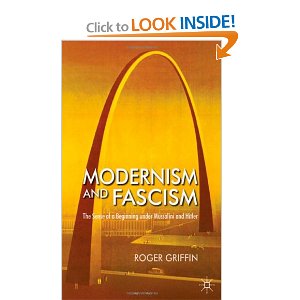
Modernism and Fascism: The Sense of A Beginning under Mussolini and Hitler

by Roger Griffin
Palgrave Macmillan, 352 pp.

Roger Griffin has published extensively on Fascism and is recognized as an authority on this topic. In Modernism and Fascism, he presents his theoretical model by focusing on three case studies: the First World War, Nazism and Italy under Mussolini. Griffin seeks to identify a common “ideological driving force” that gives rise to various social movements. He theorizes that Fascism builds upon a “core myth”: the idea that one’s nation is in decline. The Fascist is intent upon bringing about the “phoenix-like rebirth” of one’s country through the creation of a “cohesive national state”—requiring that each individual “subsume his or her personality unquestionably but willingly within the greater whole of the national community.” In this important book, Griffin has uncovered and articulated, I believe, a psychological complex that is the source of diverse historical events. Griffin’s theory is applicable to the rise of Islamic terrorism, as well as to recent events in the United States. At the moment a people feels or believes that eternal verities are under siege, social movements come into being whose purpose is to “restore” what seems to have been lost.

The King’s Two Bodies
By Ernst H. Kantorowicz
Princeton University Press, 624 pp.

Don’t be fooled by the subtitle. This study reveals an idea at the core of our political world. Beginning with St. Paul, Kantorowicz leads us through numerous authors and texts, showing us how the idea of the church as a “mystical body” transformed into the idea of the nation—another kind of mystical body. In 1571, Edward Plowden  articulated the concept of the “second body of the King.” The King, Plowden said, has two bodies: his natural body—and a body politic bound to his mortal body. Whereas the King’s Natural Body is subject to infirmities, the King’s second body—his body politic—is “utterly devoid of old age and other natural defects and imbecilities.” While the natural body and the body politic are incorporated in one person to form an indivisible unity, no doubt can arise regarding the “superiority of the Body Politic over the Body Natural.” Not only is the Body Politic “more ample and large than the Body Natural,” but in the body politic dwell certain mysterious forces that “reduce, or even remove, the imperfections of the fragile human nature.” So there it is in a nutshell: the source of the fantasy of omnipotence that defines our relationship to the nation-state.  A nation or body politic is a double of the self—the immortal part not subject to death and decay. In the Middle Ages, immortality was projected into the king. In the modern world, everyone is a king. Everyone can imagine they are bound to a body politic—and can partake of its immortality.

Politics as Religion
by Emilio Gentile
Princeton University Press, 194 pp.

Gentile, Professor of History at the University of Rome and a well-known authority on fascism and totalitarianism, defines political religion as a “developed system of beliefs, myths, rituals and symbols” that creates an aura of sacredness around a worldly entity, turning it into a “cult,” or object of worship and devotion. One such object in the modern world is the nation-state, which can appear as an “enthralling and awe-inspiring power” evoking a feeling of “absolute dependency.” Gentile presents a careful study of totalitarianism, a social movement seeking to bring about the “fusion of the individual in the organic and mystical union of the nation.” As people bind to an omnipotent God, so do we bind to nations—conceived of as omnipotent. We are aware that nationalism may take a destructive turn. However, we may forget that the idea of one’s nation serves to inspire, releasing energy and goading one to “industrious fervor.” The Olympic champion is rewarded with his or her national anthem being played. Gentile’s Politics as Religion sheds light on the sacred dimension of our “ordinary” political world.

Blood Sacrifice and the Nation: Totem Rituals and the American Flag
by Carolyn Marvin and David W. Ingle
Cambridge University Press, 416 pp.

Although Marvin and Ingle’s book is not unknown, I consider it an undiscovered classic: perhaps the most important ever written on nationalism. What is really true in any community, the authors contend, is “what its members can agree is worth killing for,” or what they can be “compelled to sacrifice their lives for.” What is sacred is “that set of beliefs for which we ought to shed our blood.” In short, nations require blood sacrifice. This profoundly disturbing idea becomes even more difficult to stomach when we realize that, according to Marvin and Ingle, the essential sacrificial victims are not enemies, but members of one’s own society. The authors identify soldiers as the “sacrificial class”: that group which enacts the ritual of blood sacrifice. Yet even as we perform this ritual, the creation of group sentiment requires that members remain “unaware of the mechanism that maintains the group.” Our deepest secret, the authors claim—the “collective group taboo”—is knowing that society depends for its existence on “violent, sacrificial death at the hands of the group itself.” I strongly suggest that everyone read and internalize the ideas contained within this great book. What would happen if the “totem secret” ceased to be a secret? If blood sacrifice gives rise to nations, what would happen to nations if people became aware of the sacrificial ritual that is required to maintain them?

“An extended meditation on the   contemporary debate about torture and terrorism that forces the reader to   grapple with troubling issues that we would prefer to ignore.”
—Sanford Levinson, Prof. of Government, University of Texas

For information on how to order, please
click here.

Sacred Violence: Torture, Terror, and Soverignty
by Paul W. Kahn
University of Michigan Press, 248 pp.

Terrorism and suicide bombings have created a flurry of scholarly research and writing on religious violence—including, most significantly, Western versions of “sacred violence.” Paul Kahn’s pathbreaking book is among the best. We deceive ourselves, Kahn contends, if we imagine that Western political practices operate in a secular world “untouched by faith and the experience of the sacred.” Nations become what they are when citizens are willing to sacrifice for a transcendent ideal. A community’s self-evident truths become real to the extent that people “are willing to die and kill for them.” Kahn identifies sacrifice as the core dynamic of Western politics. It is precisely the “violent destruction of the self” that is the “realization of the transcendental character of the sovereign.” Nations become real at the moment when the sovereign “takes possession of the body of the citizen.” The ideas put forth in Sacred Violence are revolutionary and disturbing. Yet Kahn’s presentation is calm, logical and well-balanced. Given the dispassionate voice with which Kahn presents his theory, will people be able to grasp the originality (and truth) of his argument? Time will tell.



1 Comment

Filed under historical interpretation, law of armed conflict, mass conscription, military strategy, power politics, propaganda, racist thinking, truth as casualty of war, violence of language, world events & processes

The Egyptian Revolution one year on

IRIN News

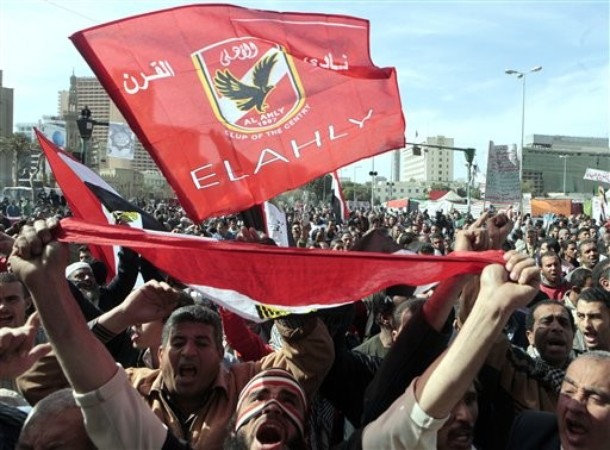
Pic by AP

CAIRO, 10 February 2012 (IRIN) – Activists and trade unions have announced 11 February as a day of general strike and civil disobedience in Egypt – in protest against continued military rule. One year after forcing their long-time ruler Hosni Mubarak to step down on 11 February 2011, many Egyptians are confused about the achievements of the revolution so far.

On the one hand, many say they are freer and more politically-empowered after asserting themselves – not only during the popular uprising that forced the president to leave after three decades in power – but also in the months that followed, in the form of continued protests against their new rulers and at the ballot box.

On the other hand, with an ailing economy, skyrocketing food prices, growing unemployment, inconsistent health services, continued deadly clashes, a weak new parliament, and a perceived unwillingness of the Supreme Council of the Armed Forces (SCAF) to leave power after taking over from Mubarak, many are asking what the revolution has brought them.

People are, in some cases, getting fed up with the revolution itself. Cairo’s central protest square, Tahrir, does not have the energy it used to and many activists feel disillusioned. They never expected the revolution to be such a lengthy process, and are facing antagonism from some Egyptians who just want the violence, insecurity and economic deterioration to end. Continue reading

Leave a comment

Filed under politIcal discourse, welfare & philanthophy, world events & processes

President Rajapaksa’s Independence Day Speech — with Ahilan Kadirgamar’s Brief Review

Ahilan Kadirgamar, in http://kafila.org/2012/02/04/a-quick-analysis-of-the-independence-day-speech-by-president-rajapaksa/

Given recent developments, I am jotting down a quick analysis of the positions, concerns and silences in President Mahinda Rajapaksa’s Independence Day speech today. The tone and substance of this speech is slightly different from the last few Independence Day speeches characterised by triumphalism and exuberance. The context of the speech is the mounting protests on the ground and increasing economic pressures.

The location of the speech in the historical city of Anuradhapura and the reference to Kebethigollawa in Anuradhapura District – the site of a horrific LTTE attack on a civilian bus in 2007 with tens of lives lost and scores injured which contributed to shifting the Sinhala public opinion fully behind the war effort – are attempts to remind the public of the horrors of war, the war victory and to mobilise Sinhala Buddhist nationalism. The solution, at the outset of the speech to all of Sri Lanka’s woes, is emphasised as the government’s “giant development works” as part of the march from “backwardness to modernity”. Continue reading

Leave a comment

Filed under democratic measures, Indian Ocean politics, politIcal discourse, power politics, power sharing, propaganda, Rajapaksa regime, Sinhala-Tamil Relations, sri lankan society, welfare & philanthophy

Mahinda Rajapaksa accused of forked tongue

 Venky Vembu, Feb 7, 2012, in First Post, with titleRajapaksa double-speak holds Sri Lanka captive to its history”

Pic by Reuters — President Mahinda Rajapaksa appears in recent days to be walking away from promises he had made to India and Sri Lanka’s Tamil minority population that he would seek out a political solution based on devolution of powers to autonomous provincial councils under the 13th amendment of the Constitution. Reuters

The modern history of Sri Lanka, centered around the politics of its Tamil minority population and its umbilically bound relationship with India, is one of broken promises, linguistic chauvinism, mutual distrust – and all-round treachery. The annihilation in May 2009 of the Liberation Tigers of Tamil Eelam, which waged a bloody 30-year campaign for a separatist Tamil homeland and was in its time arguably the world’s most ruthless killing machine, gave rise to hopes that Sri Lanka might just be able to break free of its tortured history – and move towards lasting political reconciliation.

But recent twists and turns in the political discourse in the island-nation point to a regression into the old habits of double-speak, and reflect an unwillingness to “seize the moment” to let ancient ethnic quarrels die down. Continue reading

Leave a comment

Filed under accountability, communal relations, Indian Ocean politics, life stories, politIcal discourse, power politics, power sharing, Rajapaksa regime, reconciliation, Sinhala-Tamil Relations, sri lankan society

Ranaweera reviews Leonard Woolf’s Diaries

Ariyawansa Ranaweera, in The Island, 8 February 2011 with a different title: “Woolf—A Dissenting Note”

Leonard Woolf (LW) was a multi-faceted personality—Cambridge product of the late 19th Century, civil administrator of Sri Lanka, member of the exotic Bloomsbury group, a wooer, husband of that impulsive genius, Virginia Woolf, liberal politician, writer of fiction and scholarly works on international affairs, brain behind the nascent Labour Party. These are the salient mile-stones of his long and eventful life. The major events behind them are narrated in his five volume autobiography, and also in the biography written by Victoria Glendining.

LW has come in for a lot of praise recently owing to the fact that 100 years have elapsed since his departure from Ceylon in 1911 as a civil servant. In their presentations, the contributors mainly concentrated on his career as a British civil servant from 1904-1911 in Sri Lanka. This episode of his life is presented by L.W. himself in the second volume of his autobiography titled – Growing! Continue reading

Leave a comment

Filed under cultural transmission, life stories, politIcal discourse, sri lankan society, world events & processes

Mine clearance in Sri Lanka could take 10 years or more

IRIN News

Landmine clearance in Sri Lanka’s conflict-affected north could take more than a decade, experts say. “It is expected to take [in] excess of 10 years to fully mitigate all remaining contamination in Sri Lanka,” the Mine Action Project of the UN Development Programme (UNDP) [ http://www.undp.lk/What_We_Do/Pages/Mine_Action.aspx ] in Sri Lanka told IRIN, citing a lack of resources coupled with the difficult nature of the work.

Approximately 126 sqkm of land remains to be cleared in the island’s north at the end of 2011, according to data from the National Mine Action Centre (NMAC). Set up in July 2010, NMAC is the government’s lead agency in de-mining work in the country. As of 31 December 2011, the largest remaining area was in Mannar District (33.8 sqkm), followed by Mullaitivu (27.7 sqkm), Kilinochchi (23 sqkm), Vavuniya (15 sqkm) and Jaffna (5 sqkm) in the north. Smaller areas are in borderline districts of Polonnaruwa and Anuradhapura, along with some parts of the east.

Barrier to return: More than 6,700 conflict-displaced, mainly from Mullaitivu District, continue to live at Menik Farm [http://www.irinnews.org/report.aspx?reportid=89572 ] outside the town of Vavuniya, where more than 200,000 internally displaced persons (IDPs) once lived following the end of the war [ http://www.irinnews.org/printreport.aspx?reportid=89904 ] between government forces and the Liberation Tigers of Tamil Eelam (LTTE), which had been fighting for an independent Tamil homeland since 1983 [http://www.irinnews.org/printreport.aspx?reportid=84146].

According to the UN Office for the Coordination of Humanitarian Affairs (OCHA) [http://www.humanitarianinfo.org/srilanka_hpsl/Files/Situation%20Reports/Joint%20Humanitarian%20Update/LKRN057_JHERU_Nov-Dec_2011.pdf ], since 1 January 2009, more than 554 sqkm have been cleared of mines and UXO (unexploded ordnance) in the north and east of the country.

The humanitarian demining unit of the Sri Lanka Army, international organizations – Danish Demining Group (DDG), HALO Trust, Horizon, Mines Advisory Group (MAG), Sarvatra, and Swiss Foundation for Mine Action (FSD)] – and two national organizations – Delvon Assistance for Social Harmony (DASH) and the Milinda Moragoda Institute for Peoples’ Empowerment (MMIPE)] – are engaged in demining work.

The UN Children’s Fund (UNICEF) carries out mine risk awareness programmes in the north and east. The UNDP Mine Action Unit said most of the surveys to identify the mine risk areas had been completed, but the task of clearing the mines and UXO remains time-consuming and labour-intensive.

“It turns out there aren’t any fancy scanners or high-tech mine-removal gadgets that can compete with old-fashioned sweat, discipline, and patience when it comes to picking mines out of the ground,” US diplomat Emily Fleckner said during a December site visit to Kilinochchi, where some of fiercest fighting once took place. [ http://blogs.state.gov/index.php/site/entry/halo_trust_demining_site ].

Fleckner wrote in a blog post for the State Department that officials with HALO Trust told her the organization had removed more mines in Sri Lanka during its first year of operation than all its other de-mining work combined worldwide over the same period of time.

Funding questions: But it is the overall issue of funding that has people worried most almost two years since the war was officially declared over. UNDP’s Mine Action Project says the slow work of removing mines was “compounded by decreasing donor funding” for themselves and other mine clearance agencies.

On 22 January[http://reliefweb.int/sites/reliefweb.int/files/resources/F_R_570.pdf], DDG said in an update that it had been forced to reduce its capacity by 20 percent since late 2010 due to funding constraints. DDG doubled its clearing capacity soon after the war ended in May 2009. “[But], in late 2010/early 2011 this was followed by an unheralded decrease in funding, especially amongst our major donors who reviewed their strategies globally and in particular towards Sri Lanka.”

The group has since warned of further reductions if funding constraints persist. NMAC estimates it will cost more than US$100 million to demine the last 126 sqkm.

Meanwhile, for those who have returned to their places of origin, the need to remain vigilant continues. “We know they are still around,” Mathiyavaratham Manivannan, a 32-year-old farmer in Mullaitivu District said, noting that mine-awareness programmes had made it easier for him to identify mines and UXO. “We don’t find them that often now, but we do come across them, especially when we clear new land.”

According to UNICEF, mine-related incidents were on the decline due to intense awareness programmes [ http://irinnews.org/report.aspx?reportid=90899 ]. More than 23,000 returnees took part in such programmes in December 2011 alone, with mine risk education continuing in both the north and east of the country, OCHA reported. In 2011, only 17 mine-related incidents were reported, down from 27 a year earlier. The casualty rate also dropped from 47 to 24.

This report online: http://www.irinnews.org/report.aspx?reportID=94798

1 Comment

Filed under disaster relief team, IDP camps, law of armed conflict, life stories, LTTE, NGOs, population, rehabilitation, Sinhala-Tamil Relations, sri lankan society, Tamil civilians, tamil refugees, world events & processes

A Brief History of the Anglo-Indians

A speech by Beverley Pearson at the Anglo Indian Association’s Dinner Dance in Sydney, 2005

I’m attempting to condense over 300 years of Anglo-Indian history into 10 minutes. The British Empire once held absolute power in over 52 countries covering about two-fifths of the world. But there was only one jewel in the crown – India. The first European settlers in India were the Portuguese in 1498 about 100 years before the British. The Dutch, French and the British followed.

They were all here for the duration. The inevitable happened and a new mixed race community emerged. Even though the British came in peacefully as merchants and traders they soon colonised the sub-continent of India. But the British needed allies to protect the jewel in the crown and so began a deliberate policy encouraging British males to marry Indian women to create the first Anglo-Indians. Continue reading

Leave a comment

Filed under cultural transmission, life stories, politIcal discourse, world events & processes

Elmo’s YANA MAGA revealed and reviewed in two sketches

 Review One = YANA MAGA: Sri Lanka, a gift for all

“Whatever are our aspirations, it is based on our journey and it is the journey – the yana maga – that matters, not the destination,” says Captain Elmo Jayawardena. And it is this sentiment that holds as premise for his new coffee table book.

 click on Pics

Capt Elmo is no newcomer to the literary world with three notable novels to his name that include ‘Sam’s Story’ which was awarded the Gratiaen Prize in 2001. For his second, The Last Kingdom of Sinhalay he received the State Literary Award and the third Rainbows in Braille’ was short listed for the Singapore Literary Prize. Launched in January of 2012, is the latest addition, ‘Yana Maga, Sri Lanka a gift for all..’, a coffee table book that aspires to be more than a mere keepsake. Most importantly, the author’s share of the proceeds from the book goes towards a charity organisation, CandleAid Lanka founded in 1996 by Capt Elmo. Among his many passions that include piloting of which spans his career, he is emphatic about his humanitarian work. The efforts towards alleviating poverty is one which he regards as his greatest contribution to life.

Continue reading

Leave a comment

Filed under cultural transmission, historical interpretation, life stories, patriotism, reconciliation, rehabilitation, Sinhala-Tamil Relations, sri lankan society, tolerance, voluntary workers, welfare & philanthophy