Yearly Archives: 2011

A Simple Man, A Common Man, A Contented Man is Carolis Singho of Ratgama

Susiri Weerasekera[i]
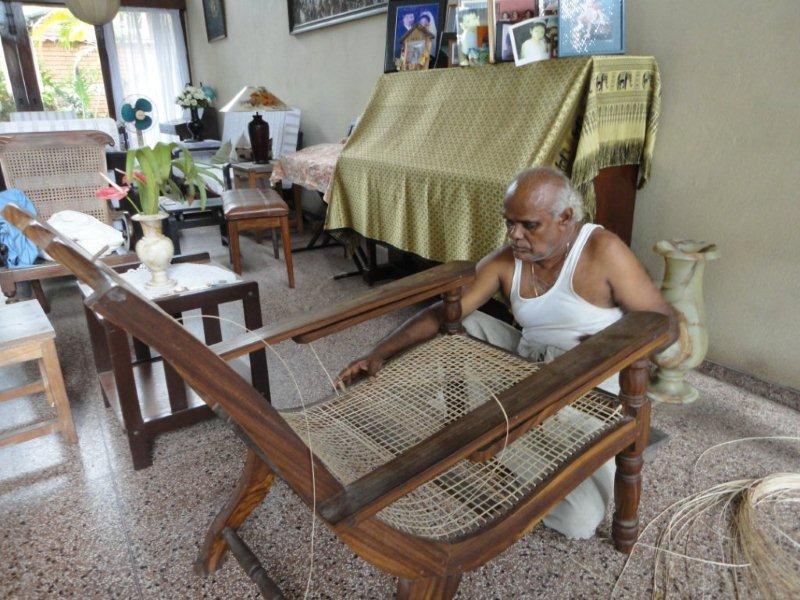
I have had the pleasure today of meeting a very average Sri Lankan man of the older type. He is a rattan weaver of 63 years from Ratgama a few miles north of Galle.[ii] Lives about 200 yds from the Galle Rd.  For the last 35 years, since the age of 18 he has toured this area at Nugegoda, weaving. His name is CAROLIS SINGHO.

He will weave our hansi putuva (easy chair) and the couch (kavitchiya) for Rs. 24,000/ taking over 5 days. (We bought the old couch in 1993 for Rs 6000/. It is worth 150,000/ today)

He is a calm and collected man whom I have seen going down our lane for years, doing the occasional weaving for us. He wears sarong and shirt. Slippers. Clean shaven, a bit grey haired. Very sturdy build.

I asked some direct questions from him as he weaved. I was lucky I was home.

 How is Ratgama? Not bad. Continue reading

Leave a comment

Filed under politIcal discourse, Rajapaksa regime, sri lankan society, unusual people, welfare & philanthophy, working class conditions, world events & processes

Rajasingham Narendran debates recent history with Ilaya Seran Seguttuwan

Courtesy of the Sri Lanka Guardian

Communal relations in independent Sri Lanka

I read with interest the response of Ilaya Seran Seguttuwan to my note titled, ‘A brief overview of post- independence history of communal relations in Sri Lanka’ (Sri Lanka Guardian of 19th Sept’2011). [article 01, article 02 ]  The criticism he directs at me is more valuable than the complements, in view of his erudition, experience and long involvement in Sri Lankan affairs. He has raised a couple of issues that require explanations from me.

1.“For reasons not clear, he is a strident critique of the TNA, the TULF and the Tamil leadership under Mr. Sambanthan and colleagues- bar a few instances he passes some complementary remarks on this grouping”.

 Yes, I am very critical, because throughout our post-independence history the Tamils have been led in a short sighted manner by their so-called leadership (I have used the pre-fix so-called to emphasize that leadership means something entirely different to me). This includes G.G.Ponnambalam’s Tamil Congress. Their politics has been emotive and reactive. They did Continue reading

1 Comment

Filed under accountability, citizen journalism, communal relations, discrimination, historical interpretation, island economy, language policies, Left politics, LTTE, politIcal discourse, power politics, power sharing, religious nationalism, Sinhala-Tamil Relations, sri lankan society, world events & processes

Perceptions of Racism in Australia: Indians and Lankans most victimized– says Kevin Dunn

Stuart Rintoul, in The Australian, 21 September 2011

 Professor Kevin Dunn

Kevin Dunn, lead researcher of the decade-long Challenging Racism Project, said new analysis suggested Indian and Sri Lankan-born Australians reported higher levels of racism in such areas as the workplace, in education, when renting or buying a house, at shops and at sporting or public events.

The findings suggested the 2009 attacks on Indian students in Melbourne were a sign of a wider problem, he said. The study found: Continue reading

4 Comments

Filed under accountability, australian media, cultural transmission, discrimination, disparagement, fundamentalism, immigration, life stories, politIcal discourse, racist thinking, violence of language, welfare & philanthophy, world events & processes

Terror cleric Abdul Nacer Benbrika headed twin cells

Cameron Stewart, in The Australian, 21 September 2011

THE nation’s two largest terror cells were linked by a common spiritual leader, joint terror training camps and close friendships between extremists in Melbourne and Sydney. After a Victorian judge yesterday threw out a second round of charges against convicted terrorists, it can be revealed that self-proclaimed Muslim cleric Abdul Nacer Benbrika was considered the central figure and the driving force behind both cells in Melbourne and Sydney. The groups’ targets were to have included a terrorist strike on the 2005 AFL grand final between the Sydney Swans and the West Coast Eagles, Melbourne’s Crown casino during Grand Prix weekend in 2006 and Sydney’s Lucas Heights nuclear reactor.

Benbrika, who is currently serving a minimum 12 years in jail for leading a terrorist organisation, was recorded telling one of his followers: “If we want to die for jihad, we have to have maximum damage. Maximum damage. Damage their buildings, everything. Damage their lives. To show them, we’ll have to be careful.”

Continue reading

Leave a comment

Filed under accountability, atrocities, australian media, democratic measures, disparagement, fundamentalism, life stories, politIcal discourse, religious nationalism, terrorism, violence of language, world events & processes

Shaping Our Future: A Few Rays of Hope

Renton de Alwis in Daily News, 21 September 2011

In the village of Kiula in the Deep South, 21 kids and one adult formed a new theatre group called ‘Kiula Warna Ranga Players’ this week. That was the culmination of a six weeks free theatre workshop they had during the school holidays. Turning part of the Kiula Junior School ground into their stage or karaliya, their performance was much better than any of us expected, proving how skills and talent combined with rigorous practice and rehearsal can do wonders for children in learning.

Manjula Ranasinghe of Janakaraliya of whom I wrote about in an earlier column, gave his know-how and skills to make the workshop an educational experience for the kids. They went through physical exercises, breathing exercises, meditation sessions, drama exercises and games, voice training, team building efforts and the like during the workshop sessions. Continue reading

Leave a comment

Filed under accountability, citizen journalism, cultural transmission, life stories, reconciliation, rehabilitation, Sinhala-Tamil Relations, welfare & philanthophy

Asylum-Seekers and Migration to Australia — A Timeline

IRIN News

BANGKOK, 20 September 2011 (IRIN) – Australia’s resumed push to swap asylum-seekers arriving by boat with refugees from Malaysia is the government’s most recent policy response to an issue that has preoccupied officials and the public for years.  Under the so-called “Malaysia Solution”, Australia would exchange the next 800 refugees to arrive by boat for 4,000 mostly Burmese, in Malaysia. On 31 August, the High Court ruled against it, declaring the proposal invalid, a decision welcomed by rights groups such as the Refugee Council of Australia. According to government figures, since 1976, more than 27,000 people have boarded boats and attempted to emigrate to Australia, a signatory to the 1951 UN Refugee Convention
IRIN considers how the debate has developed:

27 April 1976: The first boat arrivals – five refugees from Vietnam – land in Darwin. Over the next five years, more than 2,000 Vietnamese boat arrivals are reported and the term “boat people” enters the Australian vernacular; Continue reading

Leave a comment

Filed under accountability, asylum-seekers, australian media, disparagement, life stories, people smugglers, Tamil migration, welfare & philanthophy, world affairs, world events & processes

India, China and Rest of the World

Sumanasiri Liyanage, in The Island, 19 sept 2011

Many seem to ask if Sri Lanka is moving towards China away from India. Those who answer the question in the affirmative hold two opposite views. While the first group seems to be happy about Sri Lanka’s increasing ties, economic and otherwise, with China, the other appears to see it as a danger because our closer ties with China would result in antagonizing India and the West. Sri Lankan foreign policy, especially when the UNP was in power, was oriented towards the West. Although the SLFP-led governments adopted more balanced foreign policy regime, they always valued the importance of close links with the USA and its allies. During the past six years, we have witnessed a kind of paradigm shift in the Sri Lankan foreign policy placing more emphasis on the countries in the region. As I have argued on many occasions, this is a positive change. Where could India and China be located in this new foreign policy shift? Can we afford to make a choice on this issue? This issue is raised by many commentators in recent times although not in explicit terms. Continue reading

1 Comment

Filed under historical interpretation, Indian Ocean politics, LTTE, power politics, Rajapaksa regime, Sinhala-Tamil Relations, war crimes, world affairs, world events & processes

The Sri Lanka Navy’s Role in the local & global context with an emphasis of future strategies

Wasantha Karannagoda,

SEE http://www.srilankaguardian.org/2008/05/role-of-sln-in-local-global-context.html

AND http://lankanavy.blogspot.com/2008_09_01_archive.html

  AND http://en.wikipedia.org/wiki/Sri_Lanka_Navy

Leave a comment

Filed under historical interpretation, Indian Ocean politics, life stories, LTTE, military strategy, power politics, Sinhala-Tamil Relations, sri lankan society, terrorism, world events & processes

Gone missing in Sri Lanka –The Rule of Law

Shanie in the Island, 16 September 2011

“The piously belligerent army of Hindu politics would rather take us away from engagingly thoughtful discussions and would have us embrace instead their much-repeated public proclamations, for example that Rama, the epic hero, is an incarnation of God; that all Hindus worship him; and that he was born on a well identified plot 900,000 years ago. We are thus not allowed to see the Ramayana as ‘a marvellous parable’ (as Rabindranath Tagore saw it) but as a historical document which cannot be questioned. It is also taken to have enough legal status to give actively destructive Hindu politicians a licence to tear down a place of worship of other people to build a temple to Rama,in celebration of his alleged birth exactly there.”

In 1992, a mob of Hindutva fanatics destroyed the Babri mosque inAyodhya,Indiaclaiming that it was built on the sacred spot of Rama’s birthplace. Many liberal minded Indians condemned that action but were unable to reverse the action of the mob who not only took the law into their own hands but also instilled feelings of deep hurt and insecurity in a religious minority. The critical comments quoted above are from Nobel Laureate Professor Amartya Sen’s thoughtful collection of essays ‘The Argumentative Indian’ published a few years ago. Continue reading

Leave a comment

Filed under accountability, authoritarian regimes, citizen journalism, democratic measures, life stories, politIcal discourse, Rajapaksa regime, world events & processes

25 million died in Japan-inspired Asia-Pacific Wars between 1931 and 1945

Rowan Callick, in The Weekend Australian, 17-18 September 2011, under different title: “Manchurian ties bind ol’ blue eyes, blue lotus and boy king”

They are all linked with Manchuria in northeast China, which is the site of an important anniversary tomorrow that has prompted numerous films, conferences and speeches. On September 18, 1931, a Japanese army lieutenant, Kawamoto Suemori, laid dynamite near Liutiao Lake, along a line of the South Manchuria Railway owned by the Japanese government, and detonated it at 10.20pm. He did a poor job. Five minutes later, a train from Changchun steamed across the dynamited section of track, and arrived safely in Mukden, present-day Shenyang, at 10.30pm. But the pretext had been established for a war in which 25 million people, mainly civilians, died throughout Asia and the Pacific islands – and in Australia — before it ended in 1945. Continue reading

Leave a comment

Filed under accountability, life stories, military strategy, politIcal discourse, power politics, racist thinking, war crimes, world events & processes, Zen at war