
Undying Enmity in Pantomime at India Pakistan Border

SEE http://www.wimp.com/indiapakistan/

i-p border pantomimehttp://www.youtube.com/watch?v=NC9NeJh1NhI
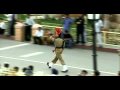
border p“Every day at dusk, Indian and Pakistani border guards put on a show of one-upmanship at the Wagah border crossing near Amritsar, Punjab. The two countries are not on the best terms, but instead of a boring stare down, there is plenty of humour and acrobatic extravaganza to be found as the soldiers try to outdo the other side by marching and parading in hilariously exaggerated fashion. Thousands show up to watch from the stands everyday, and we thoroughly enjoyed the crazy uniforms, impressively HIGH leg kicks, and the longest bellowing contest we have ever heard. Gotta say, the Pakistani bellower was a bit better that day.” http://www.youtube.com/watch?v=HPpiQTAC__s

PS: There is some parade on NOW in Sri Lanka is there not?

Leave a comment

Filed under nationalism, performance, power politics, pulling the leg, unusual people, world affairs, zealotry

Step-by-Step moves forward creatively in Sri Lanka rebuilding shattered lives across the board

Step-By-Step Studio Images Children Engaged in Mystery Painting at Vajira Sri Childrens Development Centre Mystery Painting Studios, like the Step-by-Step Studio in Colombo, are not primarily about “doing” something. They are about “being” something: being peace, being hope, being adaptable and dependable in situations that change rapidly and are far from reliable. The Monkey’s Tale Centre for Contemplative Art in Batticaloa was the first Mystery Painting studio. It was born out of the generosity of friends in Canada, America and Great Britain responding to the tsunami, which first swept ashore in Sri Lanka at Marathamunai a town some forty kilometers from Batticaloa, the day after Christmas 2004.

Just as with the response of the international community, people in Batticaloa reached into their hearts and helped out however they could. They weathered the crisis and, in doing so, learned a valuable lesson. Wherever there is turbulence there is transition, and transition – to be productive of the most positive results – must be anchored in an open and yielding heart. Continue reading

2 Comments

Filed under communal relations, performance, self-reflexivity, Sinhala-Tamil Relations, sri lankan society, tolerance, trauma, unusual people, welfare & philanthophy

Language and National Identity: The Sinhalese and Others over the Centuries

Michael Roberts, reprinting an article published in 2003 in Nationalism and Ethnic Politics, Summer 2003, 9: 75-102.**

 M-roberts by ErangaABSTRACT: The collective identity of Sinhala-speakers over four centuries dating from the 1590s is analyzed with due attention to the structural form of (a) the Kingdom of Kandy and (b) the British colonial regime that took control of the whole island by 1815/18. The analysis dwells on the modes of oral, visual-iconic and written forms of cultural transmission that pre-dated print technology, while drawing attention to the relative uniformity of the Sinhala language in both geographical and temporal scale. A semantic pattern of political alliances based on the opposition of inside to outside which works contextually like a nestling Chinese-box is one dimension of this linguistic order. This supported the tendency of Sinhalese representations to adopt an associational logic which merged past enemies (the wicked Tamils) with contemporary enemies (the Portuguese, the English) during the liberation struggles of the Kandyan state and its militia in the pre-1818 period. Such tendencies and the continuation of disparaging epithets coined during the period of Portuguese imperial intrusion into the vocabulary of the twentieth century must inform any theoretical efforts to distinguish the collective consciousness of the Sinhalese after the substantial transformations initiated under the British from that which is expressed so powerfully in the war poems of the pre-British period. Continue reading

2 Comments

Filed under British colonialism, communal relations, disparagement, economic processes, ethnicity, governance, heritage, historical interpretation, island economy, language policies, Left politics, life stories, literary achievements, Muslims in Lanka, nationalism, politIcal discourse, population, power sharing, religious nationalism, Sinhala-Tamil Relations, sri lankan society, Tamil civilians, world affairs

A Story of Southern Sinhala Recalcitrance: How the Devolution Gestures of 1981-83 moved NOWHERE

S. Sivathasan in the Sunday Leader,13 May 2013

When the Jaffna Development Council started functioning a Minister who made frequent official visits to Jaffna was Hon. Gamini Dissanayake. His known closeness to the President lent some significance to the discussions he had with Mr. Nadarajah the Chairman of the Council. A warm rapport developed between the two. To the Chairman it opened a two-way communication connecting the District with the Centre. The Minister perhaps was not unaware of the political fall-out for the government, if things turned out well.

JR-LALITH-gAMINIQuite a few meetings with the Minister were held in Colombo. The Chairman, the Government Agent Dr. Nesiah and the writer participated in these meetings. What were emphasized from the Council’s side were substantially larger funding and more devolved powers to utilize the finances effectively. The proposition struck a sensitive chord with the Minister and he took the initiative in arranging for a meeting with President J.R. Jayawardene one evening at his residence. It was in the latter part of 1982. The five of us took part in the discussions for over an hour. Development priorities with central funding were outlined by us. The Jaffna Lagoon Scheme and bridging the Mahadeva Causeway were among them. There was responsive interaction. Continue reading

4 Comments

Filed under accountability, communal relations, democratic measures, historical interpretation, life stories, politIcal discourse, power politics, Sinhala-Tamil Relations, sri lankan society

Major container ship firm sees good prospects for Sri Lanka as a maritime hub

Courtesy of the Daily News & bunkersportsnews… ALSO SEE http://www.slpa.lk/port_hambantota.asp?chk=4

 HM-Arial-View-ShapedSri Lanka can be coverted into a regional maritime hub as an alternative to Singapore, said Rob Grool, President, Fleet Seaspan Ship Management Ltd, Canada, which owns over 60 large container ships.  In an exclusive interview with Daily News Business at the Seaspan Ship Management (Vancouver) Offers Forum concluded in Colombo last Saturday held in collaboration with their manning agents in Sri Lanka, Ceyline Shipping Ltd, Grool said that Colombo, Hambantota and Galle could play a major role towards achieving this target.
“Both these harbours lie on a global maritime route and should be promoted towards reaching this target,” he added. He said that bunkering, crew exchange, supplying of commodities, repairs and spares are the key areas that these three harbours should pay attention to,” he said. Continue reading

Leave a comment

Filed under economic processes, growth pole, Rajapaksa regime, sri lankan society, world events & processes

Revisiting Gordon Weiss’s accountability in his The Cage

Padraig Colman from his web site = http://pcolman.wordpress.com/2013/05/03/the-cage-by-gordon-weiss/ …. with a shorter version now in The Sunday Island 13 may 2013

WEISS in T'currentsWhile I was reading the new publication from the International Diaspora Group on counting the dead in Sri Lanka,[i] I cast my mind back to what Gordon Weiss had to say on the subject in his book, The Cage.

cropped-Weiss-blogheader2  Bad Writing: Jason Burke[ii], writing in the Literary Review, describes this book as a : “comprehensive, fair and well-written work”. I beg to differ about the well-written bit. It is a good read, but not a good write. As seems to be the custom with contemporary authors in any genre[iii], Weiss provides a lengthy list of acknowledgements to those without whom etc…. Weiss is readable enough but it is a pity that some of those who “helped” did not draw his attention to several examples of inelegant English or lack of clarity. Continue reading

3 Comments

Filed under accountability

A People Without a Story: the Lankan Tamils

Aatish Taseer, courtesy of SUNDAY, where the title is “a People without a Story”

lanka-celebration.190 celebrations in the south–May 2009

FOUR years ago this week, the Liberation Tigers of Tamil Eelam announced that their struggle for an independent homeland in northern Sri Lanka had “reached its bitter end.” The group had been fighting on behalf of the Tamil people for more than a quarter-century, and its defeat was absolute.  Today, great sections of Tamil country are still a scene of devastation. The houses are either destroyed or brand-new; the land is uncultivated and overgrown; there are forests of decapitated Palmyra palms, damaged by heavy shelling. And then there are the relics of war — graveyards of L.T.T.E. vehicles rotting in the open air; the remains of a ship, its superstructure blown to pieces and in whose rusting starboard a gaping hole gives on to blue sea. Continue reading

Leave a comment

Filed under LTTE, politIcal discourse, population, Rajapaksa regime, reconciliation, rehabilitation, Sinhala-Tamil Relations, sri lankan society, Tamil civilians, trauma, truth as casualty of war, women in ethnic conflcits, world affairs

Julie Bishop pulverizes ABC’s prejudiced misinformation

SEE http://www.juliebishop.com.au/transcripts/1277-abc-24-the-world-with-jane-hutcheon.html : ABC 24 The World with Jane Hutcheon” .. with the Sri Lankan segment placed first in this re-presentation

jane hutcheon JANE HUTCHEON    To discuss Syria and the state of the world the Deputy Opposition Leader and Shadow Minister for Foreign Affairs Julie Bishop joins us in the studio. Julie Bishop welcome to ‘The World’, many thanks for coming in.
 821425-julie-bishopJULIE BISHOP    Good evening.

          SEGMENT TWO : ……….. 
 JANE HUTCHEON    Let’s go to Sri Lanka now , and I wonder, do you support the return of Sri Lankan asylum seekers to their country of origin? 
 JULIE BISHOP    Yes, I do. Based on what I saw and have learned from a visit to Sri Lanka in January of this year, I’m convinced that the Sinhalese in particular have no reason to fear persecution in Sri Lanka. 
 JANE HUTCHEON    What about the Tamils? 
 JULIE BISHOP    Indeed the Tamils likewise are receiving much better treatment under the Sri Lankan government and if they were to fear persecution in any form, then paying a people smuggler and getting on a rickety boat and travelling thousands of kilometres across the sea is not the right thing to do. 
 If they do want to claim asylum, if they do claim a fear of persecution, which I would dispute, then they can go 30km into India, where they would be welcome and provided with health and medical support.  Continue reading

5 Comments

Filed under asylum-seekers, Australian culture, australian media, authoritarian regimes, governance, historical interpretation, Indian Ocean politics, legal issues, life stories, LTTE, politIcal discourse, propaganda, Rajapaksa regime, Sinhala-Tamil Relations, slanted reportage, Tamil civilians, truth as casualty of war, world events & processes

The BBS That My Mother Likes = An Emblem for the Sri Lankan Equivalent of Middle America

Darshanie Ratnawalli  courtesy of the Nation and the Colombo Telegraph, with the latter drawing a volatile discussion which readers may wish to view … SEE note below pertinent to that discussion

I am the legitimate issue of a woman who unabashedly claims to admire the Bodu Bala Sena. This affords me a critical perspective into the issue, without which everyone is floundering like headless chickens. There may be other people, whose mothers etc. harbor soft spots for the BBS. But because they are not me, they would either try to keep these mothers in the closet or, in contradistinction, empathize with these soft spots; whereas I…Well you shall see.

Bodu Bala sena Gnanaara theroMy mother represents the Sri Lankan equivalent of Middle America and, as such, the demographic bloc that makes or breaks any movement dependent on mass support for its success. In Middle America (SL), one becomes a Buddhist by being a stakeholder of the Buddha Sāsana (deliberately called henceforth, the Buddhist Church of Lanka) and by emotionally aligning oneself with the age-old mission of fostering this Sāsana on this soil for the allocated five thousand years.  Once one has fulfilled this basic requirement adherence to Buddhism proper becomes peripheral and is largely left to personal discretion. Continue reading

6 Comments

Filed under citizen journalism, communal relations, cultural transmission, democratic measures, discrimination, disparagement, historical interpretation, political demonstrations, politIcal discourse, racist thinking, Rajapaksa regime, sri lankan society, truth as casualty of war, world affairs

Father Vito Perniola S.J. – Awards and Appreciations

PERNIOLA in 2013 --johnny Fr Perniola captured by Johnny in 2013

I: A Note by Carl Fernando:  The Royal Asiatic Society of Sri Lanka commenced their Annual Sessions on 28th March 2013. The prestigious Sir S. C. Obeysekere Medal for 2013 was awarded to Fr. Perniola. This medal is awarded periodically to members of the Society, of which Fr. Perniola is a Life Member, for outstanding achievements. His Pali Grammar which was published by the Pali Text Society of London and the History of the Catholic Church in Sri Lanka, running into 19 Volumes, are some of his great works. An erudite Linguist, Scholar and Historian, Fr. Perniola served at St.Aloysius’ College, Galle  for a period of about 15 years and was Rector from 1949 to 1952. He celebrates his 100th birthday on the 10th of April 2013. A thanksgiving mass will be held on that day at St. Mary’s Church, Bambalapitiya, at 4.30 pm. Continue reading

Leave a comment

Filed under heritage, historical interpretation, life stories, literary achievements, performance, sri lankan society, unusual people, welfare & philanthophy, world affairs