Create an enemy, target Muslims, sharpen animosities … To what end?

Mohamed Saleem, in the Island, 7 August 2013, where the title reads “Need an enemy? Target Muslims: Souring Buddhist-Muslim Relations”

2a-Moorman Tamby =213For months Sri Lanka has witnessed orchestrated anti-Muslim campaigns. Some Buddhist-clergy, self proclaimed saviours of true Buddhism, branding as Bodu Bala Sena, Sinhala Ravaya and Ravana Balakaya are instigating Buddhists, particularly the youth, into a state of frenzy that manifests in hate rhetoric against the Muslims, desecrating their belief systems and places for congregational worship. Stereotyping and targeting with the intent of causing social disharmony, although unacceptable in any cultured society, the anti-Muslim exuberance in this country is flourishing as the perpetrators feel encouraged to perform under the watchful eyes of the law enforcement agencies that have no qualms about Muslims being picked as targets. Continue reading

Leave a comment

Filed under communal relations, cultural transmission, economic processes, fundamentalism, historical interpretation, life stories, nationalism, politIcal discourse, power politics, Rajapaksa regime, sri lankan society, tolerance

Deep draft terminal at Colombo Port launched

Courtesy of Daily News, 8 August 2013

COLOMBO PORT -CONTAINER SHIPColombo’s new deep draft terminal constructed under the Colombo Port Expansion Project (CPEP) received its first container carrier, an 11,000 TEU Ultra Large Container Ship (ULCS) “MV CMA CGM PEGASUS” operated by CMA CGM, the world’s third largest container group and number one in France, on August 5. The vessel touched Colombo on its China-Europe leg, plying on its FAL3 (French Asia line) service. The first terminal of the CPEP, Colombo International Container Terminal (CICT) was constructed on a Built Own Transfer (BOT) agreement with a Public-Private-Partnership between the Sri Lanka Ports Authority (SLPA) and the China Merchants Holdings (International) Co., Ltd. (CMHI). Continue reading

Leave a comment

Filed under economic processes, Indian Ocean politics, politIcal discourse, Rajapaksa regime, sri lankan society, world events & processes

Queen Victoria rises again in Colombo

Courtesy of the Straits Times, 8 August 2013

Queen VIC 11A statue of Queen Victoria which was banished  from Sri Lanka’s presidential palace amid fears it brought bad luck will now be  spruced up for an upcoming Commonwealth summit. The 1897 statue of the former British monarch seated on a throne had been  banished from the palace a few years ago and dumped in the backyard of  Colombo’s museum. Museum superintendent Ranjith Hewage said the museum now planned to shift  the statue to a better location so that it faced the main road as well as a  public park, which was until recently named after her. “We will turn the statue from its present location to face the road,”  Hewage told AFP. “It will be done before the CHOGM (Commonwealth Heads of Government  Meeting).” Continue reading

Leave a comment

Filed under accountability, British imperialism, cultural transmission, female empowerment, governance, heritage, historical interpretation, sri lankan society, unusual people, world events & processes

Galle Fort — ten generations in one street

Juliet Coombe, courtesy of the Daily News

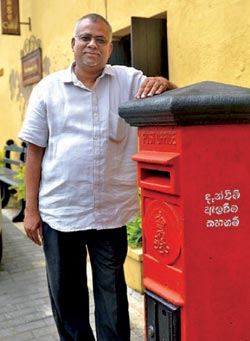
The British Colonial red letterbox sets the scene for the gargantuan colonial façade of The Heritage Café that straddles both Pedlar and Lighthouse Street replete with imposing columns, original courtyard, which considers the volatile horizon in pensive calm, solid and stoic, concealing the boundless ever changing energy and innervations of different generations and the buildings variable uses over the centuries.

MANHALManhal the owner of The Heritage Café explains with immense pride over a fish platter fit for a king that this is the only ancient fortress of its kind and that it is very much a living city, where you see fort children with satchels heading out to school early morning, street peddlers plying their trade daily, and the army running past keeping up a rigorous routine reinforcing why they are one of the best in the world. This is in dynamic contrast to other forts around Asia, which are in most part merely empty museums, with none of the historic families or life coexisting within their historic walls. Manhal always with a story to tell about the past and the biggest twinkly smile thinks his family has probably been living in Pedlar Street for around ten generations or more. “It’s difficult to know” explains Manhal, “as my family has been here for so long and since no records from the early years exist and we only have the oral history it is hard to know fully about our lives here in Galle. I am always seeking out new information and feel like an archaeologist some days putting the pieces of a puzzle together, both of this building and my family’s past lives in this ancient citadel.” Continue reading

Leave a comment

Filed under British imperialism, cultural transmission, heritage, historical interpretation, landscape wondrous, life stories, photography, sri lankan society, world affairs

Confusions and erasures around Black July among some educated Sinhalese youth

Iraj De Alwis, from GROUNDVIEWS, 31 July 2013,  where the title is “Forgetting Black July” .. so go to http://groundviews.org/2013/07/31/forgetting-black-july/ –  because that post includes (a) recordings of some interviews with young Sinhalese and Tamils, with the Sinhalese revealing appalling  ignorance about the events of July 1983; and (b) a few comments that were appreciative of De Alwis’s presentation in  thoughtful ways. ALSO refer to http://www.flickr.com/photos/sacrificialdevotion/

BLACK JULY --BBC Pic from BBC

I was born ten years after Black July. I am a Singhalese. A week or so ago, as the thirty-year anniversary approached, for curiosity’s sake, I did a small experiment. I asked some of my peers a question: “What do you know about Black July?” Of twenty-two Sinhalese, eighteen did not know what it was. I asked eight Tamil friends, all of whom knew, and had family experiences to share. Here are a few of those responses. Continue reading

1 Comment

Filed under cultural transmission, education, heritage, historical interpretation, life stories, nationalism, politIcal discourse, riots and pogroms, sri lankan society, Tamil civilians, tolerance, unusual people, world events & processes

Free Speech, Hate Speech and Double Standards

Michael O’Leary aka Padraig Colman, courtesy of The Nation, 4 August 2013, where the title is “Freedom of Expression

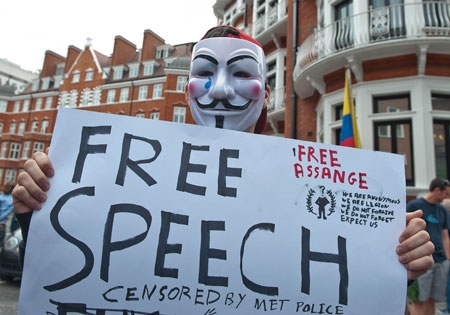
fre sppechA number of fallacies are common in the blogosphere. A lot of people cannot cope with, or even understand, disagreement. Americans bloggers are fond of citing the First Amendment to the US Constitution. If someone disagrees with them, they complain that they are being silenced. Genuine disagreement is often described as “whining”. On Colombo Telegraph and Groundviews, there have been demands for me to be silenced. Inoka Karu called on GV to root out the “rabble-rousers”. “Dear moderators: I am repeatedly appealed to you to control hellion characters such ‘off the cuff’, Padraig Colman and J Fernando.”

More  disturbing was a call for suppression of free speech from someone who presents himself as a libertarian and a principled writer. Emil van der Poorten commented: “In the interests of the sanity of the rest of us, Sanjana and Uvindu would be well advised to leave the O’Learys/Colmans out of the columns of the publications they have responsibility for.” Surely such a man could not be asking for a fellow writer’s work to be banned! When CT decided to ban Dr Vickramabahu, van der Poorten took a principled stand: “I have serious concerns about something that smacks of censorship and throwing the baby out with the bathwater here.” Continue reading

1 Comment

Filed under accountability, citizen journalism, cultural transmission, discrimination, disparagement, life stories, politIcal discourse, self-reflexivity, slanted reportage, sri lankan society, tolerance

Nation, Constitutionalism and Buddhism in Sri Lanka … by Roshan de Silva Wijeyeratne

 ROSHANThis September, Routledge will publish Nation, Constitutionalism and Buddhism in Sri Lanka, by Roshan de Silva Wijeyeratne (Griffith University, Australia). The publisher’s description follows. Nation, Constitutionalism and Buddhism in Sri Lanka offers a new perspective on contemporary debates about Sinhalese Buddhist nationalism in Sri Lanka. In this book de Silva Wijeyeratne argues forcefully that ‘Sinhalese Buddhism’ in the period prior to its engagement with the British colonial State signified a relatively unbounded (although at times boundary forming) set of practices that facilitated both the inclusion and exclusion of non-‘Buddhist’ concepts and people within a particular cosmological frame. Juxtaposing the pre-modern against the backdrop of colonial modernity, de Silva Wijeyeratne tells us that in contrast modern ‘Sinhalese Buddhism/nationalism’ is a much more reified and bounded concept, one imagined through a 19th century epistemology whose purpose was not so much inclusion, but a much more radical exclusion of non-‘Buddhist’ ideas and people. Continue reading

Leave a comment

Filed under authoritarian regimes, British colonialism, British imperialism, governance, historical interpretation, politIcal discourse, power politics, sri lankan society, world events & processes

Colonising Knowledge in the Kingdom of Kandy — Sivasundaram on U Tube

Sujit Sivasundaram …. SEE http://www.youtube.com/watch?v=RRokQbarKzM

SUJIT SIVA 22Dr Sujit Sivasundaram shows how  local knowledge in Sri Lanka was used as a means of resistance against  the British in the 1800s, and subsequently absorbed and adopted by the
colonists as their own… In this short film Dr Sujit Sivasundaram, from the Department of International History, challenges  the idea that European colonists brought Modernity – in the form of  systematic knowledge – to countries such as Sri Lanka. He argues that it  is not just territory that is occupied by a colonising force, local  knowledge, too, is also absorbed and utilised by the colonisers. Continue reading

Leave a comment

Filed under authoritarian regimes, British colonialism, British imperialism, cultural transmission, historical interpretation, sri lankan society, world events & processes

Moral immaturity befuddles the humanitarians on the asylum-seeker issue

Greg Sheridan, in The Australian, 1 August 2013, where the title reads Bleeding hearts ignore the complexity of the asylum-seeker issues”

greg sheridan AT q AND aWHAT are the real ethics of boatpeople policies? Malcolm Fraser, Phillip Adams, Dennis Altman, John Hewson, Christine Milne and the entire refugee lobby have described the policies of both Kevin Rudd and Tony Abbott in ways that make it clear they are to be regarded as immoral, unethical, bigoted, unfair, demonising and so on. Even the Catholic bishops, normally a sober body of men, have called for an end to mandatory detention of people who arrive illegally by boat. As it happens I knew both Rudd and Abbott for many years before they went into politics. Both are ruthless politicians, but both also are conscientious Christians and neither, I am certain, would ever pursue policies in relation to the disposition of human beings that they believed to be unconscionably wrong. Continue reading

2 Comments

Filed under asylum-seekers, Australian culture, australian media, cultural transmission, discrimination, disparagement, economic processes, ethnicity, fundamentalism, historical interpretation, Indian Ocean politics, legal issues, life stories, politIcal discourse, power politics, racist thinking, Sinhala-Tamil Relations, slanted reportage, sri lankan society, tolerance, truth as casualty of war, world events & processes

The psychoanalysis of racism, nationalism and revolution

Richard Koenigsberg

KoenigsbergEXTRACTS as introduction….

Faith in the NationThe idea of the nation is a fundamental “assumption” that defines the manner in which modern man perceives, and experiences, social reality. Just as people in earlier historical periods possessed an absolute faith in the reality of God, so do people in contemporary cultures possess an absolute faith in the reality of the nation.

In a democratic culture, people differ regarding the stance taken in relation to the nation: the country may be “loved” or hated; perceived to be “healthy” or sick; “strong” or weak. But whatever stance is adopted, people are united by their absolute faith in the reality of this entity, and their belief that this entity constitutes a fundamental determinant of the nature, and of the quality, of their daily lives. Continue reading

Leave a comment

Filed under atrocities, Fascism, Hitler, life stories, nationalism, performance, politIcal discourse, power politics, propaganda, unusual people, violence of language, zealotry