Category Archives: transport and communications

The Potency Borne by Pictures

Michael Roberts

This little presentation is a DEDICATION. It illustrates the potency and power of friends in producing an academic booklet in 2011. As it happens, the booklet bears the title Potency, Power & People in Groups and was financed by the good friends Godfrey & Amar Gunatilleke of the Marga Institute.

The “Acknowledgements” and the “Foreword” taken together spell out the names of those friends who assisted this project. But let me single out Anura Hettiarachchi for his aid in this project and in the endeavours leading to my book on Sinhala Consciousness in the Kandyan Period (Colombo, Vijitha Yapa Publications, 2004) because he was struck down by heart failure recently.

To Anura, then, in gratitude I place this item in my website.

Continue reading

Leave a comment

Filed under accountability, atrocities, British colonialism, citizen journalism, cultural transmission, democratic measures, demography, ethnicity, heritage, historical interpretation, insurrections, island economy, landscape wondrous, life stories, LTTE, modernity & modernization, patriotism, performance, photography, politIcal discourse, power politics, religiosity, self-reflexivity, Sinhala-Tamil Relations, sri lankan society, transport and communications, unusual people, war reportage, working class conditions, world events & processes

The Paravas in Sri Lanka and South India in the Sixteenth Century

Chandra R. de Silva

It is likely that the paravas (also known as Bharathas in Sri Lanka to indicate their Indian origin) were working as fishermen and mercenaries in South India and the north western coast of Sri Lanka well before the sixteenth century. Tradition links them to the evolution of the catamaran (a small craft with two hulls) and with a major role in pearl fishing in the Gulf of Mannar. They were also proficient in chank (turbinella pyrum) fishing: chanks being seashells that were used to make ornaments and drinking vessels. The coming of the Portuguese to the region in the sixteenth century provides us many Portuguese records that illuminate the history and seafaring skills of this community.. Historian Jorge Manuel Flores, for example, quotes a mid-sixteenth century Portuguese document which records thanks to a parava convert named Duarte de Miranda for assistance in navigating the seas off South India.

Continue reading

Leave a comment

Filed under authoritarian regimes, centre-periphery relations, communal relations, cultural transmission, economic processes, ethnicity, governance, heritage, historical interpretation, Indian religions, island economy, landscape wondrous, life stories, Portuguese imperialism, Portuguese in Indian Ocean, religiosity, sri lankan society, transport and communications, travelogue, unusual people, working class conditions, world events & processes

Re-ordering Sri Lanka’s Debt: The China-Lanka Relations Now

Demystifying China’s Role in Sri Lanka’s Debt RestructuringChina’s President Xi Jinping, left, waves as he walks with then Sri Lankan President Mahinda Rajapaksa upon arrival at the airport in Colombo, Sri Lanka, Sept. 16, 2014 ….. Credit: AP Photo/Eranga Jayawardena
Currently, Sri Lanka is in the process of restructuring its foreign debt after announcing the country’s first sovereign default on April 12. As the largest bilateral creditor, China is playing a key role in Sri Lanka’s debt restructuring process.

Continue reading

3 Comments

Filed under accountability, authoritarian regimes, centre-periphery relations, China and Chinese influences, debt restructuring, economic processes, foreign policy, governance, historical interpretation, Indian Ocean politics, legal issues, life stories, modernity & modernization, politIcal discourse, power politics, security, self-reflexivity, sri lankan society, transport and communications, world events & processes

A Different World Then? Visiting the Maldives in 1950 with Sir John Kotelawela

Government Film Unit Documentary presenting Sir John Koelawela’s Official Visit to the Maldives in 1950

… presented by Anusha Palpita

Continue reading

1 Comment

Filed under australian media, centre-periphery relations, cultural transmission, economic processes, ethnicity, heritage, historical interpretation, Indian Ocean politics, landscape wondrous, life stories, photography, politIcal discourse, self-reflexivity, slanted reportage, sri lankan society, transport and communications, travelogue, unusual people, world events & processes

IMF Intrusions on Sri Lanka’s Economy

Asoka Bandarage, in Asia Times, 2 December 2022, where the title reads thus: “IMF forcing privatization, land and resource grab on Sri Lanka” …

On September 1, debt-trapped Sri Lanka reached a preliminary agreement with the International Monetary Fund for a 48-month extended fund facility of US$2.9 billion, which hardly covers the country’s outstanding debt, nor its immediate survival needs.

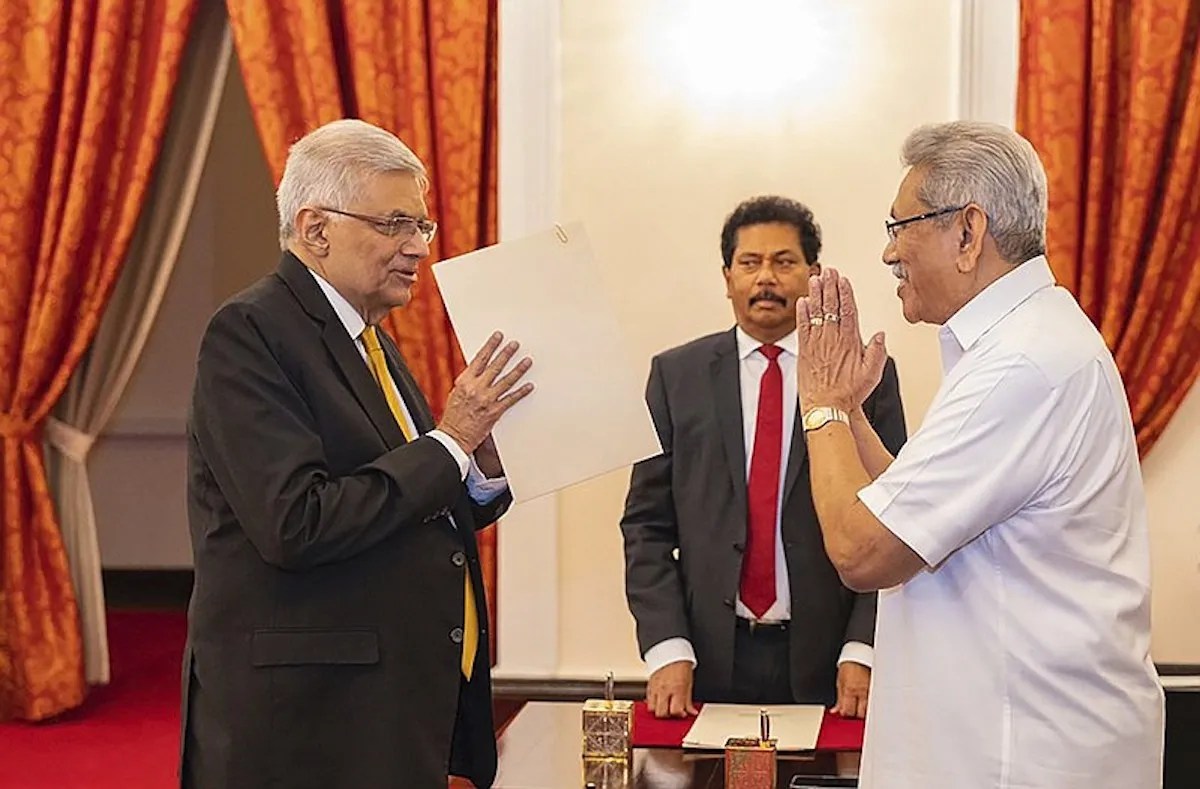
  Outgoing president Gotabaya Rajapaksa (right) greets Ranil Wickremesinghe during the latter’s oath-taking ceremony as the new leader in Colombo, Sri Lanka, in July 2022. Photo: Sri Lankan President’s Office

Continue reading

1 Comment

Filed under accountability, american imperialism, authoritarian regimes, centre-periphery relations, disparagement, economic processes, governance, historical interpretation, IMF as monster, island economy, life stories, politIcal discourse, power politics, self-reflexivity, sri lankan society, taking the piss, transport and communications, world events & processes

Sri Lanka’s Debt Dependency Deepens with Changing Food Combinations

Darini Rajasingham-Senanayake, whose favoured title runs thus: “Lanka’s Vanishing Fish:  Corporate Capture and Import Dependency Deepen the Debt Trap” .… and has been presented at

A great transformation in food culture and nutrition is taking place in Sri Lanka following various exogenous economic shocks: The traditional, nutritious ‘rice and fish’ diet, common throughout coastal Asia is increasingly substituted with imported maize or corn-fed chicken, white wheat flour breads, instant noodles and processed food.

Continue reading

Leave a comment

Filed under accountability, cultural transmission, economic processes, education, governance, historical interpretation, island economy, landscape wondrous, life stories, politIcal discourse, self-reflexivity, sri lankan society, the imaginary and the real, transport and communications, trauma, welfare & philanthophy, world events & processes

Early Academic Endeavours: Michael Roberts & His D. Phil. Dissertation

Michael Roberts

Rather out of the blue, Avishka Mario Seneviratne approached me seeking access to my first academic work , viz., the D. Phil. dissertation in History that I had secured in Oxford in mid-1965. I have a copy and it is possible there is one at Peradeniya University Library, but it is not widely available.

Mario   

 Milos


Continue reading

3 Comments

Filed under accountability, architects & architecture, art & allure bewitching, British colonialism, centre-periphery relations, cultural transmission, economic processes, education, heritage, historical interpretation, island economy, land policies, life stories, politIcal discourse, power politics, sri lankan society, teaching profession, transport and communications, unusual people, world events & processes

Extending Sri Lanka’s Ties with Türkiye

Uditha Devapriya

The Sri Lankan government has tasked the Lakshman Kadirgamar Institute to conduct a review of the country’s foreign relations. While officials have not yet come out with details, the review is set to include a reconsideration of Sri Lanka’s ties with various countries, in light of recent international developments. The Executive Director of the LKI, Dr D. L. Mendis, has emphasised the need for a more robust foreign policy, observing that while “Sri Lanka comes first”, relations with the region, “especially India”, will have to be “a bit better.” In other words, while maintaining the country’s tradition of being a friend to all, it must prioritise its relations with its neighbourhood.           

  Ambassador Demet Sekerciglu                                                                 


Continue reading

Leave a comment

Filed under economic processes, governance, historical interpretation, island economy, Middle Eastern Politics, politIcal discourse, self-reflexivity, transport and communications, world events & processes

Richard Simon’s Adamantine Moral Stance from the Clouds

Michael Roberts

In admonishing me in an email letter written as a friend concerned for my welfare (on Sunday 23rd October 2022), Richard Simon wrapped my knuckles. The best way of presenting his lines of thought is by presenting his letter in full (presented below at the end). While undoubtedly well-meaning, the pontifical moral tone is quite evident. This thread has alienated me totally and firmly.

Richard’s belief that I have been scammed and that the Thuppahi site may also be infiltrated is simply ridiculous. His reasoning here suggests a location in never-neverland.


Continue reading

2 Comments

Filed under accountability, authoritarian regimes, China and Chinese influences, communal relations, disparagement, ethnicity, governance, historical interpretation, Indian Ocean politics, island economy, landscape wondrous, life stories, modernity & modernization, politIcal discourse, power politics, self-reflexivity, sri lankan society, taking the piss, the imaginary and the real, transport and communications, truth as casualty of war, world events & processes

Reading China’s Programmes in the World Today: A Bout between Sri Lankans

Michael Roberts

In a recent email message, a good friend of mine residing in Sri Lanka, Richard Simon, contended that he was “particularly concerned to open Facebook this morning and find two posts sharing Thuppahi articles.” One of these references was to the item “Is Sri Lanka Creating a Dungeon for Itself?


Continue reading

Leave a comment

Filed under accountability, american imperialism, authoritarian regimes, China and Chinese influences, disparagement, economic processes, foreign policy, governance, historical interpretation, human rights, Indian Ocean politics, law of armed conflict, military strategy, modernity & modernization, Pacific Ocean politics, politIcal discourse, power politics, the imaginary and the real, transport and communications, truth as casualty of war, world affairs, world events & processes