
Category Archives: sri lankan society

Island-hopping: from Lanka to Cocos to Christmas and thence to Manus perhaps

sl -asylum-seekers-colin murty Sri  Lankan asylum-seekers arrive at Christmas Island airport after being flown from the Cocos  Islands yesterday. Picture: Colin Murty  Source: The Australian… ALSO SEE Rowan Callick: “Airlift to Manus swings into action,”  http://www.theaustralian.com.au/national-affairs/election-2013/airlift-to-extend-manus-swings-into-action/story-fn9qr68y-1226687190919 AND

Kamal Wickremasinghe, “Bogus refugees are making waves in Australia,” Daily News, 29 July 2013, http://www.dailynews.lk/?q=features/bogus-refugees-are-making-waves-australia
Leave a comment

Filed under asylum-seekers, australian media, authoritarian regimes, life stories, people smugglers, politIcal discourse, pulling the leg, Sinhala-Tamil Relations, slanted reportage, sri lankan society, Tamil migration, tolerance, truth as casualty of war, unusual people, world events & processes

Profound sorrow. Selvamalar and Balamanokaran lose their son at sea off Java

Paul Toohey & Ashley Mullany, in The Advertiser, Sunday, 28 July with title as I just want my baby boy back”

About 1000 asylum seekers have died trying to get to Australia illegally by boat since the Labor Government was elected. The Sunday Times was on the scene in the immediate aftermath of the latest boat tragedy this week and, in a common but rarely captured story, can tell why one woman took an extraordinary risk to reach her husband in Perth and suffered the most painful loss of all. Special report by Paul Toohey in Java and Ashlee Mullany in Perth.

SelvakumarSHE was sold a cruel lie by the people smugglers. He will never meet his son. She was told she would travel on a luxury ocean liner from Indonesia to Australia. They showed her photos of the ship that would transport her, her beautiful son and her brother to their new life in Australia. It was a superb vessel, with three storeys of cabins. “I believed them,” she said. Continue reading

Leave a comment

Filed under asylum-seekers, Australian culture, australian media, historical interpretation, immigration, life stories, people smugglers, politIcal discourse, slanted reportage, sri lankan society, Tamil migration, tamil refugees, women in ethnic conflcits, world events & processes

A grieving Tamil couple … and credulous Australians

Michael Roberts

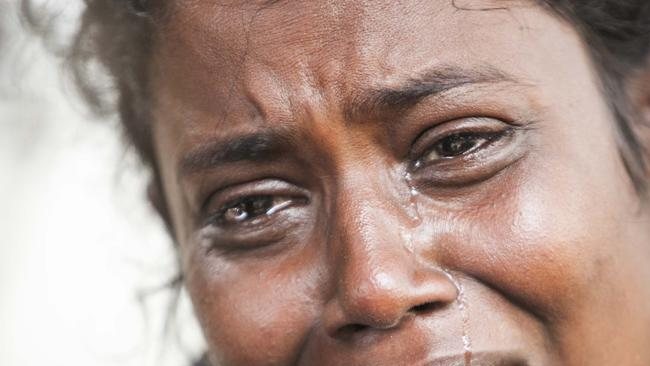
The headline picture in The Australian was — and remains — gut-wrenching, harrowing. It is a tale of searing suffering: a  young Sri Lankan Tamil couple have just lost their ten-month old infant after a boat with asylum seekers that had set off from Java sank off shore. Take Peter Alford’s story filed from Java yesterday.
  • TAMIL COUPLE
    Hard line unheard or unheeded by asylum-seekers

    The Australian·20 hours ago   

    A baby boy and a 10-year-old girl are believed to be among the dead after an asylum boat sank off Java. THE asylum-seekers from the latest sinking tragedy….

The two are Antony Jayaseelan and Rose Anu Resana, Tamils of Catholic background. They were among the 204 people on board on a boat that had left Cidaun in Java on Tuesday and then floundered in the sea, leaving 44 missing and 4 confirmed dead. It would seem that these asylum-seekers were not aware of the new Rudd-government’s hardline policy. Said Jayaseelan: “We didn’t know but even if we did know we could not stay in Sri Lanka.” Continue reading

2 Comments

Filed under asylum-seekers, Australian culture, australian media, cultural transmission, economic processes, ethnicity, historical interpretation, immigration, Indian Ocean politics, island economy, legal issues, life stories, people smugglers, politIcal discourse, Sinhala-Tamil Relations, slanted reportage, sri lankan society, Tamil migration, truth as casualty of war

Black July 83: Two Statements in The NATION

I: Editorial: “Black July 83 never again,” 21 July 2013

Remember Black July ’83’ is a print-ad campaign designed by the advertising agency JWT for the Centre for Policy Alternatives (CPA), a controversial NGO that has come in for a lot of flak from multiple quarters on grounds of financial dishonesty and aiding and abetting separatism.  ‘Never to repeat’ is the payoff line.  The campaign is to be launched shortly, The Nation learns. ‘Black July’ is remembered and remembered differently and for varying purposes by those who remember.  Whatever these differences may be there is commonality in agreement on one thing: it should never happen again.

14b--By midnight Borella town became a place where devils reign. A Scene in Borella–Pic from Victor Ivan

There’s nothing to say that ‘Black July’ will not recur.  There’s nothing to say that it must.  On the other hand, if it is not to happen again, it is important to remember what happened.  It is important to acknowledge that it inflicted a deep wound on the nation, the people who make it, their collective and individual memory; a wound that has bled into many other lacerations.  This has been a common view expressed by many across the political spectrum. Continue reading

2 Comments

Filed under accountability, JVP, life stories, LTTE, nationalism, political demonstrations, politIcal discourse, power politics, racist thinking, riots and pogroms, self-reflexivity, Sinhala-Tamil Relations, sri lankan society, Tamil civilians, terrorism, trauma, violence of language

Black Memories: July 1983

GROUNDVIEWS, 18 July 2013

In August this year, Groundviews will launch a compelling collection of content to commemorate 30 years since Black July. The content will feature original podcasts, photography and writing on a dedicated website. Building from the critically acclaimed Moving Images two years ago, Groundviews brought together leading documentary filmmakers, photographers, activists, theorists and designers, in Sri Lanka and abroad, to focus on just how deeply the anti-Tamil pogrom in 1983 has shaped our imagination, lives, society and polity.

black july --GV Photo by Natalie Soysa, for Groundviews

The resulting content, featuring voices never captured before, marrying  rich photography, video, audio and visual design with constitutional theory, story-telling and memorialising, has no historical precedent. Curated by Groundviews, the project is an attempt to use digital media and compelling design to remember the inconvenient, and in no small way, acts of daring, courage and resistance during and after Black July. Continue reading

3 Comments

Filed under accountability, communal relations, education, ethnicity, historical interpretation, life stories, nationalism, politIcal discourse, power politics, racist thinking, riots and pogroms, sri lankan society, trauma, unusual people, women in ethnic conflcits, zealotry

A Classical Appreciation for a Classical Cricketing Man

Andrew Fernando, courtesy of ESPNcricinfo

Sanga at MCC

Cricketers are sometimes labeled ‘great students of the game’. Often these students are men who distinguish themselves from the peloton of cricket’s sporty jocks by a yearning to learn more about the history and the nuances of the pursuit that consumes their lives.

When he first began playing for Lancashire, Muttiah Muralitharan was said to have had a more thorough knowledge of the team’s previous season than many of the cricketers who had played in those matches. Part of why Michael Hussey’s ‘Mr. Cricket’ moniker endured was because he would speak for hours on end about the game, in what seemed like laborious detail to his teammates. In his years as Australia captain, Ricky Ponting was found perusing grade cricket scorecards from around the country. All men, whose livelihoods had happily aligned with their life’s most ardent passion. Continue reading

Leave a comment

Filed under life stories, performance, sri lankan society, unusual people

Vijitha Yapa: Journalist, Editor, Bookseller, Publisher

Ishara Jayawardane, courtesy of The Daily News, 22 January 2013

YAPAFrom the most humble of beginnings ending up as one of the most influential people in Sri Lanka, Vijitha Yapa’s is a success story. He has been a leading journalist and editor and is now a publisher. Vijitha Yapa is a well known name in Sri Lanka being the Founder, Chairman, and Managing Director of the largest English bookstore chain in the country. Reminiscences of Gold spoke to Vijitha Yapa about his life experiences and achievements.  “I was born in a small village called ‘Waralla’ which is in the Southern Province; a little village between Kotapala and Morawaka on the Akursssa-Deniyaya road. My father was a tea planter and he was also Chairman of the Village Council. One of the things that he insisted was that we all go to school in the village and that is an experience I treasure very much. He had 10 children and all of us went to this school and the early part of our childhood was spent there. The whole school had only one building and all the classes were held there. We had long desks and benches and next to me was a boy whose father was the peon in my father’s office. It gave us a tremendous introduction to life and an ability to understand people. My father said that we should never forget our roots in the village. Continue reading

1 Comment

Filed under cultural transmission, heritage, life stories, literary achievements, performance, sri lankan society, unusual people

Thugs who roam the internet

Quotation of the month from Padraig Colman within a subsection entitled ‘Moderation in All Things”

PADRAIG However, most reputable websites have a moderation policy which forbids author abuse, obscene or offensive language and off-topic discussions. Only extreme libertarians would object to a website policing itself to eliminate hate speech that stirs up racial animosities. Whether a comment falls into any of those categories is determined by editorial judgement. Where do you draw the line between moderating and censorship?

The price paid for freedom of speech is that gangs of thugs, whose malevolence towards their fellow human beings is pathological, pseudonymously prowl the precincts of the internet. The people who moderate do not always  know the difference and are, allegedly, sometimes part of the gangs. Someone has privately suggested to me that many of the pseudonymous trolls are actually fakes manufactured by the editors to drum up interest.  An analysis of the UK Guardian’s on-line community by digital consultant Martin Belam suggests that debate is dominated by a tiny minority. (He estimated that a fifth of comments were left by just 0.0037% of the paper’s declared monthly audience.) Continue reading

Leave a comment

Filed under accountability, historical interpretation, life stories, LTTE, news fabrication, politIcal discourse, Sinhala-Tamil Relations, sri lankan society, terrorism, tolerance, unusual people, world events & processes, zealotry

In search of indigenous artists

R. K. de Silva, courtesy of Art Sri Lanka

Most of the indigenous artists appears to have been restricted to temple murals and drawings on cloth, such as flags and banners.  Of the few of these artists who painted in the water colour medium, the traditions of temple art have been maintained, the colours being generally confined to white, red, yellow, black and more rarely, blue.  The lack of perspective is also very evident. Ananda Commaraswamy in his erudite work “Mediaeval Sinhalese Art” says that there are no drawings on Sinhalese paper, which was very coarse and rough.  The only drawings and manuscripts which have been preserved, are on Dutch, and late, English paper. Coomaraswamy mentions that he was acquainted with only two paper manuscripts, one written on 158 leaves of Dutch paper and containing a selection of discourses of the Buddha and said to have been used by King Narendra Singha as a prayer book, another, on 150 leaves, written in 1811 by Iruyagama Dharmadassi and affording and interesting side-light into Kandyan court life.Both these books are illustrated, the painting being typical examples of the Kandyan style of the 18th century. Continue reading

2 Comments

Filed under cultural transmission, heritage, historical interpretation, life stories, sri lankan society, world affairs

The Colombo Chetties of Sri Lanka : Three Essays

I. The Colombo Chetties of Sri Lanka by Shirley Pulle Tissera

The Colombo Chetties form an integral part of Sri Lankan society. They are a separate ethnic group different from the Tamils, Moors, Malays, Burghers, and the majority Sinhalese community. In the census of 1946 (Vol I Para I) the Superintendent of Census, Mr. A.G. Ranasinghe, states that the Colombo Chetties must receive mention in a racial distinction of Ceylon. The term does not include the Nattukottu Chetties who have formed themselves into a guild for carrying on business in Ceylon and are only temporary residents of the Island.

3b-C'bo Chetty -- SylvafColombo Chetty –a representation painted by Hippolyte Silvaf  in the 1840s or so ** Continue reading

12 Comments

Filed under ethnicity, heritage, historical interpretation, life stories, sri lankan society, world affairs