Category Archives: rehabilitation

The Ethnic Abyss in Sri Lanka Still Remains

Dr S.  I. Keethaponcalan,in where  the title reads Sri Lanka’s Ethnic Conflict: From Reconciliation To Reescalation – Analysis,” … pubd on 21 September 2023 at EURASIA REVIEW ++

The national discourse in Sri Lanka moved from conflict termination to reconciliation with the end of the war in 2009. This essay argues that the concerned parties should shift the discourse from reconciliation to de-escalation because (1) the reconciliation project failed, and (2) the ethnic conflict shows signs of reescalation. It also argues that the possibility of anti-Tamil riots in the future cannot be dismissed.

               Reconciliation Failed

When the war ended in 2009, domestically, none of the parties were interested in reconciliation. The Tamils had more severe problems to deal with. For example, mourning their dead, finding disappeared members of their families, and resettling the internally displaced community members were some of the immediate issues the Tamil community encountered. Reconciling with the Sinhalese was the last thought in their minds. Therefore, they were not concerned about postwar reconciliation. None of the Tamil leaders discussed the need to promote reconciliation.

Continue reading

1 Comment

Filed under accountability, centre-periphery relations, communal relations, discrimination, disparagement, doctoring evidence, ethnicity, governance, historical interpretation, human rights, IDP camps, life stories, LTTE, NGOs, politIcal discourse, propaganda, refugees, rehabilitation, self-reflexivity, Sinhala-Tamil Relations, slanted reportage, sri lankan society, Tamil civilians, tamil refugees, Tamil Tiger fighters, trauma, truth as casualty of war, war reportage, world events & processes

Yasodara Kumaratunga’s Inventive Mind: Free Verse from London

Michael Roberts in Adelaide, August 2025

Among a small pile of photgrpahs, letters and papers left by my departed elder sister, Estelle Fernando, is a printed ‘pamphlet’ published by Yasodhara  Kumaratunga, the  eldest daughter of Vijaya Kumaratunga and Chandrika Bandaranaike.

It presents thirteen brief  poems coined by Yasodhara when she was “in exile in  London” — as  the Foreword by an unknown person  tells us. These were “written by Yasodhara between the ages  of 8 plus 1/2 years – 11 years” during a period when she  was beginning to learn English after an education in Sinhala.”

Continue reading

Leave a comment

Filed under accountability, asylum-seekers, communal relations, cultural transmission, heritage, historical interpretation, landscape wondrous, lettering--history, life stories, martyrdom, meditations, patriotism, performance, pilgrimages, politIcal discourse, rehabilitation, self-reflexivity, social justice, sri lankan society, trauma, travelogue, unusual people

Facing A Tsunami & A Civil War

Dennis  M. McGilvray, in an  article  pubd in 2006 in the India Review, vol. 5, nos. 3–4, July/October, 2006, pp. 372–393 Copyright © Taylor & Francis Group, LLC  …. ISSN 1473-6489 print; 1557-3036 online DOI:10.1080/14736480600939132 … one bearing this title:  “Tsunami and Civil War in Sri Lanka: An Anthropologist Confronts the Real World

Recent calls for a new “public anthropology” to promote greater visibility for ethnographic research in the eyes of the press and the general public, and to bolster the courage of anthropologists to address urgent issues of the day, are laudable although probably also too hopeful. Yet, while public anthropology could certainly be more salient in American life, it already exists in parts of the world such as Sri Lanka where social change, ethnic conflict, and natural catastrophe have unavoidably altered the local context of ethnographic fieldwork. Much of the anthropology of Sri Lanka in the last three decades would have to count as “public” scholarship, because it has been forced to address the contemporary realities of labor migration, religious politics, the global economy, and the rise of violent ethno-nationalist movements. As a long-term observer of the Tamil-speaking Hindu and Muslim communities in Sri Lanka’s eastern coastal region, I have always been attracted to the classic anthropological issues of caste, popular religion, and matrilineal kinship. However, in the wake of the civil wars for Tamil Eelam and the 2004 tsunami disaster, I have been forced to confront (somewhat uneasily) a fundamentally altered field- work situation. This gives my current work a stronger flavor of public anthropology, while providing an opportunity for me to trace older matrilocal family patterns and Hindu-Muslim religious traditions under radically changed conditions.

 BEACHFRONT HOME DESTROYED BY TSUNAMI, MARUTHAMUNAI. AUGUST 2005

Continue reading

Leave a comment

Filed under accountability, atrocities, authoritarian regimes, centre-periphery relations, charitable outreach, communal relations, counter-insurgency, demography, disaster relief team, economic processes, Eelam, ethnicity, governance, historical interpretation, human rights, insurrections, island economy, landscape wondrous, life stories, LTTE, military strategy, Muslims in Lanka, politIcal discourse, racist thinking, rehabilitation, religiosity, security, self-reflexivity, Sinhala-Tamil Relations, sri lankan society, Tamil civilians, the imaginary and the real, the tsunami 2004, transport and communications, truth as casualty of war, voluntary workers, war crimes, war reportage, welfare & philanthophy, world events & processes

Financial Restraint: Sri Lankan Government’s Initial Measures Applauded

Jehan Perera  

The government’s commitment to cut down on waste and corruption so that resources can be saved and added to enable economic growth can be seen in the strict discipline it has been following where expenditures on its members are concerned. There is a need, however, for new and innovative development projects that require knowledge and expertise that is not necessarily within the government. So far it appears that the government is restricting its selection of key decision makers to those it knows, has worked with and trusts due to long association. Two of the committees that the government has recently appointed, the Clean Lanka task force and the Tourism advisory committee are composed of nearly all men, and men from the majority community. If Sri Lanka is to leverage its full potential, the government must embrace a more inclusive approach that incorporates women and diverse others from across the country’s multiethnic and multireligious population, including representation from the north and east.

Younger Srilanka _ The winning combination – AKD & Dr. Harini. Sri Lanka gets a new leadership! ❤️_🔥🇱🇰 _ Instagram

Continue reading

Leave a comment

Filed under accountability, citizen journalism, debt restructuring, economic processes, governance, historical interpretation, island economy, legal issues, life stories, modernity & modernization, patriotism, performance, politIcal discourse, rehabilitation, self-reflexivity, social justice, sri lankan society, welfare & philanthophy

Meeting Professor Hilali Noordeen in Galle via Karen Roberts

Michael Roberts

In late 2003 or early 2004 I was privileged to receive an invitation from Nazreen Sansoni of Barefoot to participate in the Galle Literary festival where the central events took place within the precincts of the Galle Fort — a familiar spot replete with memories of my childhood and youthful experiences.

Dr Hilali Noordeen

Karen Roberts

As it happened one of the literary stars featuring in the manifold ‘events” of the GL Festival was Karen Roberts, whose background and literary work was known to me. She was, I stress, no relation, though she had been educated in a school in Wellawatte that was a stone’s throw away from my sister Estelle Fernando’s abode in Hampden Lane Wellawatte.

Continue reading

1 Comment

Filed under art & allure bewitching, communal relations, cultural transmission, education, ethnicity, heritage, historical interpretation, island economy, landscape wondrous, life stories, literary achievements, medical marvels, meditations, patriotism, performance, rehabilitation, self-reflexivity, sri lankan society, teaching profession, unusual people, world events & processes

A Poignant Tale … “I Am Not Lighting A Candle Today”

Buddhika Dassanayake, …. reflections presented on 26th December 2006

Its been two years since a friend called one morning, as we were studying for exams, to ask why lamp-posts were shaking. Two years since another friend called from Galle Hospital; tired, depressed, fiercely determined to see things through, utterly helpless. Two years since we heard that Tharini was missing; that the place we stayed at the last time we visited Unawatuna had disappeared along with the occupants.


Murali , Mahela & Kumar at a refugee camp on the east coast …having taken emergency supplies

Continue reading

Leave a comment

Filed under accountability, centre-periphery relations, charitable outreach, citizen journalism, communal relations, cultural transmission, ethnicity, heritage, historical interpretation, landscape wondrous, life stories, patriotism, performance, politIcal discourse, refugees, rehabilitation, self-reflexivity, Sinhala-Tamil Relations, sri lankan society, tolerance, trauma

The Tsunami Twenty Years After

Padraig O’Leary writing from the vicinity of Colombo now

Twenty Years after the Tsunami

Did the children and I come to you when the waves came?

Were the kids there with you when death came?

In eternity, do you want to be mine again?

Will you come back at least in my dreams?

Those words were written by a grieving husband on the side of a rusting railway carriage at Peraliya in southern Sri Lanka.


On 26 December 2004, 36,000 to 50,000 people (the numbers of dead vary depending on the source) died in Sri Lanka in the St Stephen’s Day tsunami. Between 1,700 and 2,500 passengers on the holiday train, Queen of the Sea, perished as the wave engulfed it at Peraliya, between Colombo and Galle. Rescuers recovered only 824 bodies, as many were swept out to sea or were taken away by relatives without informing the authorities. The village itself also suffered heavy losses: hundreds of inhabitants died and out of 420 houses, the great wave spared only ten.

Continue reading

3 Comments

Filed under accountability, demography, historical interpretation, life stories, meditations, patriotism, performance, population, rehabilitation, self-reflexivity, sri lankan society, the tsunami 2004, trauma, travelogue, world events & processes

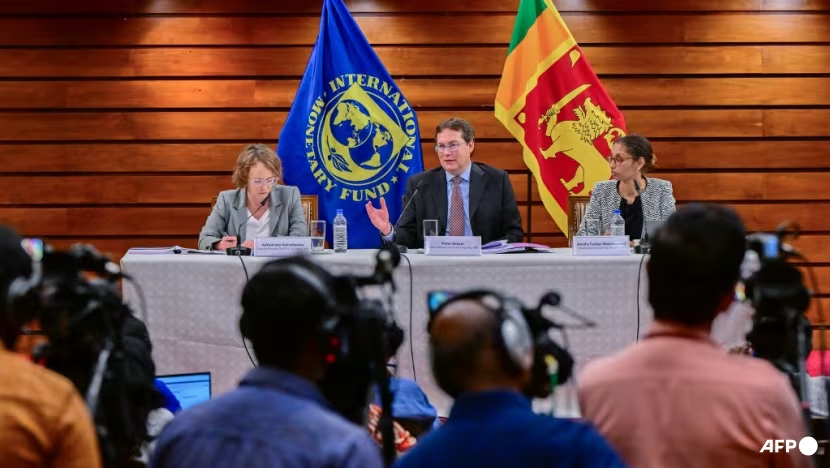
The IMF’s Vice-Like Grip on Sri Lanka’s Testicles … Continues

Darini Rajasingham-Senanayake, whose chosen title runs thus‘ ‘The IMF’s Remarkable Timing and a President’s Mandate for Debt Justice” …. with highlighting imposed by The Editor Thuppahi**

At Annual Meetings in Washington in October International Monetary Fund head, Kristalina Georgieva claimed Sri Lanka as a debt restructuring ‘success’ story.[i]  Left unsaid was that Sri Lanka’s external debt had apparently ballooned from $26 billion to a purported whopping $100 billion during two years of “reforms’ under the IMF’s Extended Fund Facility (EFF)![ii]

A month later, the island’s newly elected Cabinet led by President Anura Kumara Dissanayaka signed off on an official “bond exchange” with International Sovereign bondholders (ISB). The President had done a U-turn on election pledges to re-negotiate agreements with the IMF and ISB that were widely perceived to be detrimental to the county.

Continue reading

2 Comments

Filed under centre-periphery relations, commoditification, debt restructuring, economic processes, foreign policy, governance, IMF, IMF as monster, island economy, life stories, modernity & modernization, patriotism, performance, politIcal discourse, power politics, rehabilitation, self-reflexivity, sri lankan society, world affairs, world events & processes

A Reading of the Sri Lankan Elections from THE ECONOMIST

Item in The Economist, 23 Nov 2024: “Sri Lanka’s Left Turn: Sri Lanka’s president with Marxist roots now dominates parliament too” .… with highlighting emphasis imposed by the Editor, Thuppahi

SRI LANKA was once a pioneer of free-market capitalism in South Asia. After J.R. Jayewardene took power with a super-majority in 1977, he introduced a French-style executive presidency and economic reforms that overturned the left-wing orthodoxy of the previous two decades. Cheered on by Western governments concerned about Soviet influence, Sri Lanka became the first country in the region to liberalise its economy.

Continue reading

Leave a comment

Filed under accountability, centre-periphery relations, chauvinism, debt restructuring, economic processes, export issues, foreign policy, governance, IMF, Indian Ocean politics, island economy, Left politics, legal issues, life stories, parliamentary elections, patriotism, performance, politIcal discourse, power politics, rehabilitation, security, self-reflexivity, sri lankan society, working class conditions, world affairs, world events & processes

Gerald Peiris: A Lifetime of Wide-Ranging Research & Service

These are but some of his publications over a career spanning the 1950s to 2020s — with eyesight deterioration blighting his last platform of life. No more table tennis, but much to remember. So, here. let me doff my cap to thee, Gerry Machang, …. Mike

Continue reading

2 Comments

Filed under art & allure bewitching, centre-periphery relations, commoditification, communal relations, counter-insurgency, cultural transmission, democratic measures, demography, devolution, economic processes, Eelam, electoral structures, ethnicity, governance, growth pole, heritage, historical interpretation, Indian Ocean politics, insurrections, irrigation, island economy, land policies, landscape wondrous, language policies, law of armed conflict, legal issues, life stories, LTTE, military strategy, modernity & modernization, Muslims in Lanka, nationalism, parliamentary elections, patriotism, politIcal discourse, population, power politics, power sharing, prabhakaran, rehabilitation, security, self-reflexivity, Sinhala-Tamil Relations, social justice, sri lankan society, Tamil civilians, tamil refugees, Tamil Tiger fighters, teaching profession, terrorism, transport and communications, truth as casualty of war, UN reports, unusual people, war crimes, war reportage, welfare & philanthophy, working class conditions, world events & processes, zealotry