Category Archives: politIcal discourse

Hobson’s Choice in Lanka …. The Same Again Manikey! Kota Uda!

Capt. Elmo Jayawardena, whose preferred ttile is “Hobson’s or “Homben Yana” Choice?” 

Way back in the 16th century there lived a man in Cambridge by the name of Thomas Hobson.

He rented and sold horses and was the proud owner of a stable that had 40 stallions of all colours and breeds. Anyone who wanted to rent a horse from him to ride the paddock or journey into the far horizon, paid money and got a horse. There was one condition, the renter was not allowed to select the horse. The ‘wanna be’ rider had only one choice. He had to take the horse that was in the stall nearest to the door. It was a simple matter of either ‘take it or leave it.’  When the word spread about this, it became known among possible horse renters that what they got was ‘Hobson’s Choice’.

Continue reading

Leave a comment

Filed under accountability, coronavirus, disparagement, economic processes, island economy, life stories, meditations, politIcal discourse, sri lankan society, the imaginary and the real, trauma, working class conditions

Addressing History: Sri Lankan Identities over Time

HistoricalDialogue.lk

Dear Friends of HistoricalDialogue.lk, …. We’re happy to announce the launch of our new podcast series, ‘Witnesses to History’. Hosted by Smriti Daniel, the tri-part series is now live on our website and takes you on a journey through Sri Lanka’s history as living memories. Listen to the first episode ‘Holders of History’ which gives an insight into our shared understanding of identity and our shared past – Episode 01 ( 28 mins). Follow the link to also view some exciting bonus material that is archived on the page.

Continue reading

Leave a comment

Filed under accountability, cultural transmission, democratic measures, female empowerment, heritage, historical interpretation, life stories, literary achievements, meditations, performance, politIcal discourse, sri lankan society, travelogue, truth as casualty of war, unusual people, welfare & philanthophy, world events & processes

Dry Zone Peasantry and Chēna Transformations in Sri Lanka

Gerald Peiris [i]

Chēna is an anglicized rendition of the Sinhala term hēna. Chēna cultivation is widely regarded as being equivalent to ‘shifting cultivation’ which is described as a form of agriculture engaged in by people living in sparsely populated areas with easy access to scrubland or forest that could be used as venues for rainfed farming which may, depending on circumstances, constitute their only, main, or supplementary source of livelihood. In conventional perceptions, moreover, ‘shifting cultivation’ is a subsistence-oriented economic activity of poverty-stricken peasant communities. It should, however, be noted that in most parts of Sri Lanka, the term hēna connotes a plot of land devoted to rainfed cropping, regardless of whether the farming practices pursued on the plot involves “slash-and-burn” and/or “land rotation”.

  Precipitation & Irrigation Map of Lanka — https://en.wikipedia.org/wiki/Geography_of_Sri_Lanka

Continue reading

3 Comments

Filed under British colonialism, centre-periphery relations, commoditification, economic processes, heritage, historical interpretation, island economy, land policies, landscape wondrous, life stories, politIcal discourse, self-reflexivity, sri lankan society, travelogue, unusual people, welfare & philanthophy, world events & processes

Leonard Woolf’s Weliwewa Terrain: Gerald Peiris’s Profound Expertise 

Michael Roberts

I have sustained a friendship and interacted with Gerald Peiris from Ramanathan Hall days at Peradeniya University beginning in July 1957. The formal discussions organised at the Ceylon Studies Seminar from 1968-1975 on the one hand and, on the other, casual, but occasionally dynamic, conversations at the Senior Common Room or the Campus Pub in those halcyon years deepened our cooperation …. and continually sharpened my brains.

Continue reading

1 Comment

Filed under accountability, British colonialism, centre-periphery relations, cultural transmission, economic processes, heritage, historical interpretation, island economy, landscape wondrous, life stories, modernity & modernization, politIcal discourse, self-reflexivity, sri lankan society, travelogue, unusual people, welfare & philanthophy, working class conditions, world events & processes

Captain Cook Symbolically Demolished in Canada

A Pseudo-Filipino named “Sir” Roger O’Neil

I can well understand why some Canadians knocked Captain Cook’s statue of its perch into a harbour in British Columbia.  

The only reason the Canadian PM has given a token apology about colonial crimes against indigenous peoples in Canada is because Canada has just been caught with its hands in the cookie jar with the discovery of mass graves. The Canadian government pursued a genocidal policy against indigenous peoples for 150 years — depriving them of language, forbidding the use of their indigenous birth names, medical neglect, sexual abuse, to name a few of their crimes. The government knew of it and were responsible for it for 150 years.

Continue reading

Leave a comment

Filed under atrocities, authoritarian regimes, British colonialism, centre-periphery relations, cultural transmission, disparagement, economic processes, education, ethnicity, heritage, landscape wondrous, Left politics, legal issues, life stories, meditations, performance, political demonstrations, politIcal discourse, power politics, racist thinking, self-reflexivity, social justice, the imaginary and the real, trauma, unusual people, vengeance, working class conditions, world events & processes, zealotry

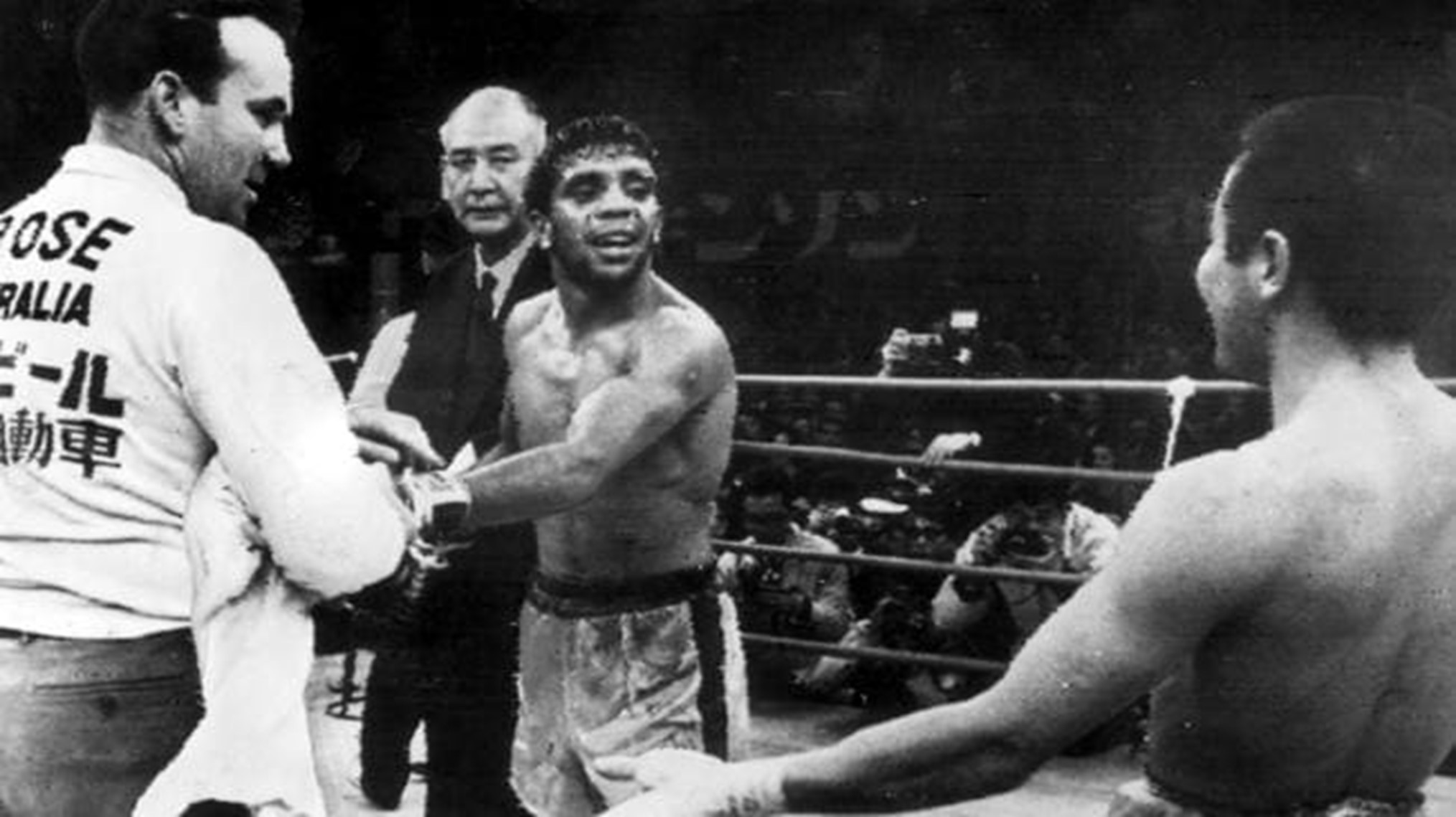
Lionel Rose: Aboriginal Boxer who united Australia

Will Swanton, in The Weekend Australian, 3-4 July 2021, where the title runs “Lionel Rose: battler who united Australia” 

Lionel Rose unified the nation more powerfully than Bradman, if more briefly — Bradman never had 250,000 cheering him through the streets.

Lionel Rose turns to embrace Fighting Harada … after he is pronounced the winner 

Lionel Rose met Paul Keating. Snipped him for a hundred. The Prime Minister reckoned he never carried any cash. Rose persisted. Did him slowly. Come on, mate. Can’t you spare a lousy hundred for a battler? Larrikinism abounded in Australia’s sporting stars of the 1960s and 1970s. Rose, Dawn Fraser, John Newcombe, larger than-life characters. It was the 1990s by the time Rose hit Keating where it hurt. The hip-pocket. Mischievousness was alive and kicking in Rose, and part of the reason for the request, but he needed the dough, too.

Continue reading

2 Comments

Filed under accountability, art & allure bewitching, Australian culture, australian media, communal relations, cultural transmission, democratic measures, discrimination, economic processes, education, ethnicity, heritage, historical interpretation, landscape wondrous, life stories, patriotism, performance, politIcal discourse, self-reflexivity, social justice, the imaginary and the real, unusual people, world events & processes

Today’s Far Right League of Nations

Eviane Leidig,  in  Foreign Policy, 20 January 2020, where the title reads “The Far-Right Is Going Global”

An unofficial visit by nationalist European leaders to Kashmir highlights the solidarity of far-right movements across the globe. In October 2019, 23 members of the European Parliament (MEPs) visited Kashmir, just two months after the Indian government removed the region’s special autonomous status. The trip sparked controversy when it was revealed that most of the MEPs belonged to far-right political parties, including France’s National Rally (formerly National Front) and Germany’s Alternative für Deutschland (AfD). It wasn’t just the affiliations of these visitors that drew attention: The MEPs had been granted access to Kashmir even as foreign journalists and domestic politicians were barred access to the region, and the Indian-administered government had imposed an internet shutdown since August.

Continue reading

Leave a comment

Filed under authoritarian regimes, centre-periphery relations, communal relations, economic processes, foreign policy, governance, historical interpretation, human rights, Indian Ocean politics, Indian religions, nationalism, politIcal discourse, power politics, truth as casualty of war, world events & processes

Origins of Sri Lankan Nationalism

Upali C Wickremeratne, presenting a critical review of  Sinhala Consciousness in the Kandyan Period: 1590s to 1815, by Michael Roberts, (Colombo, Vijitha Yapa Publications, 2003)…. originally presented in Ethnic Studies Review, vol. XXI,  No. 2, July 2003, pp. 207-20…. with pictorials imposed by Roberts against the grain of this article. NOTE: the title is that chosen by Wickremeratne … and is in fact a misnomer.

It is hard to think of a book, amongst those written by those affecting to be scholarly, which is based more on conjecture than this. The criteria for evidence should be considered. It is not a question of whether the sources are oral or documentary.  After all the evidence in a law court is mainly oral.  It is a question of considering the arguments for and against any particular point of view.  It is a question of weighing the evidence. A civil case is decided on a balance of probabilities and a criminal case on whether there is a reasonable doubt.  It is not a question of facts or the truth. Law draws a distinction between hearsay, opinion and evidence based on cross-examination.  Collingwood wanted an army of questions led into the sources. They would enable one’s own biases and predilections to be questioned.  It would supply the place of cross-examination.

Continue reading

Leave a comment

Filed under accountability, British colonialism, cultural transmission, ethnicity, historical interpretation, Indian traditions, insurrections, Kandyan kingdom, landscape wondrous, life stories, nationalism, patriotism, politIcal discourse, Portuguese imperialism, Portuguese in Indian Ocean, power politics, sri lankan society, transport and communications, unusual people, vengeance, violence of language, world events & processes

The Sri Lankan Tamil Hands within USA’s Programme for Sri Lanka

Daya Gamage

 US Official Robert Blake with Reps of Tamil Diaspora

EMAIL NOTE from Gamage, 1 July 2021:  Cooperation between some U.S. State Department officials and members of the Tamil Diaspora has been truly extraordinary. The U.S. Embassy in Colombo was very open in its reporting to Washington that the Tamil Diaspora in the U.S. had long “been a source of funding and hard-line support for the LTTE.”[1] At the same time, two months before the defeat of the LTTE, U.S. Ambassador to Colombo Robert Blake was recommending that the USG strengthen its official dialogue with several U.S.-based Diaspora organizations with which the embassy had established a rapport through “almost daily” email communications. In a cable on March 19, 2009, the embassy argued that:

“Recognizing the difficulty of engagement, Post recommends a redoubled effort to reach out to Tamil groups in the U.S. A number of organizations, including Tamils for Justice, Tamils for Obama, and PEARL, remain active politically, and opportunities to interact with them should be sought. . .” Ambassador would welcome opportunities, either in combination with senior State Department officials or just with Colombo diplomatic Mission staff, to meet and converse with the U.S.-based Diaspora through DVD.  Such meetings would allow U.S. Embassy to brief the groups on USG efforts to alleviate the humanitarian suffering of the civilian population in the safe zone and U.S. actions urging the government to offer credible political proposals for lasting peace.

Continue reading

Leave a comment

Filed under accountability, american imperialism, centre-periphery relations, communal relations, discrimination, ethnicity, foreign policy, governance, historical interpretation, Indian Ocean politics, legal issues, life stories, LTTE, military strategy, nationalism, politIcal discourse, power politics, Rajapaksa regime, security, self-reflexivity, Sinhala-Tamil Relations, sri lankan society, Tamil civilians, Tamil migration, tamil refugees, truth as casualty of war, unusual people, vengeance, war reportage, world events & processes

Lessons Derived from the Anti-Muslim Riots of 1915 …. For Today

Walter Wuthmann, in Daily News, 7 May 2018, where the title runs: “Revisiting 1915: Lessons from A Violent Past”

The recent mob attacks[ against Muslim families and property in Kandy is another sad chapter in Sri Lanka’s history of ethnic violence. Now, many are re-examining the past, looking for reasons for why this ugly strain of communalism will not subside, and for ways to fight it for the future. Because before Digana in March, and before Aluthgama in 2014, there was 1915.

  An old photo of the Mosqueat Castele Street inKandy where the initial spark for the “1915 riots”originated

Continue reading

Leave a comment

Filed under atrocities, British colonialism, Buddhism, centre-periphery relations, chauvinism, communal relations, conspiracies, cultural transmission, discrimination, disparagement, economic processes, ethnicity, fundamentalism, historical interpretation, Islamic fundamentalism, island economy, landscape wondrous, legal issues, life stories, news fabrication, politIcal discourse, power politics, self-reflexivity, sri lankan society, the imaginary and the real, trauma, truth as casualty of war, unusual people, vengeance, violence of language, working class conditions, world events & processes