Category Archives: photography

Nostalgic Pictorial Excursions in and around My Galle Fort

Michael Roberts

I was born and bred in Galle Fort, living there in Pedlar Street and then in Middle Street in houses rented from Muslim moor landlords by my retired father, T. W. Roberts, of the CCS. I visit the place whenever I can and several pictures taken during the last ten years are inserted within this collection… with Images by Michael Roberts, where not otherwise specified

deft work -chain gang Dutch-style verandahs –here in a house being repaired with a chain gang transferring clusters of tiles –yes, tiles — Up-Catch-Shift-Place. Wow, efficient-Pic by Roberts Continue reading

1 Comment

Filed under cultural transmission, landscape wondrous, life stories, photography, the imaginary and the real, tourism, travelogue

A Pictorial Feast: Imaging the Isle Across … Vintage Photography from Ceylon

Alkazi Foundation of the Arts

The Archaeological Survey of India and National Museum in collaboration with Alkazi Foundation for the Arts is organizing an exhibition titled ‘Imaging the Isle Across:Vintage Photography from Ceylon’. Drawn exclusively from the Alkazi Collection of Photography, this exhibition is a collateral event of the Delhi Photo Festival, 2015;and will also be one of the events commemorating the 90th year of the art collector, Ebrahim Alkazi. The exhibition will showcase an overview of the early imagery from Sri Lanka for the very first time as part of an eclectic exhibition, showcasing vintage images from the late 19th and early 20th century.

2 The Kandy Perahära

10 Lordly planters & their minions Continue reading

1 Comment

Filed under British imperialism, cultural transmission, heritage, landscape wondrous, life stories, modernity & modernization, photography, plural society, sri lankan society, the imaginary and the real, transport and communications, travelogue, unusual people, world affairs

Nihal Fernando’s Odyssey in and with Sri Lanka: An Appreciation

Neville Weeraratne, in The Sunday Island, 26 April 2015
article_image

There is, on the title page of Nihal Fernando’s ‘Sri Lanka — A Personal Odyssey’ a photograph of a shadow of a man holding what must be a camera. It falls on a wide beach with a set of footprints leading to where the subject, Nihal Fernando himself stands. Beyond them and in the distance is a glimpse of the sea. This is an image that gently nudges me into recognizing Nihal himself, one of the finest men of our time, a great artist, a selfless devotee, his skills indisputable. I do not know who took the picture but it is surely an inspired gesture and helps to illustrate a confession Nihal made on another occasion, in the Prologue to his ‘The Wild, the Free, the Beautiful’: ” I do not choose my subjects, they chose me …” Continue reading

1 Comment

Filed under cultural transmission, heritage, landscape wondrous, life stories, literary achievements, photography, self-reflexivity, the imaginary and the real, unusual people

Sex and Serendipity in Lanka with Robert Aldrich’s New Book

Cultural Encounters and Homoeroticism in Sri Lanka: Sex and Serendipity has just appeared in print …. Published by Routledge, London, 2014.  Hardback and e-book, 234 pages.  (ISBN 978-0-415-74236-8)**

Sri Lanka was long known to travellers for its beautiful landscape, fascinating culture and unparalleled position at the crossroads of the Indian Ocean.  This book explores the sojourns of some of those who came to the island, those with a homosexual sensibility – figures such as the Victorian social reformer Edward Carpenter and the German naturalist Ernst Haeckel, the French dandies Count d’Adelswärd-Fersen and Count de Mauny, such American and British writers as Paul Bowles and Arthur C. Clarke, and the Australian painter and diarist Donald Friend.  The writings, art and other works of these figures showed, in addition to their fascination with Sri Lanka, a particular attraction to young Sri Lankan men, as models, companions, friends and occasionally as partners.  This homoerotic fascination was also reflected in the work of several Sri Lankans, notably in the photographs of Lionel Wendt.

Lionel Wendt Photo Continue reading

Leave a comment

Filed under cultural transmission, heritage, life stories, photography, self-reflexivity, sri lankan society, the imaginary and the real, travelogue, unusual people, world affairs

Photographs of Ceylon and the American Circus: The Oriental India Poster

Benita Stambler, The John and Mable Ringling Museum of Art, Sarasota, Florida, USA, benita.stambler@ringling.org

ORIENTAL INDIAOriental India, 1896, Strobridge Lithographing Company, Barnum & Bailey Circus, The Ringling Museum, Tibbals Collection, ht2004820.

My research on the photographs of Sri Lanka has taken an interesting turn lately that has provided new information about the American circus. For the last several years I have been trying to learn about the photographic record of Ceylon in the late nineteenth century. The John and Mable Ringling Museum of Art in Sarasota, Florida, where I work has, besides a growing collection of Asian art and its famous European Baroque art, a fabulous collection of posters, photographs and ephemera on the circus, important to the museum because of the Ringling family’s connection with the American circus. Continue reading

Leave a comment

Filed under British colonialism, cultural transmission, performance, photography, sri lankan society, the imaginary and the real, world affairs

The Call of Galle and Its Environs: A Flock of Foreigners

Avantika Chilkoti, in the Daily News, 2 February 2015

The price of homes along the country’s southern coast have rapidly increased since the end of civil conflict in 2009 The ruined ramparts of Galle Fort feel out of place in this peaceful seaside town. The bastioned stone walls, built by Dutch settlers in the 17th and 18th centuries, seem to belong to a faraway era when there was a threat of bloody conflict, not in what is now a quiet bay in southwest Sri Lanka. In fact, as recently as 2009, Galle wasn’t so far from bloody conflict. Although the south of the island remained relatively safe, a civil war ravaged the north for 26 years. The small number of foreign investors that invested in this picturesque town despite the violence has now rapidly increased since the government defeated the separatist Tamil guerrillas.

We love Galle because it combines something of the charm of a Mediterranean, medieval town with the exotic, tropical landscape,” says Hamish Macdonald, a British expat with property in Colombo and Galle. “The beaches are beautiful.” DSC00056 Mosque and New Lighthouse from old lighthouse bastion on south west corner of the Fort — Pic by Michael Roberts in 2011

Continue reading

1 Comment

Filed under cultural transmission, economic processes, landscape wondrous, life stories, modernity & modernization, photography, sri lankan society, the imaginary and the real, tourism, transport and communications, travelogue, world events & processes

Christina of Bunnik Tours in Raptures over Lanka’s Sights and Sites

Contributor headshot - Christina Pfeiffer dinkusChristina Pfeiffer, 18 December 2014

Women sashay past, saris fluttering and hips swaying rhythmically to the thumping drums. The high-pitched whining of a wind instrument draws me like the call of the Pied Piper. I’m swept along by the crowd of spiritual devotees circling a massive white stupa at Anuradhapura in Sri Lanka’s Cultural Triangle. The region, in the centre of the island, was the seat of two powerful kingdoms, Anuradhapura and Polonnaruwa. It’s the place to visit for statues, relics, ruins and to soak up Sri Lanka’s days of glory. There’s an air of mystery around the Cultural Triangle and although more than 2000 years have passed, I can still feel the seductive tug of power from a long-gone kingdom that was once great.

dd- smilesSmiles here there and everywhere–Pic by Pfeiffer Continue reading

Leave a comment

Filed under australian media, island economy, landscape wondrous, photography, propaganda, sri lankan society, the imaginary and the real, tourism, travelogue, wild life

Marginalisation in Britain as Path to Islamic Fervour and/or Cricketing Fervour

Michael Roberts, reprint of an article written in May 2003 and published in the International Journal of The History of Sport , 2004, vol. 21, no. 3-4, pp. 650-663. This article remains substantially the same as the original draft in May 2003, but has been embellished by additions in April 2004.[1] …. It is further embellished with hyperlinks that embrace subsequent processes and events, including the ISIS phenomenon and its repercussions. Insofar as lone wolf or lone cell extremism has embraced Australia as well (e.g. Man Haron Monis and Numan Haider) our reflections can be guided by the thoughts penned recently by Alan Dupont (2014) and yours truly (2014 and 2013).

Moeen+Ali- Moeen Ali  Omar Khan Sharif Omar Khan Sharif 

Kabir_Ali_ - WIKI Kabir Ali of Lancashire -elder brother of Moeen

LEE RIGBY KILLERS  Michael Adebolajo and Michael Adebowale – killers of Lee Rigby, 22 May 2013

killer--_1733665a Adebolajo’s declamation after the assassination

Man Monis 11 Man Haron Monis  NUMAN HAIDER NumanHaider–www.adelaidenow.com.au

In interpreting the reasons that induce a handful of Sri Lankan cricket fans within the migrant diaspora to indulge in confrontational abuse that extends even to members of the Sri Lankan cricket team, I suggested recently that a condition of marginalisation and alienation may be one of the factors promoting such excesses.[2] This analysis was informed by my experience in the Australian setting. Here, however, I focus on Britain and England. This land now hosts a number of migrant peoples, each internally diverse, but present in sufficient numbers to provide voice. As such, Britain is a sociological laboratory for comparative studies. Within this terrain I extend my hypothesis to link migrant marginalisation and alienation not only to cricketing fervour, but also to Islamic fervour of the sort recently expressed by the suicide bombers Omar Khan Sharif and Asif Mohammed Hanif. This thesis is speculative and does not have the support of substantial empirical research on my own part.
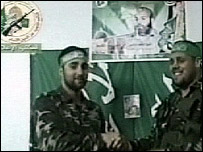
Hanif and sharif Sharif & Hanif in A Gaza lat before their suicide operations in 2003- from Hamas release later – see http://news.bbc.co.uk/2/hi/uk_news/3543269.stm Continue reading

7 Comments

Filed under Al Qaeda, arab regimes, atrocities, cultural transmission, Islamic fundamentalism, jihad, life stories, martyrdom, photography, politIcal discourse, power politics, religiosity, suicide bombing, terrorism, the imaginary and the real, unusual people, war reportage, world events & processes, zealotry

Cartographic & Photographic Illustrations in support of the Memorandum Analysing the War in Sri Lanka and Its Propaganda Debates

Michael Roberts

No survey of Eelam War IV — especially its last phase from late 2008 to May 2009 — can be pursued without some comprehension of the unfolding geographical context and some attention to illustrative pictorial details of the LTTE ditch-and-bund system of defense as well as the defensive deployment of a congealed mass of people and Tiger personnel from circa mid-February to mid-May 2009 within what is best referred to as the “Last Redoubt.”[1] Attention to pictorial evidence must obviously embrace evidence of shelling and casualties (both injured and dead) as well as prima facie instances suggestive of extra-judicial execution by both sides. These in their turn must sit alongside the graphic photographs of clusters of people streaming or struggling across the Nandikadal Lagoon or crossing sand and scrub terrain in April and May 2009 after the Sri Lankan Army infiltrated and penetrated the Tiger arena in the Last Redoubt…. and released them from their corralled situation.[2]

1-UNITED-NATIONS-SRI-LANKA-facebook+ Pic 1: The Fate of the Corralled Tamil Populace of  Thamilīlam = on the move constantly — from mid 2008 in some instances Pic from en.wikipedia.com Continue reading

31 Comments

Filed under accountability, atrocities, Eelam, governance, historical interpretation, Indian Ocean politics, law of armed conflict, legal issues, life stories, LTTE, mass conscription, military strategy, NGOs, patriotism, photography, politIcal discourse, power politics, prabhakaran, propaganda, Rajapaksa regime, Sinhala-Tamil Relations, slanted reportage, sri lankan society, Tamil civilians, Tamil Tiger fighters, the imaginary and the real, trauma, truth as casualty of war, UN reports, unusual people, vengeance, war crimes, war reportage, wikileaks, world events & processes

Explaining the World to the World

Alan Huffman reflects on the Life and Legacy of war photo journalist Tim Hetherington …… First published in Oxford Today, Volume 27 No 1. Reproduced with kind permission of the Chancellor, Masters and Scholars of the University of Oxford.

In Mohammed al-Zawwam’s memory of that day, there were so many badly injured people around him, crying out for help, bleeding onto the gurneys, that he almost didn’t want to film. Yet he did film. He didn’t stop until his battery died.

A dozen or so wounded people had arrived in the triage tent at al-Hekma hospital in Misrata, Libya, on 20 April 2011, following a mortar attack on the city’s embattled Tripoli Street. Some days had brought more injured to the tent during Misrata’s three- month siege, but 20 April was extraordinary in other ways, as is painfully clear in al-Zawwam’s almost unwatchable video. Continue reading

2 Comments

Filed under cultural transmission, Fascism, historical interpretation, life stories, meditations, photography, politIcal discourse, self-reflexivity, the imaginary and the real, unusual people, world affairs
