Selections made by the Library of Soclal Science in New York which has teamed up with the Ideologies of War, Genocide and Terror Website and Newsletter in making thiss eelction and disseminating nformation on the subject. Further information can be gathered from Orion anderson, Communicaitons Director, LSS, tel = 718-393-1104 and andersono@libraryofsocialscience.com
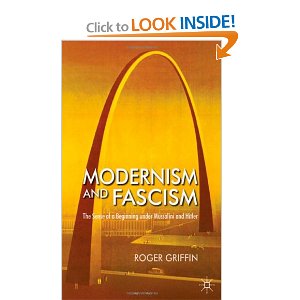
 Modernism and Fascism: The Sense of A Beginning under Mussolini and Hitler
by Roger Griffin
Palgrave Macmillan, 352 pp.
Roger Griffin has published extensively on Fascism and is recognized as an authority on this topic. In Modernism and Fascism, he presents his theoretical model by focusing on three case studies: the First World War, Nazism and Italy under Mussolini. Griffin seeks to identify a common “ideological driving force” that gives rise to various social movements. He theorizes that Fascism builds upon a “core myth”: the idea that one’s nation is in decline. The Fascist is intent upon bringing about the “phoenix-like rebirth” of one’s country through the creation of a “cohesive national state”—requiring that each individual “subsume his or her personality unquestionably but willingly within the greater whole of the national community.” In this important book, Griffin has uncovered and articulated, I believe, a psychological complex that is the source of diverse historical events. Griffin’s theory is applicable to the rise of Islamic terrorism, as well as to recent events in the United States. At the moment a people feels or believes that eternal verities are under siege, social movements come into being whose purpose is to “restore” what seems to have been lost.
The King’s Two Bodies
By Ernst H. Kantorowicz
Princeton University Press, 624 pp.
Don’t be fooled by the subtitle. This study reveals an idea at the core of our political world. Beginning with St. Paul, Kantorowicz leads us through numerous authors and texts, showing us how the idea of the church as a “mystical body” transformed into the idea of the nation—another kind of mystical body. In 1571, Edward Plowden articulated the concept of the “second body of the King.” The King, Plowden said, has two bodies: his natural body—and a body politic bound to his mortal body. Whereas the King’s Natural Body is subject to infirmities, the King’s second body—his body politic—is “utterly devoid of old age and other natural defects and imbecilities.” While the natural body and the body politic are incorporated in one person to form an indivisible unity, no doubt can arise regarding the “superiority of the Body Politic over the Body Natural.” Not only is the Body Politic “more ample and large than the Body Natural,” but in the body politic dwell certain mysterious forces that “reduce, or even remove, the imperfections of the fragile human nature.” So there it is in a nutshell: the source of the fantasy of omnipotence that defines our relationship to the nation-state. A nation or body politic is a double of the self—the immortal part not subject to death and decay. In the Middle Ages, immortality was projected into the king. In the modern world, everyone is a king. Everyone can imagine they are bound to a body politic—and can partake of its immortality.
Politics as Religion
by Emilio Gentile
Princeton University Press, 194 pp.
Gentile, Professor of History at the University of Rome and a well-known authority on fascism and totalitarianism, defines political religion as a “developed system of beliefs, myths, rituals and symbols” that creates an aura of sacredness around a worldly entity, turning it into a “cult,” or object of worship and devotion. One such object in the modern world is the nation-state, which can appear as an “enthralling and awe-inspiring power” evoking a feeling of “absolute dependency.” Gentile presents a careful study of totalitarianism, a social movement seeking to bring about the “fusion of the individual in the organic and mystical union of the nation.” As people bind to an omnipotent God, so do we bind to nations—conceived of as omnipotent. We are aware that nationalism may take a destructive turn. However, we may forget that the idea of one’s nation serves to inspire, releasing energy and goading one to “industrious fervor.” The Olympic champion is rewarded with his or her national anthem being played. Gentile’s Politics as Religion sheds light on the sacred dimension of our “ordinary” political world.
Blood Sacrifice and the Nation: Totem Rituals and the American Flag
by Carolyn Marvin and David W. Ingle
Cambridge University Press, 416 pp.
Although Marvin and Ingle’s book is not unknown, I consider it an undiscovered classic: perhaps the most important ever written on nationalism. What is really true in any community, the authors contend, is “what its members can agree is worth killing for,” or what they can be “compelled to sacrifice their lives for.” What is sacred is “that set of beliefs for which we ought to shed our blood.” In short, nations require blood sacrifice. This profoundly disturbing idea becomes even more difficult to stomach when we realize that, according to Marvin and Ingle, the essential sacrificial victims are not enemies, but members of one’s own society. The authors identify soldiers as the “sacrificial class”: that group which enacts the ritual of blood sacrifice. Yet even as we perform this ritual, the creation of group sentiment requires that members remain “unaware of the mechanism that maintains the group.” Our deepest secret, the authors claim—the “collective group taboo”—is knowing that society depends for its existence on “violent, sacrificial death at the hands of the group itself.” I strongly suggest that everyone read and internalize the ideas contained within this great book. What would happen if the “totem secret” ceased to be a secret? If blood sacrifice gives rise to nations, what would happen to nations if people became aware of the sacrificial ritual that is required to maintain them?
|
“An extended meditation on the contemporary debate about torture and terrorism that forces the reader to grapple with troubling issues that we would prefer to ignore.”
—Sanford Levinson, Prof. of Government, University of Texas
|
Sacred Violence: Torture, Terror, and Soverignty
by Paul W. Kahn
University of Michigan Press, 248 pp.
Terrorism and suicide bombings have created a flurry of scholarly research and writing on religious violence—including, most significantly, Western versions of “sacred violence.” Paul Kahn’s pathbreaking book is among the best. We deceive ourselves, Kahn contends, if we imagine that Western political practices operate in a secular world “untouched by faith and the experience of the sacred.” Nations become what they are when citizens are willing to sacrifice for a transcendent ideal. A community’s self-evident truths become real to the extent that people “are willing to die and kill for them.” Kahn identifies sacrifice as the core dynamic of Western politics. It is precisely the “violent destruction of the self” that is the “realization of the transcendental character of the sovereign.” Nations become real at the moment when the sovereign “takes possession of the body of the citizen.” The ideas put forth in Sacred Violence are revolutionary and disturbing. Yet Kahn’s presentation is calm, logical and well-balanced. Given the dispassionate voice with which Kahn presents his theory, will people be able to grasp the originality (and truth) of his argument? Time will tell.

 Amal Jayasinghe:“8,000 killed in last year of Sri Lanka war: census,”in http://www.dailystar.com.lb/News/International/2012/Feb-25/164619-8000-killed-in-last-year-of-sri-lanka-war-census.ashx#axzz1nS0juqu4, 25 Feb. 2012 ALSO SEE http://www.statistics.gov.lk/PopHouSat/VitalStatistics/EVE2011_FinalReport.pdf
 Pic from AFP
  Pic from Island
 Aerial Pic from Times journo with Ban ki moon, late May 2009 Continue reading