
Category Archives: life stories

Michelle de Kretser’s “Questions Of Travel” secures Miles Franklin Award

Courtesy of ABC News, 19 June 2013

michelle de kretser[As announced in mid-June] Michelle de Kretser won the 2013 Miles Franklin Award, Australia’s most prestigious literary prize. De Kretser won the $60,000 prize for her novel Questions Of Travel, a story drawn around two disparate characters that explores belonging and questions of home and distance. Judges announced the award at the National Library of Australia in Canberra this afternoon, praising the novel as “witty and poignant”. The chair of the judging panel, Richard Neville, says it was difficult to choose a winner from the first all-female shortlist in the award’s history.

“The judging process itself is exhaustive and exhausting… this year there was intense discussion on the winner,” he said. “Michelle’s novel is a novel of great ambition and great wisdom. It’s dealing with all, so many issues that Australian society’s talking about and it’s just a wonderfully written, engaging novel.” Continue reading
Leave a comment

Filed under Australian culture, australian media, cultural transmission, heritage, life stories, literary achievements, self-reflexivity, unusual people, world affairs

The serene smiling face of Ashton Agar highlights multi-cultural Australia

Chip Le Grand and Pia Akerman, in The Weekend Australian, 13 July 2013, where the title readsCricket’s new face, Ashton Agar, has a serene smile.”

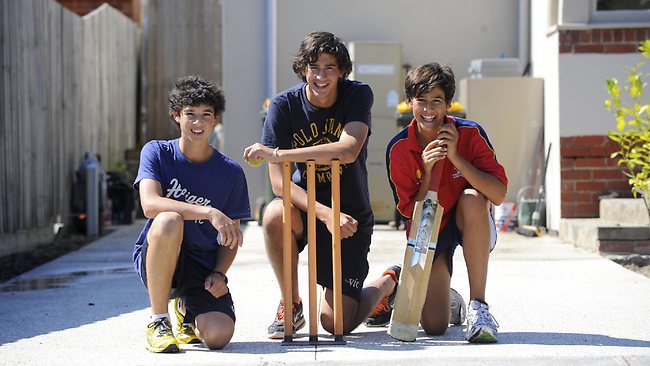
AGARs threeTHE face of Australian cricket has always been hard set. Ricky Ponting’s furrowed brow. Steve Waugh’s defiant stare. Allan Border’s stubborn resolve. The Chappells and their killer gleam. The new face of Australian cricket wears a broad smile that has captured the hearts of a sleep-deprived nation. That it shone as brightly in the moments after Ashton Agar got out for 98 as it did when he was chasing an improbable century on debut evokes Kipling’s famous line about triumph and disaster and treating those two imposters just the same. Back home in Melbourne, it reminded Agar’s high school maths teacher and cricket coach of the advice he gives every kid that takes block for De La Salle College. “You want the opposition to walk off the ground wanting to hate you but not having a reason,” says Marty Rhoden, a teacher and coach to all three Agar brothers. “He is so level-headed and grounded. You notice the first thing he did when he ran back on to the ground after taking off his pads was to go up to (his brothers) Will and Wes and apologise for getting out.” Continue reading

5 Comments

Filed under Australian culture, cultural transmission, ethnicity, immigration, life stories, sri lankan society, unusual people, world affairs

Willa Wickramasinghe and the SSC Pamphlets: An Appreciation

Michael Roberts

WillaWilfred Wickramasinghe, “Willa” to his pals, was born on 12th December 1932 and was educated at S. Thomas’ College, Mount Lavinia. He thereafter joined the Sri Lanka Air Force and passed out first in his batch at Diyatalawa. The government of that day said they had no money to send him to Cranwell in UK for his officer training, so he promptly resigned his commission and set off for England in order to study insurance. While in London he became President of the Sri Lanka Students’ Union during the late 1950s over two successive years, succeeding Ratnasiri Wickramanayake (subsequently a Prime Minister). Wilfred became a Communist while a student in England and travelled widely in Russia and other Communist countries. Continue reading

7 Comments

Filed under cultural transmission, heritage, historical interpretation, life stories, literary achievements, nationalism, politIcal discourse, sri lankan society, unusual people, welfare & philanthophy

Bikes for Life and Cricket towards Reconciliation at Kilinochchi via FOG

Skandakumar

Kushil Kili 02I have just back from Killinochchi ……at 4 am Tuesday morning after having left at 8 am on Sunday!! It was a  rewarding trip that allowed a group of us to visit an orphanage of 330 children, and see the work a retired GA in charge, Rasanayagam, is doing for them and for 6000 widows in that area. We also visited a Harmony Centre constructed by the Army that  will soon provide access to IT, English, et cetera — a centre that also has a badminton court and modest gym facilities . Continue reading

1 Comment

Filed under cultural transmission, life stories, patriotism, performance, Sinhala-Tamil Relations, sri lankan society, Tamil civilians, unusual people, welfare & philanthophy, world events & processes

Lamenting the Literary Terrorist

Richard Jackson, 25 June 2013, courtesy of academia.com,

9-11 two 9-11-one

Why have novelists so far failed to write a believable terrorist character, one that reflects actual people in the real world? Why do literary terrorists instead mostly conform to propagandistic stereotypes and widespread cultural myths? I must have read a hundred novels both popular and serious literary fiction with central terrorist characters, and I have yet to be satisfied with one which I feel represents a real person in the real world. Here, I am not referring to offbeat characters accused of terrorism (such as Paul Auster’s Leviathan), terrorists who are dead and their motivations have to be reconstructed retrospectively (such as Yasmina Khadra’s The Attack), or characters accused of terrorism who are really not terrorists in any reasonable sense (such as Heinrich Boll’s The Lost Honour of Katharina Blum). Continue reading

1 Comment

Filed under cultural transmission, life stories, literary achievements, world events & processes

Figuring the Death Toll during the LTTE’s Endgame: Issues at Stake, I

Kath Noble, in the Island, 3 July 2013, where the title readsThis is no Game

Some months ago, my attention was drawn to a report on civilian deaths in the final phase of the war. The author – as yet unnamed – claimed to have something important to add to the debate that began in 2009 as the Army closed in on the LTTE in Mullaitivu.

2009-03-22 00.59.52I must admit that I didn’t feel very inclined to read it. Of course it is disturbing that estimates of the number of people killed between January and May that year vary from almost zero to 147,000. But there are many things to be disturbed about in Sri Lanka – the Government is pursuing a thoroughly regressive agenda on just about every front. Should we ignore its failure to tackle extremist groups, even if only for a moment? What about its effort to roll back the 13th Amendment? How could we justify focusing on a subject that is clearly no longer urgent? In 2009, the LTTE had surrounded itself with an unknown number of people, and the question of how the Army was responding was of obvious importance – lives were at risk.

Today, taking time to uncover the truth of that painful episode seems like a luxury. That alone is a tragedy. When the report is called ‘The Numbers Game’, it is even more difficult to persuade oneself to proceed. Whatever the body count, we are talking about the violent end of somebody’s relatives. Continue reading

3 Comments

Filed under historical interpretation, life stories, LTTE, military strategy, news fabrication, politIcal discourse, power politics, prabhakaran, propaganda, Rajapaksa regime, reconciliation, Sinhala-Tamil Relations, slanted reportage, sri lankan society, Tamil civilians, Tamil Tiger fighters, truth as casualty of war, UN reports, world events & processes

Governing the North: Major-General Chandrasiri in Q and A for friendly newspaper

Irangika Range, in Daily News, 3 July 2013 with title “Peace did not come on a Platters

CHANDRASIRI 11 Rebuilding the North after 30 years of terrorist conflict was no easy task. The government’s rebuilding efforts in the North which are in accordance with the principles of the Mahinda Chinthanaya programme has gained fruition within four years since the end of the conflict and the establishment of permanent peace. The four main areas which have been given priority are de-mining, resettlement, developing infrastructure facilities and the provision of basic needs for rural development. Security Forces personnel have become an integral part of the massive social and economic development drive in the North. Around 95 per cent of the area has been de-mined, while over 400,000 civilians have been resettled in their places of origin.

Q: How would you summarize the current situation in the North?

A: When we defeated terrorism four years ago, the situation in the North was a mess. The recovery and rebuilding process was no easy task, but, hard work has helped realise our goals. Today, life has returned to normal where devastation and hopelessness were the order of the day. Not only have we brought peace, but, we have given the province a new lease of life with the necessary infrastructure development. Roads, lakes, ports, airports, houses, schools, farms, health facilities have been built and reconstructed, advanced technology introduced to a province which had been bruised, battered and bloodied by three decades of terrorist conflict. Continue reading

2 Comments

Filed under accountability, economic processes, governance, island economy, life stories, LTTE, military expenditure, politIcal discourse, Rajapaksa regime, reconciliation, rehabilitation, Sinhala-Tamil Relations, slanted reportage, Tamil civilians, world events & processes

Caste in modern Sri Lankan politics: A repetition of an old excursion from early 2010

Michael Roberts, c0urtesy of transcurrents in early 2010

fonseka

A Preamble from 2013 to set the scene: Lakruwan de Silva’s historical excursion in early 2010 was inspired by the Presidential contest early that year and General Sarath de Fonseka’s vicissitudes on the political front. His reference to the famous – or maybe infamous – competition between segments of the Govigama elite and segments of the Karava during the course of the electoral contest for the “Educated Ceylonese seat’ in the Legislative Council in 1911 seemed to encourage some commentators to argue that caste competition among the Sinhalese was far more momentous in the early 20th century than Sinhala-Tamil rivalry. This was, in my view, a sweeping generalization of a half-baked character which was not alive to the manifold strands of competitive politics — strands which did not preclude each other. Ethnic competition for jobs and political space, ‘internal’ caste jostling between Vellālar and others among the Tamils, caste rivalries among the Sinhalese (whether Wahumpura vs Batgam, Karāva vs Goi, Salāgama vs Karāva, et cetera) and arguments between Buddhist revivalists and Christian denominations and, for that matter, competition between Karāva clerics and Tamil clerics in the Methodist Church (as I was told by Dr. GC Mendis) co-existed in the same temporal moment in different realms. This assertion is based on a long engagement with the details of political history in the British colonial period, one which led to studies of the pogrom against the Mohammedan Moors in 1915, the various nationalist currents of that time and the thinking of Anagārika Dharmapala as revealed in his diaries. Continue reading

2 Comments

Filed under British colonialism, caste issues, citizen journalism, economic processes, historical interpretation, life stories, politIcal discourse, self-reflexivity, Sinhala-Tamil Relations, sri lankan society

Dayan’s pragmatism in his Long Book on the Long War

Padraig Colman, in Sunday Island, 30 June 2013

DAYAN SPEAKSVaried Career: As well as being a diplomat, Dr Jayatilleka has been an urban guerrilla, political activist, active politician and academic political scientist. His book on the political thought of Fidel Castro was published by Pluto Press in London. His latest book brings much inside knowledge to a detailed narrative of Sri Lanka’s war and links it to issues of global significance.

Realism – Justification of War: Other reviewers have drawn out a particular emphasis on the ethics of violence and the concept of a just war. Jayatilleka argues that violence is common in the real world and it is often necessary for the state to sanction violence to protect itself and its people. This does not justify ‘‘terrorism targeting unarmed, non-combatant civilians; torture and arbitrary execution of prisoners; executions within the organization; and lethal violence against political prisoners’’. Continue reading

Leave a comment

Filed under accountability, governance, historical interpretation, law of armed conflict, life stories, LTTE, politIcal discourse, power politics, power sharing, prabhakaran, reconciliation, Sinhala-Tamil Relations, sri lankan society, terrorism, world events & processes

Maname in Retrospect: Homage to the Pioneers of 1956

KNO Dharmadasa, in the Island, 4 and 5 June 2013

MANAMEManame is not only without question the finest thing I have seen on the Sinhalese stage”, wrote Regi Siriwardena in his regular column on the arts to the Ceylon Daily News on November 6, 1956, and added further , ” It is also one of the three or four most impressive dramatic performances in any language I have been privileged to attend.” Such an adulatory statement from a critic who was widely considered the highest authority on the arts in the country was something totally unexpected as far as the Maname team who had come down from Peradeniya were concerned. The producer- director Dr. E.R. Sarchchandra, Senior Lecturer in the Department of Sinhalese in the one and only university in the island, the University of Ceylon, had warned his young cast that there was a possibility of adverse reaction from the audiences in Colombo. He had had a short meeting of the cast just before setting out to the metropolis and told them not to get disheartened if that was to happen. In fact he himself called the production ” an experiment.” Writing “A Note to the Production” for the programme, a Note handed to the audience on the first night, November 3, at the Lionel Wendt Theatre, he stated ” the aim of this experiment is both to explore potentialities as a traditional form may possess in the search for an indigenous tradition in drama as well as to bring to light another type of play which may be enjoyed on its own merits.” Continue reading

5 Comments

Filed under cultural transmission, historical interpretation, life stories, literary achievements, sri lankan society