
Category Archives: life stories

The War Heroes’ Monument of St. Aloysius’ College, Galle

The ceremonial opening of war heroes’ monument on 24 November 2022 was by the Chief of Staff of the Sri Lanka Army Major General Jagath Kodithuwakku, … RWP RSP ndu – Chief of Staff (යුධ හමුදා මාණ්ඩලික ප්‍රධානී), …  Colonel of the Regiment Sri Lanka Light Infantry, … President – Army Sports Committee … Chairman – Sri Lanka National/Army Angampora Committee…. President Old Aloysian Military Association.
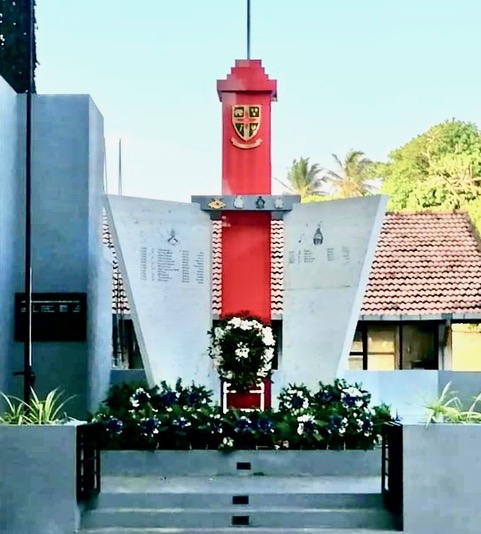
 

In a colourful ceremony conducted with the pomp, precision and pageantry that is synonymous with the armed services, the well-designed War Monument dedicated to Aloysians who gave their lives for the country during the senseless ‘war’ was declared open. Congratulations to the organisers and to those who worked tirelessly to establish this monument…. NOTE from the Aloysian Chroniclers

Continue reading

Leave a comment

Filed under accountability, art & allure bewitching, cultural transmission, education, heritage, historical interpretation, landscape wondrous, life stories, meditations, propaganda, religiosity, sri lankan society, trauma, unusual people, world events & processes

Ranil’s Moves to Resolve Ethnic Issues in Rapid-Action Measures

DBS Jeyaraj, in Daily Mirror, 24 December 2022where the title runs thus: President Ranil’s initiative to resolve Tamil national question” …. & a kind-of sub-heading read  The All Party conference was a success of sorts with all participants agreeing on the need for a power-sharing solution”

The Tamil Progressive Alliance (TPA) leader and Colombo District MP, Mano Ganesan received a telephone call from Ranil Wickremesinghe on 19 July 2022

It was a day before the Presidential election where the MPs were scheduled to vote and elect a new executive President to fill the vacancy created by President Gotabaya Rajapaksa’s resignation. Ranil Wickremesinghe, who was the then Prime Minister and acting as the interim President, was a candidate for the Presidential election.


Continue reading

2 Comments

Filed under accountability, american imperialism, centre-periphery relations, communal relations, debt restructuring, democratic measures, devolution, economic processes, electoral structures, ethnicity, foreign policy, governance, historical interpretation, Indian Ocean politics, island economy, landscape wondrous, language policies, legal issues, life stories, parliamentary elections, patriotism, performance, politIcal discourse, power politics, Rajapaksa regime, security, self-reflexivity, Sinhala-Tamil Relations, sri lankan society, Tamil civilians, Tamil migration, Tamil Tiger fighters, the imaginary and the real, unusual people, world events & processes

Crunchtime: Resolving Sri Lanka’s Political Dilemma

Chandre Dharmawardana, in The Island, 02 January 2023 where the preferred title runs thus: Using SORTITION to prevent electing of same crooks to parliament”

The terrorism of the LTTE ended in May 2009, and most Sri Lankans looked forward to a dawn of peace, reconciliation and progress.  Even Poongkothai Chandrahasan, the granddaughter of SJV Chelvanayagam could state that ‘what touched me the most that day was that these were poor people with no agenda ~ wearing their feelings on their sleeves~. Every single person I spoke to said to me, “The war is over, we are so happy”. They were not celebrating the defeat of the Tamils. They were celebrating the fact that now there would be peace in Sri Lanka’ (The Island, 23rd August 2009, http://archive.island.lk/2009/08/23/news15.html).

Continue reading

7 Comments

Filed under accountability, authoritarian regimes, communal relations, cultural transmission, democratic measures, disparagement, economic processes, electoral structures, ethnicity, governance, historical interpretation, island economy, language policies, legal issues, life stories, parliamentary elections, patriotism, political demonstrations, politIcal discourse, power politics, press freedom & censorship, self-reflexivity, Sinhala-Tamil Relations, social justice, sri lankan society, Tamil civilians, trauma, vengeance, world events & processes

The DRS Technology as Idea: Senaka Weeraratna’s Inventive Mind

Senaka Weeraratna 

Both the DRS in Cricket and Goal Line Technology in Soccer have a common origin in the ‘Player Referral’ concept conceived by Senaka Weeraratna in 1997.

This was the first occasion in world history that a case was made (in 1997), using the analogy of the apellate function of the legal system, to press home the point that we needed to adopt it on the playing field in a modified form in combination with modern technology, i.e. video play back in the hands of Third Umpire, to determine the accuracy of a decision made by an on field or ground umpire by way of a Review System.

Continue reading

2 Comments

Filed under accountability, architects & architecture, australian media, centre-periphery relations, citizen journalism, cricket for amity, cultural transmission, education, ethnicity, governance, historical interpretation, legal issues, life stories, modernity & modernization, performance, photography & its history, politIcal discourse, power politics, self-reflexivity, Sri Lankan cricket, taking the piss, truth as casualty of war, unusual people, world events & processes

Rukmani Devi aka Daisy Rasammah Daniels: A Stellar Career

Wikipedia on Daisy Rasammah Daniels or Rukmani Devi … at … https://en.wikipedia.org/wiki/Rukmani_Devi

 Daisy Rasammah Daniels, known popularly as Rukmani Devi (15 January 1923–28 October 1978: Sinhala: රුක්මණී දේවී) was a Sri Lankan film actress and singer, who was often acclaimed as The Nightingale of Sri Lanka“.[1]

She made it to the silver screen via the stage and had acted in close to 100 films at the time of her death. Having an equal passion for singing as well as a melodious voice, she was Sri Lanka’s foremost female singer in the gramophone era.[2] After her death, she was awarded the Sarasaviya ‘Rana Thisara’- Life Time Achievement Award at the 1979 Sarasaviya Awards Festival.[3]

Continue reading

Leave a comment

Filed under art & allure bewitching, commoditification, cultural transmission, economic processes, ethnicity, heritage, historical interpretation, Indian traditions, landscape wondrous, life stories, patriotism, performance, plural society, self-reflexivity, sri lankan society, travelogue, unusual people

Bond Scam Shenanigans at the Politico-Economic Heights & The Chilling Killing of Dinesh Schaffter

Darini Rajasingham-Senanayake, in Climate-Change, 29 December 2022, where the title of her essay runs thus: “The media of Climate Anxiety and Debt Bondage: Cui Bono in a Post-Truth World?”

“If you don’t like the weather, just wait a minute’ runs a wry idiom in New England where the weather may change dramatically in minutes. However, these days blaming the weather for pretty much everything is fashionable– be it global warming or cooling, no rain, or too much rain, drought, floods or a snow blizzard in winter.


Continue reading

2 Comments

Filed under accountability, atrocities, economic processes, legal issues, life stories, self-reflexivity, sri lankan society, trauma, unusual people, vengeance

Vale: Preofessor Merlin Peiris, A Classicist Par Excellence

Punsara Amarasinghe, in The Guardian, 18 December 2022, where the ttile runs thus: Prof. Merlin Peiris: The last of the Mohicans leaves the stage”

The greatest quality that would aggrandize Merlin’s name above the current mediocre scholars in Sri Lanka is his intellectual tolerance towards dissent.


The demise of Prof Merlin Peiris embodies the end of an epoch representing the humanities academia in Sri Lanka as he was obviously the last of those great doyens who lived when the country’s humanities education was prospering in those halcyon days at the edge of the British rule. Prof. Merlin was one of the first students of the maiden batch of Peradeniya University when it was shifted from Colombo in 1950 and began his flair for classics even before he entered the university under the wings of Noel Phoebus at St. Peter’s College in Bambalapitya.

Continue reading

Leave a comment

Filed under accountability, art & allure bewitching, cultural transmission, education, heritage, historical interpretation, life stories, literary achievements, meditations, self-reflexivity, sri lankan society, unusual people, world events & processes

Sri Lankans in The Australian Foreign Service

Victor Melder, in Memo dated 28 December 2022, correcting a major error in the recent Daily News Item

The news item in the Daily News of yesterday (see below) is NOT correct, we have had two Sri Lankan born Australian Ambassadors. There could even be more.

The first: David Ian WILLÉ:  born 1942, educated at Royal College, Colombo. Emigrated with his parents to Melbourne, Australia in 1957. Studied at Melbourne University, obtaining a BA and LLB. Appointed to the Australian Diplomatic Service and posted as Australian High Commissioner to the West Indies, on his return was appointed Head of the Russian desk at the Department of Foreign Affairs, Canberra. (see The Burghers of Ceylon Worldwide – Kelaart, 2007)

Continue reading

Leave a comment

Filed under accountability, Australian culture, cultural transmission, heritage, historical interpretation, life stories, performance, self-reflexivity, sri lankan society, unusual people, world affairs

Fraternal Polyandry in Ceylon in Dutch Times

Jan Kok, Luc Bulten and Bente M. de Leede:

“Persecuted or permitted? Fraternal Polyandry in a Calvinist colony, Sri Lanka (Ceylon), seventeenth and eighteenth centuries,” a work published by Cambridge University Press, 2022 … presented here in Thuppahi in synopsis

Abstract: Several studies assume that Calvinist Christianity severely undermined or even persecuted the practice of polyandry in the Sri Lankan areas under Dutch control. We analyze Dutch colonial policy and Church activities toward polyandry by combining ecclesiastical and legal sources. Moreover, we use the Dutch colonial administration of the Sinhalese population to estimate the prevalence of polyandry. We conclude that polyandry was far from extinct by the end of the Dutch period and we argue that the colonial government was simply not knowledgeable, interested and effective enough to persecute the practice in the rural areas under its control.


Continue reading

4 Comments

Filed under accountability, authoritarian regimes, British colonialism, centre-periphery relations, commoditification, cultural transmission, disparagement, economic processes, ethnicity, gender norms, heritage, historical interpretation, island economy, Kandyan kingdom, landscape wondrous, life stories, modernity & modernization, politIcal discourse, religiosity, self-reflexivity, sri lankan society, travelogue, unusual people, world events & processes

A Royal-Thomian Cricket Match Remembered Not Only for the Cricket

Hugh Karunanayake

                                               “Oft in the stilly night

                                                Ere slumber’s chains has bound me

                                                Fond memory brings the light

                                                Of other days around me

                                               The smiles, the tears,

                                               Of boyhood years”  

The Royal Thomian match of 1951 will for long be remembered for its nail-biting finish, and for the manner in which the Royal College team led by skipper T. Vairavanathan  extracted a victory from the jaws of defeat. It will certainly occupy a top position in the history of the series, the second oldest school cricket encounter in the world, (the first game being played in 1880).

Continue reading

1 Comment

Filed under accountability, charitable outreach, Colombo and Its Spaces, cricket for amity, cultural transmission, education, hatan kavi, heritage, historical interpretation, landscape wondrous, law of armed conflict, life stories, patriotism, performance, Royal College, self-reflexivity, sri lankan society, tolerance, unusual people