Category Archives: Hinduism

Peter Mayer: Straddling USA-India-Australia via Academia

Michael Roberts

 The world of university lecturers is quite varied and cannot be easily distilled. My experience is mostly based on my years teaching at Peradeniya University n Sri Lanka (1960-62 & 1966-76) and Adelaide University from 1978-2004—besides exposures to the environments in Oxford, Chicago, Heidelberg & Bielefeldt.

I have decided to introduce my TPS readership to some personnel from this highly-variegated field. My first choice has been an easy one: PETER MAYER is an easy man – personable, talented, multi-skilled and well-travelled. As vitally, he is an American who has married an equally personable lady named “Latha” who is from India.

Continue reading

Leave a comment

Filed under accountability, art & allure bewitching, Australian culture, australian media, British colonialism, centre-periphery relations, communal relations, cultural transmission, democratic measures, education, education policy, ethnicity, foreign policy, governance, Hinduism, historical interpretation, Indian Ocean politics, Indian traditions, language policies, Left politics, life stories, modernity & modernization, nationalism, outmigration, politIcal discourse, power politics, racism, religiosity, social justice, teaching profession, terrorism, unusual people, world events & processes

Introducing A Cutting Edge Journal: SOUTH ASIA

Michael Roberts

SOUTH ASIA has been a form of Australian exploration — in the plural form of manifold journeys and investigations — in South Asia for several decades. I was a small cog in this cluster of activities some 20 years back; but, alas, fell away. Some old partners in arms are still part of the Editorial Advisory Board; but its a fresh and bright team that is bringing the Indian subcontinent into the Aussie arena. Sri Lankan scholars and readers need to take note of this work and chip in with their own ‘commentary’ — whether in article form or as avid readers.

Check https://www.tandfonline.com/journals/csas20 …. AND/OR write to ……….. OR ……………………….. priya.chacko@adelaide.edu.au

Cover image for South Asia: Journal of South Asian Studies, Volume 47, Issue 6 Continue reading

1 Comment

Filed under ancient civilisations, australian media, British imperialism, Buddhism, centre-periphery relations, communal relations, cultural transmission, economic processes, electoral structures, ethnicity, European history, governance, heritage, Hinduism, historical interpretation, Indian General Elections, Indian Ocean politics, Indian religions, Indian traditions, land policies, landscape wondrous, life stories, literary achievements, migrant experiences, modernity & modernization, parliamentary elections, patriotism, pilgrimages, plural society, politIcal discourse, Portuguese imperialism, Portuguese in Indian Ocean, power politics, Presidential elections, press freedom & censorship, racism, Rajiv Gandhi, religiosity, riots and pogroms, security, self-reflexivity, terrorism, transport and communications, working class conditions, world events & processes, zealotry

Lecture on Buddhist Temple Paintings durng the Colonial Period

Prof. Chandanie Wanigatunge will be delivering a National Trust Lecture on Temple Paintings during Colonial Period” ….. at 6.00 pm, Thursday, 29th February 2024 ………. The Auditorium of the College of Surgeons of Sri Lanka, No. 6, Independence Avenue, Colombo 7….. accessible on You Tube: https://www.youtube.com/@ntsl9627

Degaldoruwa Temple


Continue reading

Leave a comment

Filed under architects & architecture, art & allure bewitching, Buddhism, cultural transmission, education, ethnicity, female empowerment, Hinduism, historical interpretation, Indian traditions, Kandyan kingdom, landscape wondrous, life stories, performance, religiosity, travelogue, world affairs

Revelations within Colonial Photographs of Ceylon: “Veins of Influence”

Veins of Influence: Colonial Sri Lanka (Ceylon) in Early Photographs and Collections, by Shalini Amerasinghe Ganendra

 [This book is a pioneering monograph that brings a rich array of early and previously unpublished images of Sri Lanka (Ceylon) into the global discourse of photography, pairing a striking lens of visual appreciation with distinctly humanizing perspectives.


Continue reading

Leave a comment

Filed under accountability, architects & architecture, art & allure bewitching, British colonialism, Buddhism, commoditification, Dutch colonialism, economic processes, ethnicity, female empowerment, governance, heritage, Hinduism, historical interpretation, island economy, landscape wondrous, life stories, modernity & modernization, photography, photography & its history, plantations, Portuguese imperialism, power politics, religiosity, sri lankan society, Tamil civilians, the imaginary and the real, tourism, transport and communications, unusual people, wild life, working class conditions

The Berlin Wall: Dividing West & East Berlin … Epitome of the Cold War

Compiled by Retd SLAF Group Captain Kumar Kirinde, with this title “Berlin Wall: The Guarded Concrete Barrier That Once Encircled  A Part of the German Capital”

Source:  https://en.wikipedia.org/wiki/Berlin_Wall

Introduction

The Berlin Wall was a guarded concrete barrier that encircled West Berlin of the Federal Republic of Germany (FRG and referred to as West Germany), from 1961 to 1989, separating it from East Berlin and the German Democratic Republic (GDR and referred to as East Germany). FRG belonged to the post war USA led Western Bloc of countries and GDR to the USSR led Eastern Bloc.

Continue reading

3 Comments

Filed under accountability, architects & architecture, authoritarian regimes, ethnicity, foreign policy, governance, Hinduism, historical interpretation, landscape wondrous, legal issues, life stories, political demonstrations, politIcal discourse, power politics, security, trauma, unusual people, world events & processes

Amitav Ghosh: Straddling the Mediterranean & Indian Worlds

Dr. Shalva Weil, in https://ejewishphilanthropy.com/in-an-ancient-land-trade-and-synagogues-in-south-india/

The Calcutta-born novelist Amitav Ghosh tells the tale, in his novel In an Ancient Land, of a medieval traveler by the name of Abraham Ben Yiju who conducted an import/export business from Cairo through Aden to India. Ben Yiju was a member of the Synagogue of Ben Ezra, or the”Synagogue of the Palestinians”, as it used to be known while it was still standing, in Cairo, at the end of the nineteenth century. It was in that synagogue that congregation members used to accumulate and store their papers and manuscripts. The last In an Ancient Land Revisited Trade and Synagogues in South India document that is known to have been deposited in this Genizah was a get, a divorce settlement, authorized in Bombay (today Mumbai).

Continue reading

Leave a comment

Filed under ancient civilisations, art & allure bewitching, centre-periphery relations, commoditification, communal relations, cultural transmission, economic processes, ethnicity, heritage, Hinduism, historical interpretation, Indian Ocean politics, Indian religions, Indian traditions, Jews in Asia, landscape wondrous, life stories, literary achievements, Middle Eastern Politics, modernity & modernization, politIcal discourse, religiosity, self-reflexivity, tolerance, travelogue, unusual people, world events & processes

Caste in Jaffna

Prashanth Kuganathan** whose title runs thus: “Social Stratification in Jaffna: A Survey of Recent Research on Caste”

A SYNOPSIS: Since 1983, war has dominated the perception of Sri Lanka. This has affected scholarship on the country, such that the subjects of an overwhelming number of research proposals and publications have been on the war and the prospects and prescriptions for peace. This survey paper is an attempt to locate the system of caste in transition in the Jaffna Peninsula by reviewing recent literature written after the commencement of the war. While detailed ethnographies of caste in Jaffna may have temporarily come to a halt, caste practices have not and remain a salient part of everyday life among the Tamils in Sri Lanka. As the war ended in 2009, it is therefore important that social scientists on Sri Lanka revisit the topic of caste, that is an integral part of not just Tamil culture or society, but being Tamil itself. As the study of caste is dominated by research in India, a microanalysis of Jaffna and Sri Lanka, particularly the nuances of this system in transition due to war and militancy, could contribute to the macro-study of caste at a sub-continental perspective.

Continue reading

8 Comments

Filed under caste issues, centre-periphery relations, commoditification, communal relations, cultural transmission, demography, discrimination, economic processes, education, Eelam, ethnicity, governance, heritage, Hinduism, historical interpretation, Indian traditions, island economy, landscape wondrous, legal issues, life stories, LTTE, politIcal discourse, power politics, religiosity, Saivism, self-reflexivity, Sinhala-Tamil Relations, sri lankan society, Tamil civilians, Tamil migration, tamil refugees, truth as casualty of war, unusual people

Prejudice & Patriotism: Cricket in This Space

Roshan Kishore, in Hindustan Times, 29 October 2021, with this title “Cricket and patriotism: What links them in India”

Pakistan’s victory over India in the ongoing T20 cricket World Cup match on October 24 has kicked up a political storm in India. First there was uproar over online trolling which targeted India’s pace bowler Mohammad Shami along religious lines. Many Opposition leaders came out in Shami’s support, and several cricketers and the Board of Control for Cricket in India also spoke up for him. Meanwhile, reports of Muslims celebrating Pakistan’s victory started doing the rounds. Those who did so will be booked under sedition charges, Uttar Pradesh chief minister Yogi Adityanath said in a tweet on October 28.

Continue reading

Leave a comment

Filed under accountability, cricket for amity, cultural transmission, demography, discrimination, disparagement, ethnicity, heritage, Hinduism, Indian religions, Indian traditions, life stories, meditations, politIcal discourse, power politics, racist thinking, religious nationalism, self-reflexivity, the imaginary and the real, tolerance, truth as casualty of war, unusual people, world events & processes, zealotry

Exploring the Etymological Strands of the Word “Thiruketheeswaram”

Chandre Dharmawardana

The word stub “ket,”, கேத, in the place name:  Tiru-k-keteeswaram,  திருக்கேதீசுவரம்

In finding a meaning for the component –ket– in Tiru-ket-heesvaram, well known Engineer Thiru Arumugam has quoted an interpretation given in 1849 by Pridham which leans on a mythological tale of Vishnu’s exlir of mortality that fell into the hands of a demon. The demon was said to be cut into two and became Rahu and Ketu (.இராகு கேது) recognized in astrology.  Predham stretches his imagination very far to convert the Tamil -கேத- sound to கேது in finding  an “explanation” or rationalization for the stub  -கேத- found in the place name.

Continue reading

Leave a comment

Filed under ancient civilisations, architects & architecture, art & allure bewitching, centre-periphery relations, cultural transmission, demography, economic processes, ethnicity, heritage, Hinduism, historical interpretation, Indian religions, Indian traditions, island economy, landscape wondrous, life stories, literary achievements, pilgrimages, religiosity, self-reflexivity, Sinhala-Tamil Relations, sri lankan society, Tamil migration, the imaginary and the real, transport and communications, travelogue, world events & processes

Thiruketheeswaram: the Site of a Temple from Pre-Historic Times

Thiru Arumugam, being an article presented recently in The CEYLANKAN, Journal of the Ceylon Society of Australia. No. 3, August 2021

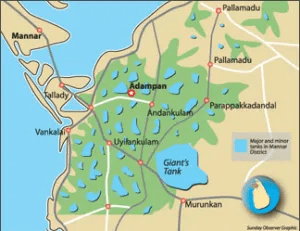
Thiruketheeswaram is located about eight km north of Mannar Town. It is on the coastal mainland of Ceylon, near the seashore on the direct coast road from Mannar to Jaffna. It has been the site of a Temple dedicated to Siva from pre-historic times. The place name of Thiru-Kethu-Iswaram has been devised as follows.  ‘Thiru’ means sacred or holy and “Iswaran” is another name for Siva. As regards ‘Kethu’, Charles Pridham in his 1849 book A Historical, Political and Statistical account of Ceylon and its Dependencies describes how the gods asked Vishnu to prepare an elixir which would make them immortal. The elixir was prepared by churning the oceans but a demon who was a bystander also managed to drink the elixir. When Vishnu realised this, he cut off the demon’s head, but he was too late as the elixir had already made him immortal. The two parts became Rahu and Kethu, which are significant planets in the Hindu astrological system. In order to propitiate his sin, Kethu (Fig. 1) wandered from place to place and ultimately reached the shores of Lanka. He performed severe penances and he   was ultimately blessed with the Lord’s vision and the place where this occurred was named Thiru-Kethu-Iswaram or Thiruketheeswaram.

Continue reading

3 Comments

Filed under ancient civilisations, architects & architecture, art & allure bewitching, cultural transmission, economic processes, heritage, Hinduism, historical interpretation, Indian religions, Indian traditions, landscape wondrous, life stories, literary achievements, meditations, photography, pilgrimages, politIcal discourse, religiosity, self-reflexivity, Sinhala-Tamil Relations, sri lankan society, tolerance, travelogue, world events & processes