Category Archives: debt restructuring

Sri Lanka’s Economy Now: After A Honeymoon….

Item in THE ECONOMIST, 6 Sep 2025, entitled The Sri Lankan government’s honeymoon is nearly over” … & sent to me by  Jayantha Somasundaram of Canberra; while the highlights are my imposition

Initial popularity:  OPENED IN AUGUST with the stated ambition of making Sri Lanka “India’s Macau”, the City of Dreams development in downtown Colombo houses a casino, luxury hotels, high-end shops and a champagne-and-cocktail bar “floating amid the clouds”. The gleaming but for now largely deserted halls of the vast complex seem a symbol of renewal: a far cry from the mass civil unrest of just three years ago and the accompanying economic collapse—rampant inflation, fuel shortages, mass poverty and foreign-debt default.

Continue reading

Leave a comment

Filed under accountability, centre-periphery relations, Colombo and Its Spaces, communal relations, debt restructuring, democratic measures, economic processes, ethnicity, governance, growth pole, historical interpretation, human rights, IMF, island economy, JVP, Left politics, legal issues, life stories, LTTE, migrant experiences, outmigration, performance, plural society, power politics, self-reflexivity, Sinhala-Tamil Relations, social justice, sri lankan society, tourism, welfare & philanthophy, world events & processes

Financial Restraint: Sri Lankan Government’s Initial Measures Applauded

Jehan Perera  

The government’s commitment to cut down on waste and corruption so that resources can be saved and added to enable economic growth can be seen in the strict discipline it has been following where expenditures on its members are concerned. There is a need, however, for new and innovative development projects that require knowledge and expertise that is not necessarily within the government. So far it appears that the government is restricting its selection of key decision makers to those it knows, has worked with and trusts due to long association. Two of the committees that the government has recently appointed, the Clean Lanka task force and the Tourism advisory committee are composed of nearly all men, and men from the majority community. If Sri Lanka is to leverage its full potential, the government must embrace a more inclusive approach that incorporates women and diverse others from across the country’s multiethnic and multireligious population, including representation from the north and east.

Younger Srilanka _ The winning combination – AKD & Dr. Harini. Sri Lanka gets a new leadership! ❤️_🔥🇱🇰 _ Instagram

Continue reading

Leave a comment

Filed under accountability, citizen journalism, debt restructuring, economic processes, governance, historical interpretation, island economy, legal issues, life stories, modernity & modernization, patriotism, performance, politIcal discourse, rehabilitation, self-reflexivity, social justice, sri lankan society, welfare & philanthophy

A Depressing Assessment of Sri Lanka’s Predicament About Six Years Back

THIS is an old essay that stayed buried in the Thuppahi system. It neverthless provides food for thought and serves as a testimony to its author (a brother of my friend the late Neville Jayaweera). Stanley too has since passed away …

 Sanjeewa Jayaweera

Most living in Sri Lanka feel like they have got into the boxing ring with Muhammad Ali. The ferocious punches thrown regularly are taking their toll, with most either on their knees or on the canvas. The final punch that will knock us out seems inevitable, but the question is when?

Continue reading

Leave a comment

Filed under accountability, authoritarian regimes, centre-periphery relations, debt restructuring, economic processes, governance, historical interpretation, island economy, Left politics, legal issues, life stories, performance, politIcal discourse, power politics, Rajapaksa regime, self-reflexivity, sri lankan society, welfare & philanthophy, world events & processes

Migration Scams Rampant in Sri Lanka

Niruni de Mel in The Island, 16 February 2024 where the title runs thus: “Scammed and Stranded: The Dark Side of Sri Lanka’s Migration Industry”

A fisherman from the quiet town of Mannar sold his mother’s, sisters’, and sister-in-law’s jewelry and, with a loan from his brother, paid a migration agent Rs. 12.8 million for a Canadian visa. Months later, he discovered the agent had vanished, leaving his family in crippling debt and his dreams in ruins. His story is not unique. Across Sri Lanka, countless desperate individuals fall prey to fraudulent migration schemes, losing their life savings in the process.

Continue reading

Leave a comment

Filed under accountability, atrocities, centre-periphery relations, commoditification, debt restructuring, demography, economic processes, ethnicity, historical interpretation, human rights, island economy, life stories, migrant experiences, politIcal discourse, security, self-reflexivity, social justice, sri lankan society, world events & processes

Thoughts on Rajiva Wijesinha’s Book on Ranil Wickremasinghe

Uditha Devapriya

I was perhaps a little overenthusiastic, in trying to claim objectivity for Rajiva Wijesinha’s latest book, when I said at the launch on Tuesday, December 17, at Lakmahal, that the role of the political commentator and observer is not to pass judgments, but rather to lay bare the facts for the reader to decide. During the Q and A I was bluntly – and justly – critiqued by a member of the audience: no, he said, the role is not to overwhelm the reader with facts – it is to come to conclusions, to make the reader aware.

Continue reading

Leave a comment

Filed under accountability, centre-periphery relations, debt restructuring, disparagement, economic processes, governance, historical interpretation, IMF, island economy, legal issues, life stories, performance, politIcal discourse, power politics, sri lankan society, taking the piss, world events & processes

The IMF’s Vice-Like Grip on Sri Lanka’s Testicles … Continues

Darini Rajasingham-Senanayake, whose chosen title runs thus‘ ‘The IMF’s Remarkable Timing and a President’s Mandate for Debt Justice” …. with highlighting imposed by The Editor Thuppahi**

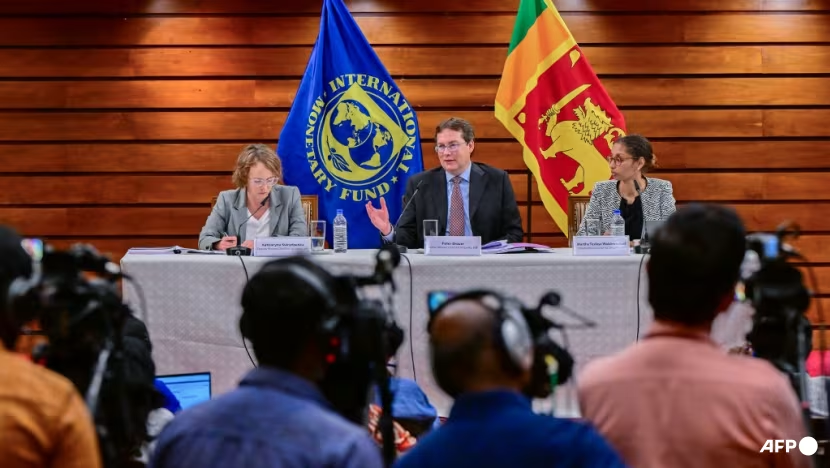
At Annual Meetings in Washington in October International Monetary Fund head, Kristalina Georgieva claimed Sri Lanka as a debt restructuring ‘success’ story.[i]  Left unsaid was that Sri Lanka’s external debt had apparently ballooned from $26 billion to a purported whopping $100 billion during two years of “reforms’ under the IMF’s Extended Fund Facility (EFF)![ii]

A month later, the island’s newly elected Cabinet led by President Anura Kumara Dissanayaka signed off on an official “bond exchange” with International Sovereign bondholders (ISB). The President had done a U-turn on election pledges to re-negotiate agreements with the IMF and ISB that were widely perceived to be detrimental to the county.

Continue reading

2 Comments

Filed under centre-periphery relations, commoditification, debt restructuring, economic processes, foreign policy, governance, IMF, IMF as monster, island economy, life stories, modernity & modernization, patriotism, performance, politIcal discourse, power politics, rehabilitation, self-reflexivity, sri lankan society, world affairs, world events & processes

A Reading of the Sri Lankan Elections from THE ECONOMIST

Item in The Economist, 23 Nov 2024: “Sri Lanka’s Left Turn: Sri Lanka’s president with Marxist roots now dominates parliament too” .… with highlighting emphasis imposed by the Editor, Thuppahi

SRI LANKA was once a pioneer of free-market capitalism in South Asia. After J.R. Jayewardene took power with a super-majority in 1977, he introduced a French-style executive presidency and economic reforms that overturned the left-wing orthodoxy of the previous two decades. Cheered on by Western governments concerned about Soviet influence, Sri Lanka became the first country in the region to liberalise its economy.

Continue reading

Leave a comment

Filed under accountability, centre-periphery relations, chauvinism, debt restructuring, economic processes, export issues, foreign policy, governance, IMF, Indian Ocean politics, island economy, Left politics, legal issues, life stories, parliamentary elections, patriotism, performance, politIcal discourse, power politics, rehabilitation, security, self-reflexivity, sri lankan society, working class conditions, world affairs, world events & processes

The Stark Political Choices Facing Sri Lanka’s Voters

Sugath Kulatunga, … whose preferred title was The Choice”

The President RW and the leader of the opposition in their political manifestos are making extravagant promises to the people in the process of seeking a path to come into power. So do the other Presidential candidates who have not so far tasted power. We cannot judge them on performance, while RW and Sajith could be judged on their past performance. Sajith was the Deputy of the ruling party and a senior Cabinet Minister of past UNP governments. RW held key Cabinet posts of Prime Minister, Minister of Education and also Industries. They are responsible for the present crisis in the economy as they did not address the balance of payments arena, particularly the balance of trade problem which has been the chronic issues.

Continue reading

2 Comments

Filed under accountability, authoritarian regimes, centre-periphery relations, debt restructuring, democratic measures, economic processes, electoral structures, export issues, governance, historical interpretation, island economy, life stories, parliamentary elections, performance, politIcal discourse, power politics, sri lankan society, world events & processes

Kenya: An IMF Lapdog in Serious Strife

A. K. L.  Steinbeck, …. with title and underlining imposed by The Editor, Thuppahi

WATCH =  https://x.com/DOmowale/status/1805701195366822364 …& … https://www.aljazeera.com/news/liveblog/2024/6/25/kenya-protests-live-deadly-anti-tax-protests-after-finance-bill-approved

ONE = Here, Kenyan protestors wreck Kenya’s parliament, setting fire to the building. About 20 protestors have been killed by police at a time when Biden refers to Kenya as “a major non-NATO ally,” after Kenya surrendered its sovereignty over to the IMF, World Bank, Western creditors, bankers, NATO and the CIA. 

Continue reading

Leave a comment

Filed under accountability, american imperialism, authoritarian regimes, centre-periphery relations, counter-insurgency, debt restructuring, disparagement, economic processes, governance, historical interpretation, human rights, IMF, IMF as monster, life stories, performance, politIcal discourse, riots and pogroms, self-reflexivity, slanted reportage, social justice, the imaginary and the real, trauma, Uncategorized, world events & processes

Reaching Out with Digital Education–Vanni Hope in Sri Lanka

Thuppahi has consitently supported the charitable outreach that has been pursued by Ranjan Sivagnanasundaram and his VANNI HOPE projects and has no hesitation in backing this line of charitable aid. 

“Enhancing Access to Digital Education for Disadvantaged Students/Children in the Rural Area of Sri Lanka”

 Introduction: The role of technology in teaching and learning is rapidly becoming a crucial and widely discussed topic in the modern education system. Most education experts agree that, when used effectively, information and communication technology have the potential to enhance teaching and learning while shaping job opportunities. Computer illiteracy is now seen as a new form of illiteracy, sparking a strong desire to provide schools in remote villages with the necessary computer facilities and trained personnel to develop technologically skilled students. It is undeniable that computers can assist in the instructional process and support students’ learning.

Continue reading

Leave a comment

Filed under accountability, centre-periphery relations, charitable outreach, cultural transmission, debt restructuring, economic processes, education, ethnicity, governance, island economy, landscape wondrous, language policies, life stories, modernity & modernization, patriotism, reconciliation, rehabilitation, self-reflexivity, social justice, sri lankan society, teaching profession, unusual people, voluntary workers, welfare & philanthophy, working class conditions