Category Archives: cultural transmission

Leonard Woolf’s WELIWEWA and Its Terrain

Gerald Peiris**

After getting the article in Thuppahi on Leonard Woolf and Silindu presented by Ernest MacIntyre, I read Village in the Jungle (for the second time since long ago) and found it difficult to connect the essence of the Woolf narrative with what the producers of the play referred to as an attempt to portray village like in a remote setting in the interior of the ‘deep south’.

Leonard Woolf in his aging years & glimpses of village women gathering tank-water in 2oth century Ceylon

Continue reading

2 Comments

Filed under accountability, British colonialism, centre-periphery relations, commoditification, cultural transmission, economic processes, ethnicity, historical interpretation, island economy, landscape wondrous, life stories, literary achievements, modernity & modernization, population, self-reflexivity, social justice, sri lankan society, unusual people, welfare & philanthophy, working class conditions

In Appreciation of Brendon Gooneratne

Hugh Karunanayake: “OBITUARY: Dr, Brendon Gooneratne, 28 March 1938-22 June 2021)”

Dr Brendon Gooneratne, an acclaimed physician, entrepreneur,  author, antiquarian, collector, environmentalist and all round sportsman, passed away in Welimada where he was receiving treatment after a fall. The news of Brendon’s demise was communicated by his daughter Devika just a day following his death.

Continue reading

1 Comment

Filed under cultural transmission, education, heritage, historical interpretation, landscape wondrous, life stories, literary achievements, patriotism, performance, self-reflexivity, sri lankan society, travelogue, unusual people

Captain Cook Symbolically Demolished in Canada

A Pseudo-Filipino named “Sir” Roger O’Neil

I can well understand why some Canadians knocked Captain Cook’s statue of its perch into a harbour in British Columbia.  

The only reason the Canadian PM has given a token apology about colonial crimes against indigenous peoples in Canada is because Canada has just been caught with its hands in the cookie jar with the discovery of mass graves. The Canadian government pursued a genocidal policy against indigenous peoples for 150 years — depriving them of language, forbidding the use of their indigenous birth names, medical neglect, sexual abuse, to name a few of their crimes. The government knew of it and were responsible for it for 150 years.

Continue reading

Leave a comment

Filed under atrocities, authoritarian regimes, British colonialism, centre-periphery relations, cultural transmission, disparagement, economic processes, education, ethnicity, heritage, landscape wondrous, Left politics, legal issues, life stories, meditations, performance, political demonstrations, politIcal discourse, power politics, racist thinking, self-reflexivity, social justice, the imaginary and the real, trauma, unusual people, vengeance, working class conditions, world events & processes, zealotry

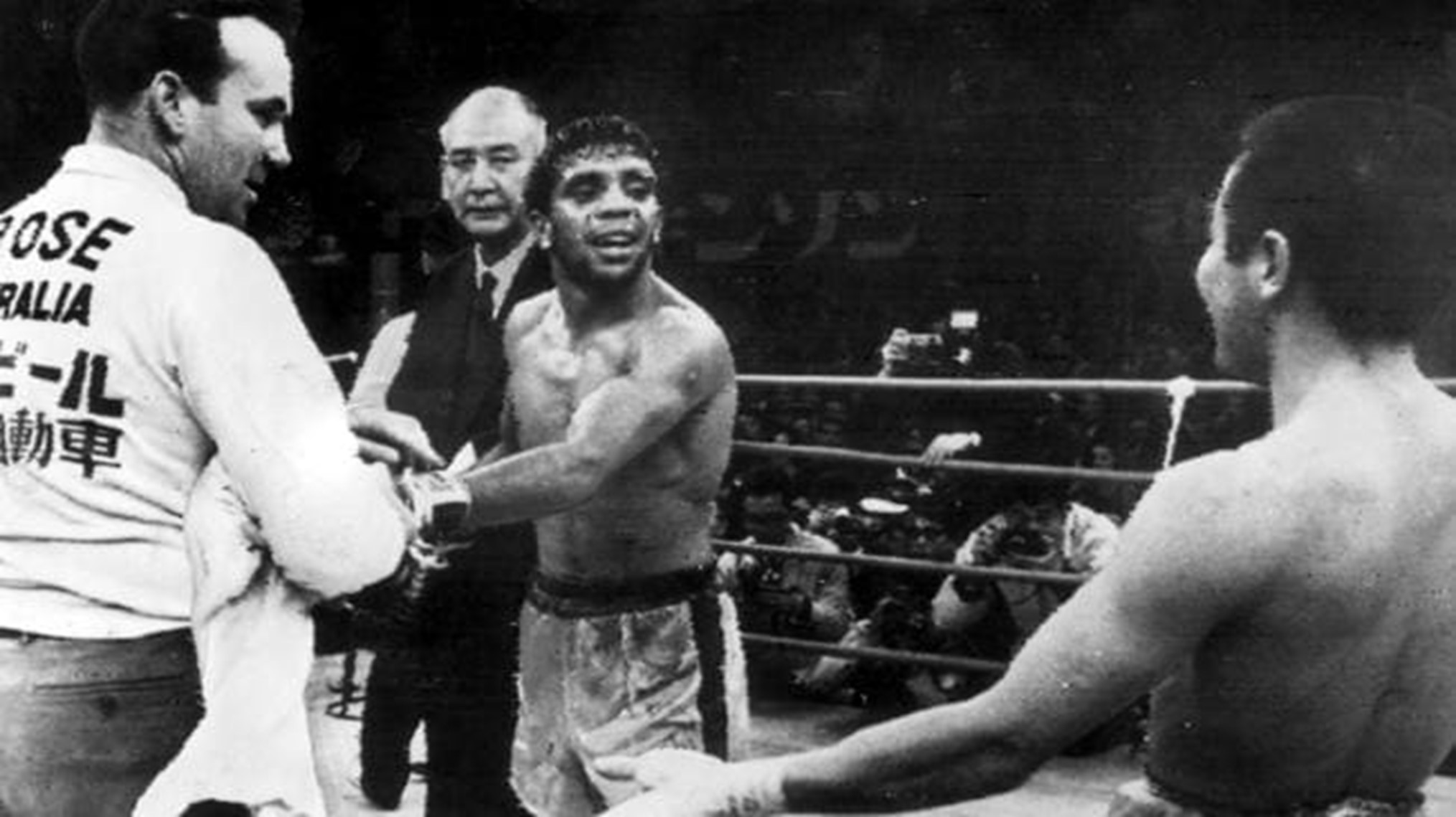
Lionel Rose: Aboriginal Boxer who united Australia

Will Swanton, in The Weekend Australian, 3-4 July 2021, where the title runs “Lionel Rose: battler who united Australia” 

Lionel Rose unified the nation more powerfully than Bradman, if more briefly — Bradman never had 250,000 cheering him through the streets.

Lionel Rose turns to embrace Fighting Harada … after he is pronounced the winner 

Lionel Rose met Paul Keating. Snipped him for a hundred. The Prime Minister reckoned he never carried any cash. Rose persisted. Did him slowly. Come on, mate. Can’t you spare a lousy hundred for a battler? Larrikinism abounded in Australia’s sporting stars of the 1960s and 1970s. Rose, Dawn Fraser, John Newcombe, larger than-life characters. It was the 1990s by the time Rose hit Keating where it hurt. The hip-pocket. Mischievousness was alive and kicking in Rose, and part of the reason for the request, but he needed the dough, too.

Continue reading

2 Comments

Filed under accountability, art & allure bewitching, Australian culture, australian media, communal relations, cultural transmission, democratic measures, discrimination, economic processes, education, ethnicity, heritage, historical interpretation, landscape wondrous, life stories, patriotism, performance, politIcal discourse, self-reflexivity, social justice, the imaginary and the real, unusual people, world events & processes

Dr Brendon Gooneratne: Versatile Talents …. Underlined from Outside His House and from Deep Within

A Note from Michael Roberts, July 2021

I first encountered Brendon Gooneratne as a formidable fast bowler playing for the Colombo branch of the University of Ceylon against against my Peradeniya branch around 1959/60, mainly as a pace bowler. Thereafter, I encountered him briefly as he courted Yasmine Dias Bandaranaike, a colleague in the Arts Faculty at Peradeniya …. and then  for a month or so when the married couple were neighbours of my household at Augusta Hill in Peradeniya University in late 1971. We have met subsequently on and off in Colombo and Sydney because of our strong interest in Ceyloniana.

  A reproduction of a framed photo of Brendon at Mount Kosciusko taken by his wife Yasmine

Meeting and listening to Yasmine at the Galle Literary Festival in 2008 was a great pleasure. Her ‘imprint’ has been captured for one and all in an essay I presented then as “January 2008 – When all roads led to Galle” [web-location lost].

Their continued ‘investments’ in the island were deepened by the residences which this couple invested in within the city of Colombo and as “Pemberton” (a conversion of a planting bungalow named ‘Pemberton’) in the upcountry terrain of Uva. So, Brendon’s ‘departure’ from our life-world is a loss of some magnitude. I mark it here in Thuppahi with (A) the mundane account in Wikipedia and (B) a moving testimony from his daughter Devika Gooneratne, …. a farewell that is as remarkable as it is worthy as epitaph — not least for its grounded assessment of the medical staff in Badulla area upcountry in ways that speak volumes for the personnel and system. 

So, this Note is a “Hurrah” for Brendon and “Three Cheers” for Devika and her mother.

Continue reading

1 Comment

Filed under accountability, art & allure bewitching, cultural transmission, education, ethnicity, female empowerment, heritage, historical interpretation, landscape wondrous, life stories, literary achievements, medical puzzles, meditations, patriotism, performance, self-reflexivity, sri lankan society, teaching profession, transport and communications, trauma, travelogue, unusual people, world events & processes

Origins of Sri Lankan Nationalism

Upali C Wickremeratne, presenting a critical review of  Sinhala Consciousness in the Kandyan Period: 1590s to 1815, by Michael Roberts, (Colombo, Vijitha Yapa Publications, 2003)…. originally presented in Ethnic Studies Review, vol. XXI,  No. 2, July 2003, pp. 207-20…. with pictorials imposed by Roberts against the grain of this article. NOTE: the title is that chosen by Wickremeratne … and is in fact a misnomer.

It is hard to think of a book, amongst those written by those affecting to be scholarly, which is based more on conjecture than this. The criteria for evidence should be considered. It is not a question of whether the sources are oral or documentary.  After all the evidence in a law court is mainly oral.  It is a question of considering the arguments for and against any particular point of view.  It is a question of weighing the evidence. A civil case is decided on a balance of probabilities and a criminal case on whether there is a reasonable doubt.  It is not a question of facts or the truth. Law draws a distinction between hearsay, opinion and evidence based on cross-examination.  Collingwood wanted an army of questions led into the sources. They would enable one’s own biases and predilections to be questioned.  It would supply the place of cross-examination.

Continue reading

Leave a comment

Filed under accountability, British colonialism, cultural transmission, ethnicity, historical interpretation, Indian traditions, insurrections, Kandyan kingdom, landscape wondrous, life stories, nationalism, patriotism, politIcal discourse, Portuguese imperialism, Portuguese in Indian Ocean, power politics, sri lankan society, transport and communications, unusual people, vengeance, violence of language, world events & processes

Lessons Derived from the Anti-Muslim Riots of 1915 …. For Today

Walter Wuthmann, in Daily News, 7 May 2018, where the title runs: “Revisiting 1915: Lessons from A Violent Past”

The recent mob attacks[ against Muslim families and property in Kandy is another sad chapter in Sri Lanka’s history of ethnic violence. Now, many are re-examining the past, looking for reasons for why this ugly strain of communalism will not subside, and for ways to fight it for the future. Because before Digana in March, and before Aluthgama in 2014, there was 1915.

  An old photo of the Mosqueat Castele Street inKandy where the initial spark for the “1915 riots”originated

Continue reading

Leave a comment

Filed under atrocities, British colonialism, Buddhism, centre-periphery relations, chauvinism, communal relations, conspiracies, cultural transmission, discrimination, disparagement, economic processes, ethnicity, fundamentalism, historical interpretation, Islamic fundamentalism, island economy, landscape wondrous, legal issues, life stories, news fabrication, politIcal discourse, power politics, self-reflexivity, sri lankan society, the imaginary and the real, trauma, truth as casualty of war, unusual people, vengeance, violence of language, working class conditions, world events & processes

Upcountry Clubs of Yesteryear — Nostalgic Histories

Sugi De Silva promoting Tours of Sri Lanka’s Upcountry Clubs of Yesteryear

Our search for the legacy of Sports and Clubs in Sri Lanka took us to Nuwara Eliya. Featuring one of the oldest and picturesque sporting venues in Sri Lanka – Radella Club (1856). Legacy Tour on Quadrangle is dedicated to Sporting institutions and legendary individuals who promoted Sports in Sri Lanka commencing from the Colonial era. During the 19th century under the patronage of British Administrators and by Planters and Military officials, various Sports Clubs were established exclusively for them to patronize recreational activities and social gatherings. By the middle of the 20th century, most of these Clubs were opened to Ceylonese or natives to patronize. Then Ceylon’s now Sri Lanka’s Sports and Sporting culture were built on these ‘Exclusive Clubs’ and these are the homes to some of the greatest and were Ceylon’s pride. The rich heritage along with the ‘Legendary Sporting Icons’ of yesteryear who made a mark through these hallowed sports clubs in various sports helped in popularising Sports in Sri Lanka. The journey has been long, challenging and we hope you will enjoy the stories we share from our tour to these Sports Clubs and Pubs.

Continue reading

1 Comment

Filed under architects & architecture, British colonialism, centre-periphery relations, communal relations, cricket for amity, cultural transmission, economic processes, ethnicity, heritage, historical interpretation, island economy, landscape wondrous, life stories, patriotism, performance, population, self-reflexivity, sri lankan society, the imaginary and the real, tolerance, tourism, travelogue, Uncategorized, unusual people, world events & processes

Vale Dr Brendon Gooneratne: Wide-ranging Appreciations

A tribute from News 1st to Late Dr. Brendon Gooneratne = https://www.youtube.com/watch?v=M2REVQayLGY 

Continue reading

Leave a comment

Filed under art & allure bewitching, cultural transmission, heritage, historical interpretation, life stories, meditations, performance, sri lankan society, travelogue, unusual people

Confronting Ethnic Violence and Its Roots in Vengeance

Michael Roberts

In presenting Basil Fernando’s book to the public, I have been led back in time to critical data he presented to me in the early 1990s re the “riots of July 1983.” As an act of condemnation THEN, my essay on those events depicted the MOMENT as a “pogrom.”[1] This label was guided by my awareness that in Russian usage this label meant “destruction” and thus went beyond the English dictionary translations of that word. Though I have been rapped on the knuckles by Kingsley M. de Silva for this nomenclature,[2] I remain adamant. What occurred in late July 1983 was a horrific set of events that cannot be buried inside that relatively mundane label “riots.”


Jubilant {Sinhala) rioters celebrate their mayhem at Borella Junction in Colombo on the 24/25th July night 1983

Continue reading

2 Comments

Filed under accountability, art & allure bewitching, atrocities, authoritarian regimes, Buddhism, centre-periphery relations, chauvinism, communal relations, cultural transmission, disparagement, economic processes, ethnicity, governance, heritage, historical interpretation, Indian traditions, landscape wondrous, language policies, life stories, photography, political demonstrations, politIcal discourse, power politics, religiosity, riots and pogroms, self-reflexivity, Sinhala-Tamil Relations, sri lankan society, Tamil civilians, the imaginary and the real, trauma, truth as casualty of war, unusual people, vengeance, violence of language, working class conditions, world events & processes