Posted on May 5, 2024 by kvramakrishnarao


discovery of the Hero-stones proceeded: The discovery of the three inscribed hero stones, which date back to the 3rd century BCE, at Pulimankombai in Theni district in 2006, is now a pictorial document along with all other estampages of the memorial stones documented in the book Nadukal Kalvettukkal (Inscriptions from hero stones), authored by eminent archaeologist R. Poongundran, former assistant director, Tamil Nadu Archaeology Department[1]. The memorial stones which display inscriptions in the ancient Tamil Brahmi script throw light on the literacy of the ancient Tamil society. “The three hero stones were discovered by the staff and students from the Department of Epigraphy and Archaeology of Tamil University, Thanjavur. The memorials were, for the first time, spotted in the village Pulimankombai, when a piece of land was tilled for agriculture,” informs Poongundran.

References from the books of Dr Poongundran: Besides the three hero stones discovered at Pulimankombai, plenty of other ones documented in Poongundran’s book, stand testimony to the idea of ancient Tamils considering cattle as their wealth. The book speaks of the hero stones erected in memory of the warriors, who died in seizing the enemy’s cattle and recovering theirs from the foe. The seizing of an enemy’s cattle as a declaration of war was called Aakolpoosal in classical Tamil. “The two themes Vetchi (the act of seizing enemy’s cattle) and Karanthai (the act of recovering the cattle from the enemy) were described in Tolkapiyam, the available ancient treatise of Tamil. Besides, many songs in Sangam Tamil literature speak on erecting the nadukal in memory of the warriors who died in the act of seizing the enemy’s cattle and recovering theirs from the enemy” informs Poongundran. One of the three ancient hero stones discovered at Pulimankombai informs in its Tamil Brahmi inscription that the memorial was erected to honour a warrior named ‘Pedu Theeyan Andhavan’, who was killed during his attempt in seizing his enemy’s cattle in a village called ‘Koodal’.

Tamil literary references: Reminding the origin of worshipping ancestors as family deities, the 335th song in Purananuru, a Sangam period work, says that there were no other Gods other than the slain warriors depicted in the hero stones. Sangam age poet Mangudi Kizhar describes the hero stones thus in his lyric:
There are no gods, other than the
memorial stones of heroes who blocked enemies,
killed their elephants with lifted, bright tusks
and got killed, to be worshipped with rice showerings!
Aavur Mulankizhar, another Sangam age poet, while writing on the death of his benefactor Malli Kizhan Kaariyathi, informs :
… now that he has become
a memorial stone, that young hero with a victorious spear, who
killed the cattle raiders…… he returned wearing fragrant ‘karanthai’ garlands that hang
down like udders of cows.
(It was a tradition in the ancient Tamil society to wear garlands stringed of vetchi flowers when going off on cattle raids and wear garlands of karanthai flowers while returning). “The language used in most hero stones was in vernacular. Besides, there are also a few memorial stones which contain the information on the deceased in the traditional Tamil verse forms Aasiriyappa and Venba” says Poongundran.

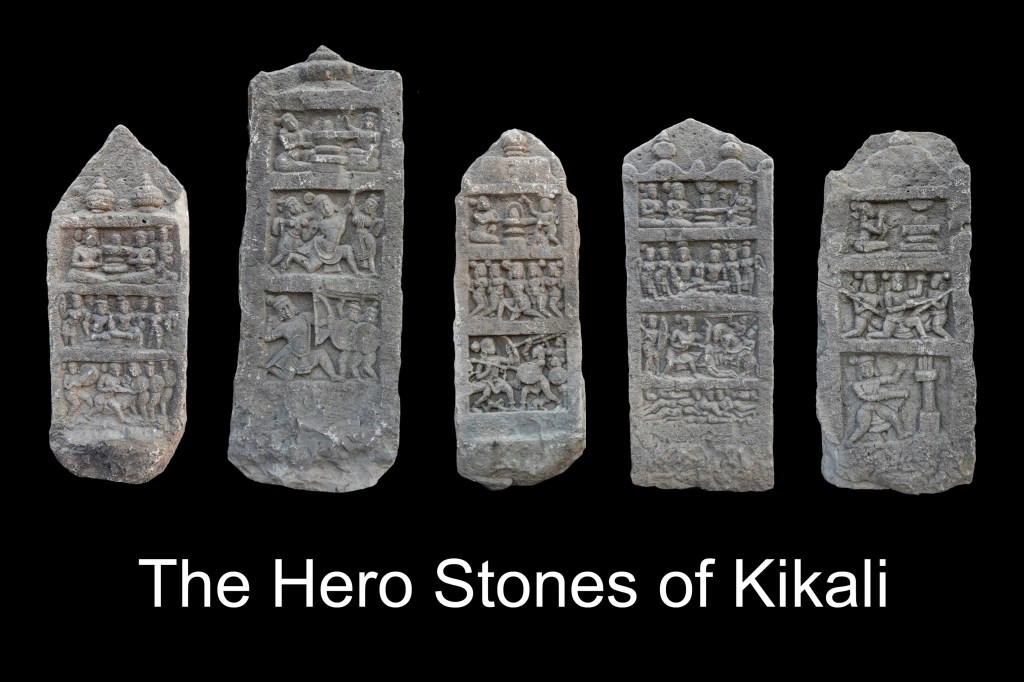
Hero-stones for the marginalized: Hero stones were crafted for the common, marginalised people in the northern belt of Tamilnadu when most of them died trying to protect their cattle, considered a major wealth, said Tamil Nadu State Archaeology Department former deputy director Dr R Poongundran[2]. He was speaking at the seminar on ‘Thondaimandalam, history, archaeology, art and folk traditions’, organised by the friends of heritage sites in Chennai[3]. Hero stones in this region were usually installed by relatives or younger warriors. They erected the stones in memory of these people, who sacrificed themselves for the sake of society and also worshipped them. In Tamil Nadu, there is a hero stone even for a dog that died in a battle along with its master, with its name inscribed on it. Another stone was erected for a fowl, he said. Poongundran said the practice of erecting hero stones continued till the 12th century CE.

The Hero-stones erected for common people also for the services rendered: Following Keezhadi excavations, where artefacts belonging to the sixth century were discovered recently, two hero stones belonging to the fifth century were discovered at Desoor village near Vandavasi on Tuesday. A team of officials from Tiruvannamalai Historical Research Centre discovered as many as five stones, out of which two belong to the fifth century and others, to the 10th century. The two stones, which are five feet in height and 1,500 years old, have inscriptions in the ‘Tamil language’. Tahsildar (HS) S Balamurugan told Express, “The scripts indicated that they belonged to the fifth century.” Based on information given by a revenue officer, the team conducted research and found the stones near a dilapidated structure. Balamurugan said[4], “The stones were found intact, and the locals were performing poojas. The other three stones discovered in the same place belonged to the 10th century. Upon closer examination, we found a stone had two images of a father and son, which is a first-of-its-kind in the district.” According to historian, R Poongundran[5], “Hero stones were erected in memory of Kotrambha Kizhar and his son Seelan.”

The Hero-stones of the Pallava period: Archaeologists have discovered four hero stones dating back to the Pallava dynasty, at Vathalmalai in Noolahalli panchayat[6]. The hero stones were placed in honour of people who had lost their lives when fighting against robbers and defending their village[7]. The stones were also engraved with ‘vatteluttu’, an ancient South Indian alphabet. Speaking to TOI, Kumaravel Ramasamy, secretary, Yakkai Heritage Trust (YHT) said, “Of the four hero stones, one stone is from the Mahendravarman Pallava period (600 CE-630 CE), while two stones are from the Eswara Varma Pallava period (705 CE – 710 CE). The last stone is unidentifiable as it is damaged.” He said each stone depicted two heroes who lost their lives while fighting to save their village. The names of the kings, Mahendravarman Pallava and Eswara Varma Pallava, were engraved in vatelluthu letters. A team of archaeological experts, led by YHT secretary Kumaravel, and comprising president Sudhakar Nalliappan, Chandran, Vignesh Varman, and Sathish Kumar, found the stones in the first week of September. They had sent details of the hero stones to R Poongundran, former deputy director, the archaeology department, Chennai, for further studies. Poongundran said vatteluttu inscriptions are usually found only in towns and villages. “It is very rare to discover such hero stones in Vathalmalai, which is a tribal region.” He added that the heroes engraved on the stones were depicted carrying bows, arrows and swords. “They are shown continuing to fight even after arrows have pierced their bodies,” Poongundran added.

A woman installing Nadukal for her husband: A hero stone at Semmayagoundenpalayam in the district might not be known to the outside world, but it has tales to tell from as early as the eighth century[8]. Usually hero stones are built by a group of people belonging to a hamlet or by male relatives of a local hero[9]. But this one has been installed by a woman in memory of her husband who killed a leopard that strayed into the hamlet for killing cattle. A hero stone at Semmaya.gounden.palayam in the district might not be known to the outside world, but it has tales to tell from as early as the eighth century. People in the vicinity have been offering pujas to the stone from time immemorial with a belief that arthritis and few other ailments related to the veins would be cured.
© K. V. Ramakrishna Rao
05-05-2024

[1] Documenting Tales behind Slain Heroes, By B. Meenakshi Sundaram, Jul 26, 2021;
https://simplicity.in/app/articledetail.php?aid=1286
[2] Times of India, Hero stones established for men from marginalised sections in Tamil Nadu, TNN / Updated: May 8, 2023, 09:58 IST
[3] https://timesofindia.indiatimes.com/city/chennai/hero-stones-established-for-men-from-marginalised-sections/articleshow/100060991.cms
[4] Indian express, 1,500-year-old hero stones discovered in Tamil Nadu’s Vandavasi, Updated on: 14 Nov 2019, 7:04 am
[5] https://www.newindianexpress.com/states/tamil-nadu/2019/Nov/14/1500-year-old-hero-stones-discovered-in-tamil-nadus-vandavasi-2061476.html
[6] Times of India, Four hero stones from Pallava dynasty discovered in tribal region, TNN / Sep 15, 2023, 09:35 IST.
[7] https://timesofindia.indiatimes.com/city/salem/four-hero-stones-from-pallava-dynasty-discovered-in-tribal-region/articleshow/103679360.cms
[8] The Hindu, A hero stone tells a tale from eighth century, October 13, 2014 01:50 am | Updated April 17, 2017 06:38 pm IST – Tirupur: R. VIMAL KUMAR.
[9] https://www.thehindu.com/news/national/tamil-nadu/a-hero-stone-tells-a-tale-from-eighth-century/article11067897.ece
&&&&&&&&&&&
ALSO NOTE