
Item in The Economist, 23 Nov 2024: “Sri Lanka’s Left Turn: Sri Lanka’s president with Marxist roots now dominates parliament too” .… with highlighting emphasis imposed by the Editor, Thuppahi
SRI LANKA was once a pioneer of free-market capitalism in South Asia. After J.R. Jayewardene took power with a super-majority in 1977, he introduced a French-style executive presidency and economic reforms that overturned the left-wing orthodoxy of the previous two decades. Cheered on by Western governments concerned about Soviet influence, Sri Lanka became the first country in the region to liberalise its economy.
South Asia’s most developed nation has now leapt back to the left. It was surprising enough that Anura Kumara Dissanayake, an outlier from a party with Marxist roots, won a presidential election on September 21st. More stunning still was his National People’s Power (NPP) coalition’s landslide victory in a parliamentary poll on November 14th. It won 159 of 225 seats, more than enough to change the constitution. Previously, the NPP had just three.
Mr Dissanayake’s mandate is another clear warning to South Asia’s political and business elites in 2024, following electoral upsets in Pakistan and India and a student-led revolution in Bangladesh. Considering his Janatha Vimukthi Peramuna ( JVP) party’s past links to China, his victory could intensify that country’s tussle with India for influence in the region. It is also a test for the International Monetary Fund (IMF), given his pledge to review a bail-out.
But the outcome raises questions for Mr Dissanayake too. What exactly does “Comrade President” (as he was introduced at rallies) plan to do with his vast powers and how will ideology shape those plans? Can he meet voters’ high expectations within the IMF’s constraints? And how open to criticism and political opposition will he be if public support wanes? His campaigns were based on broad promises to end endemic corruption and cronyism. That proved hugely effective among voters still reeling from Sri Lanka’s first debt default, in 2022. Mass protests ousted the president that year, and though his successor stabilised the economy and secured a $2.9bn IMF bail-out, voters penalised him in September over continuing corruption and austerity measures.
Opponents portrayed Mr Dissanayake as a dangerous radical. They cited the JVP’s two failed uprisings in the 1970s and 1980s (the party renounced violence in 1994). They pointed to his paltry government experience—he was briefly an agriculture minister two decades ago. And they said he would cause a financial crisis by trying to renegotiate the IMF bail-out.
So far, such warnings have been unwarranted: Mr Dissanayake has been far more of a pragmatist than a revolutionary. As he often boasted in election rallies, he has run the country with a cabinet of just three for almost two months without spooking markets. Harini Amarasuriya, the prime minister whom he reappointed on November 18th, is widely respected. And the cabinet of 21 people he named after this month’s election includes a sensible balance of academics, seasoned politicians and new faces.
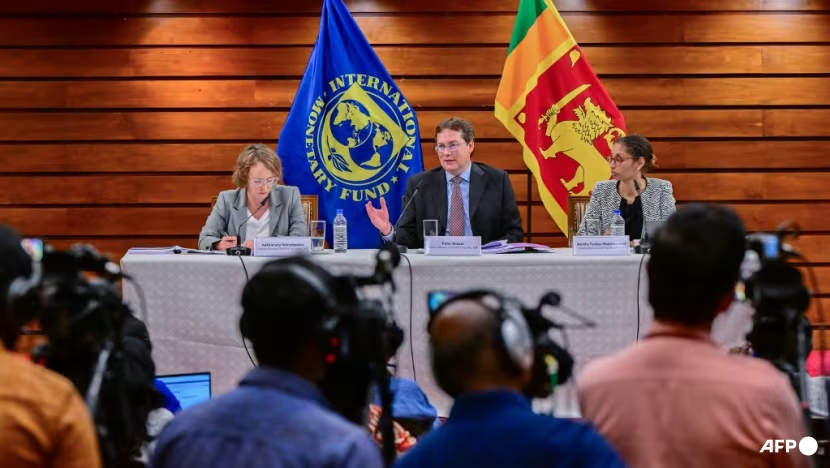
His handling of the IMF has been especially telling. While it may be possible to adjust tax rates and other parts of the existing plan for meeting bail-out benchmarks, some feared that he would demand much more, potentially reopening debt-restructuring talks with creditors, including India and China. But in a meeting with an IMF team that arrived in Sri Lanka on November 17th, Mr Dissanayake committed to the existing agreement, according to people familiar with the discussions. “That question is at least resolved in the short term and that is important for the stability of the economy,” said one.
At the same time, in a nod to the public pressure he faces to increase social spending, Mr Dissanayake urged the IMF to maintain a “balanced approach that considers the hardships faced by citizens”. And his government did not provide details on longer-term questions, such as its growth strategy and its views on trade or the role of the state sector. “That’s where you will have an ideological issue,” predicts Murtaza Jafferjee of Advocata Institute, a thinktank in Colombo, the capital. He fears that the government’s protectionist and statist instincts could stifle badly needed productivity growth.
Some answers may become clearer in the next few weeks, when Mr Dissanayake is expected to present an interim budget. Not all Sri Lankans may like what they hear. For the moment, though, most are just glad to be rid of a political old guard that pushed their once promising economy to the brink of collapse.
^^^^^*******************^^^^^

