
Gamini Goonetilleke, … with a few photographs awaiting insertion later
Image 1 – A view of the Jaffna Fort

Jaffna Fort – main entrance
The siege of Jaffna Fort
The Tigers had surrounded not only the Fort but also the Palali Air Base to prevent the mobility of the troops and also to cut off supplies. They positioned anti-aircraft guns in the Fort area. This threatened the helicopter borne supplies to the stranded troops and the battle for the Fort turned out to be fierce and intense.

Image 3 – Map of Jaffna Fort indicating the LTTE positions
 Images 4 5 6 – Tiger bunkers and concrete lined tunnels

 The Tigers were determined to capture the Jaffna Fort at any cost as it was situated in the heart of the city, in close proximity to the Pannai causeway that linked the Mandativu Island. On 10 June 1990 the first shots were fired at the Jaffna Fort. But clear instructions had been given to the army not to retaliate. The next day a massive bomb exploded close to the strong wooden door on the lagoon side of the Fort. However they were unable to penetrate the army defences. As the siege became more acute and the lives of the troops became endangered, the Sri Lankan military made many attempts to break the siege.
 Images 7- Bell 212 helicopter
 Image 8 – Helicopter gunship with Air force gunner Three days later a rescue operation code named “Operation Eagle 1” was carried out and a helicopter gunship landed on the road bordering the Fort, adjoining the lagoon. This was perhaps the only site a helicopter could land. Landing a helicopter inside the Fort was out of the question as the enemy would have destroyed it with ease. They were able to provide the stranded troops with a few more weapons for defensive and offensive purposes. The conditions were getting difficult for the troops with each passing day. They were not only running short of ‘ammo’ but also food. In the meantime the water and power supply to the Fort had been cut off. The only water that was available was from a well within the Fort, but this was salty.
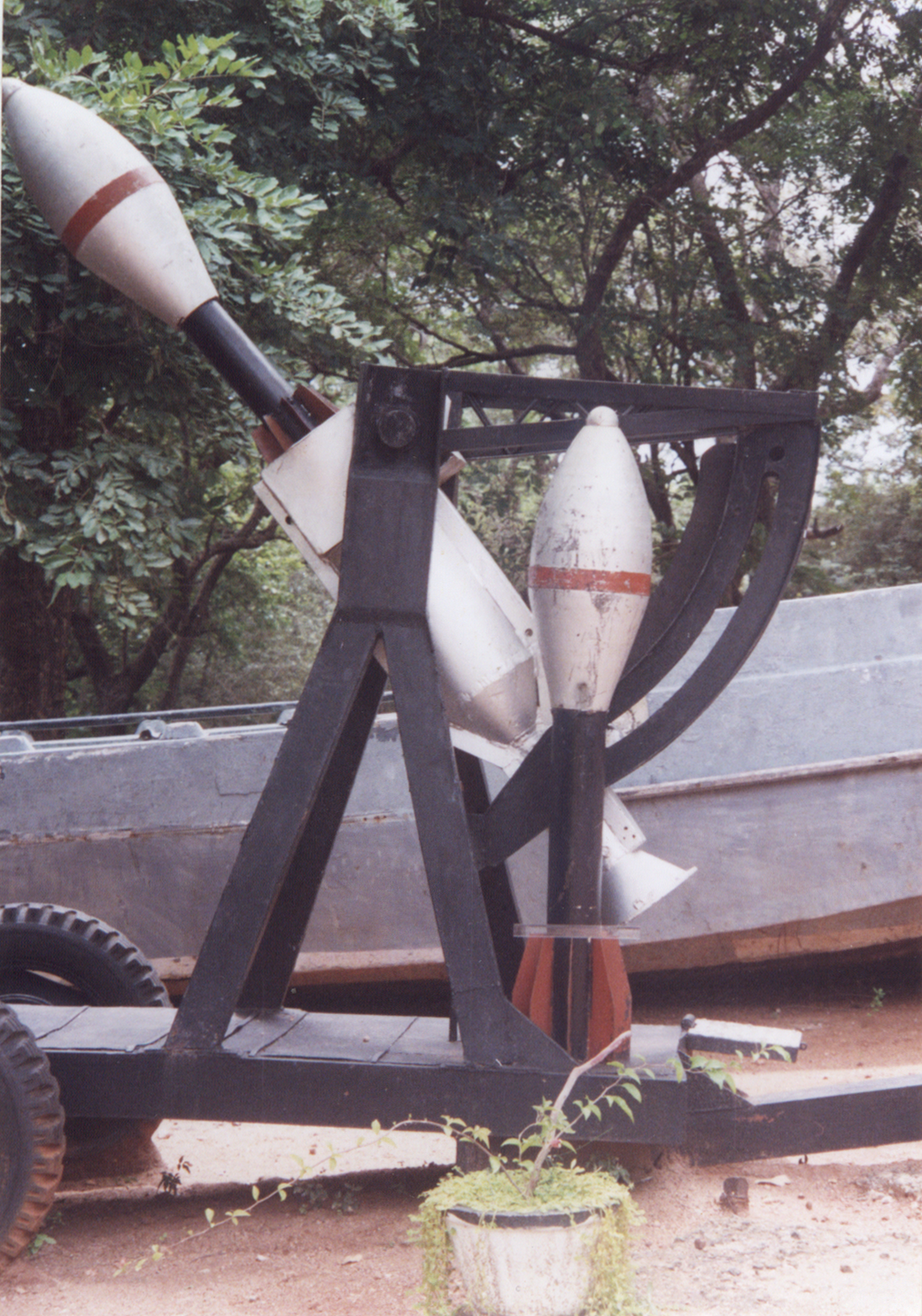
There were no medicines or dressing at all for the wounded. The troops that were stranded had to fight on with no end in sight. The rampart gave them the much needed protection against the barrage of enemy fire using all types of weapons both conventional and improvised. One improvised weapon that was used heavily in this battle was the “Pasilan 2000”, a Tiger invention. This was a heavy mortar fired from a launcher mounted on a tractor. As the mortar was heavy, it was only effective at close range.



The conditions for the besieged troops were getting worse day by day. The casualties were increasing in number. There were no doctors or paramedics within the Fort. The injured had to be kept in a bunker to prevent further injury. At least fourteen of the troops succumbed to their injuries and had to be buried within the Fort. The dry provisions that had been provided were gradually getting exhausted. They had to live on a meal of rice and dhal on many days and nights. At other times raw papaw from trees grown within the Fort filled their stomachs. Fish living in the moat were caught, boiled and consumed under desperate situations.
The soldiers stranded in the Fort were looking open-mouthed at the skies day in day out hoping for an air drop of some food. The Air Force attempted to air drop food packets on many occasions, but most of it landed in enemy territory or in the lagoon. Dry provisions such as rice that were dropped into the Fort were contaminated and the bags split open on being dropped from a height of over 6000 feet. The contaminants included shrapnel from mortars, debris and dirt including pieces of human flesh that was all over the Fort. One soldier later told me that “it was stinking to glory with human flesh and dead bodies all over”.
 Image 12 – SIAI Marchetti ‘bomber’
The entire power of the Air Force was mobilized to systematically bomb the Tiger positions. The ‘Machetti’ bombers, civilian aircrafts and helicopter gun-ships were utilized to pound the area and the buildings occupied by the Tigers with the aim of dislodging the siege. Thousands of locally made “Barrel Bombs” blasted the metropolis areas, reducing the houses and buildings to heaps of rubble. Some of these “Barrel Bombs” dropped from Y-8 transport planes fell inside the Fort.
 Image 13 – Barrel bombs
  Image 14 – Y8 Aircraft
This added to the misery of the stranded troops as they had to take cover in bunkers to avoid being injured by the explosion of their “own bombs”. Some no doubt sustained injuries. Artillery shells were fired relentlessly from the land and the sea at Tiger positions. In spite of this massive bombing onslaught, the LTTE fighters held their positions deep underground in their solid bunkers. There is no doubt that there would have been many civilian and Tiger casualties as well as deaths of people living in the vicinity. Their numbers are not known and will never be known. The Tiger casualties were treated at the Jaffna Government Hospital, funded by the State. The Forces had no access to this hospital, a rather strange situation.
While tightening the siege amidst relentless bombardment by the security forces from land, sea and air, the Tigers launched offensive raids on the Fort garrison in an attempt to over-run it. Women fighters also participated in these most dangerous and daring operations. One such offensive attack took place on 5 August 1990 during which a woman guerilla unit commanded by “Lt Sangitha” made a brave attempt to break-through the entrance of the Fort. This daring raid was foiled by the heavy resistance of the Sri Lankan troops. “Lt Sangitha” and three other women fighters died in this operation.
On 25 August, Sanoos, a Reserve Police Constable on guard duty at the entrance to the Fort was injured by a mortar blast. A colleague who was close to him died on the spot. A part of the left buttock of Sanoos had been ripped off. He was in agony and the impression he had was that he too would slowly but surely bleed to death like some of the others who had been injured earlier. Being a Muslim he started reciting the Holy Quran. There were no ‘pain killers’, leave alone antibiotics, saline or blood for the injured. Others in the Fort wrapped him in a sheet and took him to a bunker for safety until the arrival of the helicopter. The Palali Army camp was informed but helicopters could not land to evacuate Sanoos. He had to wait with this major injury for another day. Mohideen was another Policeman who had been stranded within the Fort. He too was injured but two weeks before Sanoos. Mohideen had a piece of shrapnel going through his left chest that led to the collection of blood within the chest. He survived for 2 weeks without any treatment.

Image 15 – Mohideen at the Palaly Base Hospital being treated for the chest injury
On 26 August the Air Force carried out a rescue mission code named “Operation Eagle 2”. Like an Eagle, the helicopter flew very low over the lagoon to avoid enemy fire. It could not land. As it came close to the Fort, and was stationary for a few minutes, Mohideen and Sanoos were carried and thrown into the helicopter by the troops. They were lying on the floor of the helicopter. They were in agony. Sanoos was helpless. He could not move his legs. The gunner of the helicopter gunship was holding on to him with one hand while firing at the enemy with the other. The empty shells from the gun mounted on the helicopter were landing on the body of Sanoos. These were red hot and added to the misery of Sanoos.
As the helicopter reached a satisfactory height to avoid being hit by Tiger fire, the gunner pulled him in further. A few minutes later the helicopter landed in Mandativu island which was the center for coordinating all military operations connected with the rescue attempt. The two casualties were given “first aid” after many days before their transfer to the Palali hospital by ambulance. They were lucky!
 Image 16 – Sanoos, with injury to his buttocks admitted in a state of shock and collapse
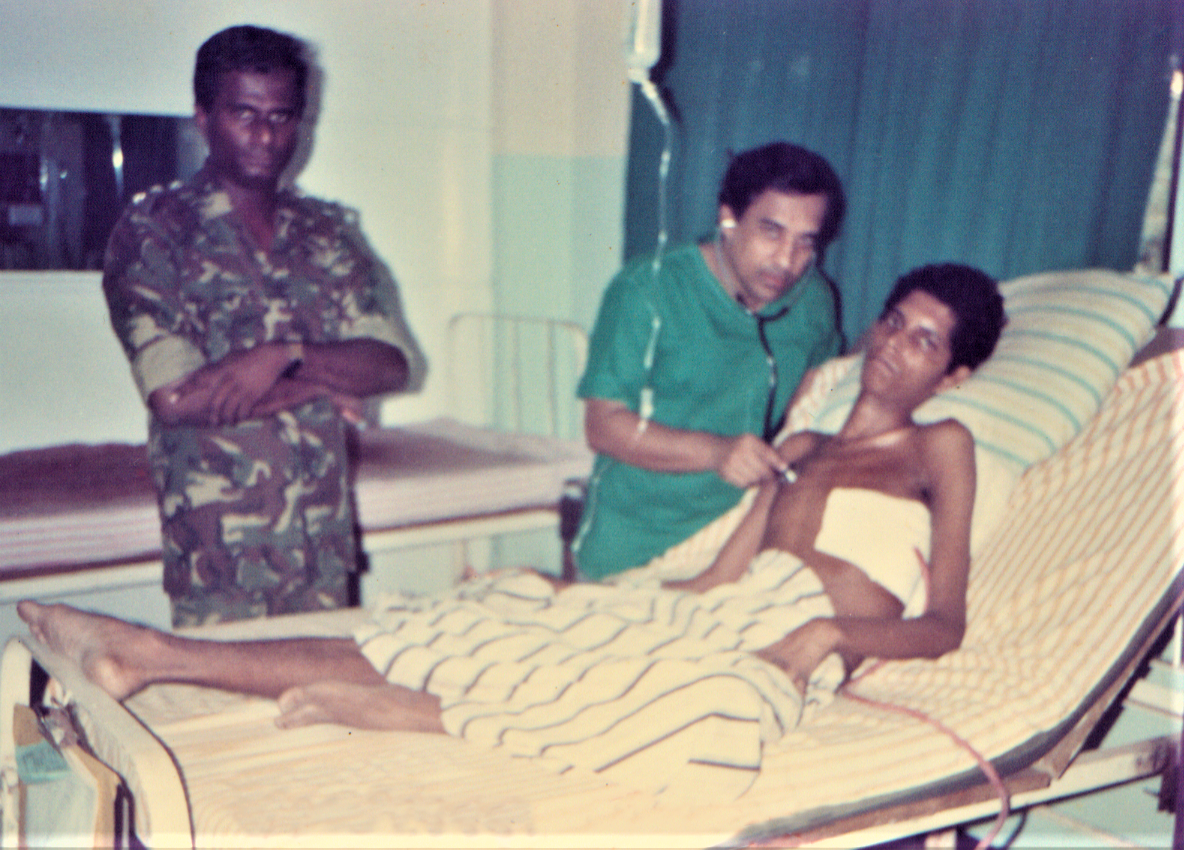
Sanoos and Mohideen reached Palali hospital around midnight. Both were extremely ill, no doubt, with serious injuries which would have killed them if there was further delay. Mohideen had blood transfusion, saline, antibiotics and a tube was inserted to the chest to drain the blood that had collected within the chest cavity. Sanoos required extensive surgery. A part of his left buttock was gangrenous.
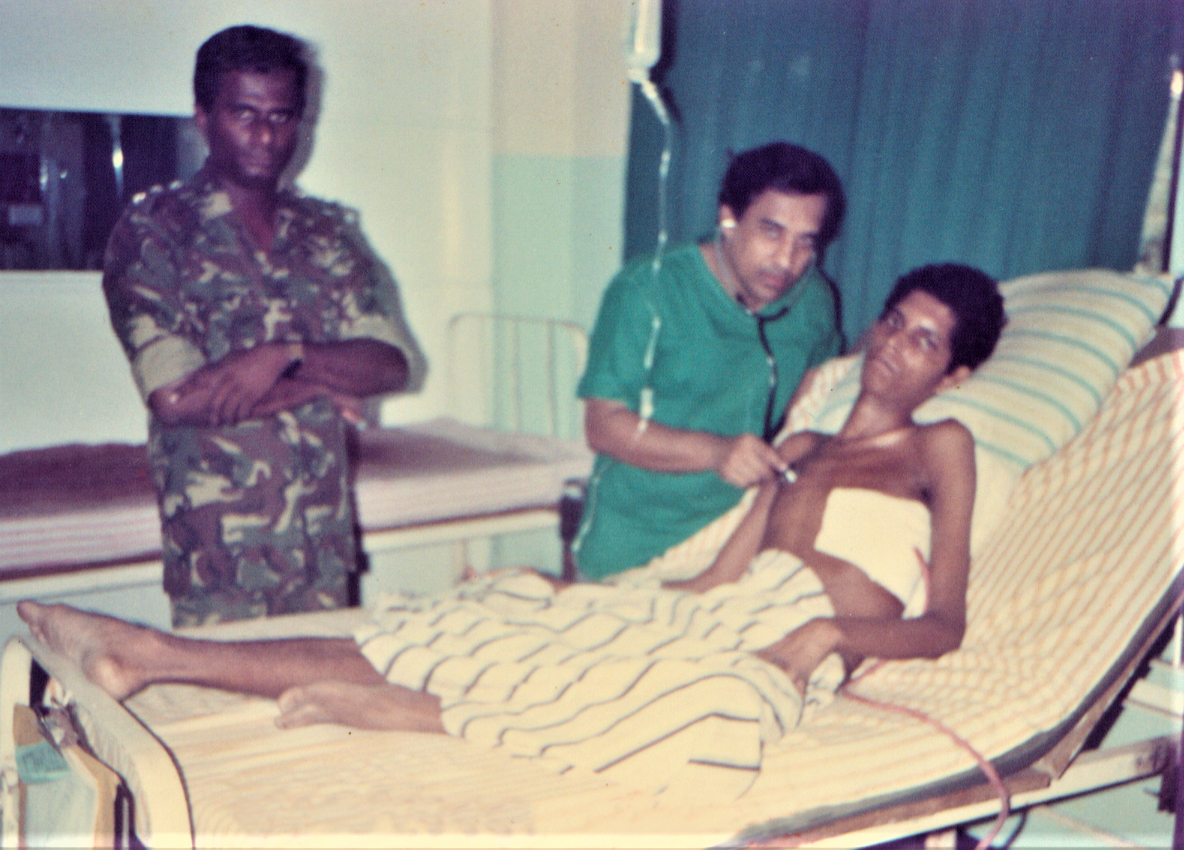
 Image 17 – The injury on the buttocks of Sanoos before surgery
 Image 18 – Sanoos after emergency surgery
At the operation this part of the buttock had to be cut off until red, bleeding contracting muscle was evident, indicating that all dead tissue has been removed. This is the basic principle of war surgery which I had learnt many times over while treating battle casualties. He too required blood transfusion to replenish the blood lost after the injury. Strong antibiotics helped to overcome the infection that had set in. Their condition improved gradually and I decided to transfer them to Colombo after five days. My turn of duty at Palali had finished by then and I decided to accompany these two casualties. A Y-8 transport plane was arranged and as usual the patients and the surgeon had to lie on the floor of the aircraft en route to Ratmalana.
Image 19 – surgical team and the patient e  n-route to Ratmalana in Y – 8 aircraft, all lying on the floor of the aircraft
Both of them recovered completely with further treatment. As the existence of the besieged soldiers became precarious and the fall of the garrison became imminent, the Sri Lankan forces launched a massive combined operation to dislodge the siege. On 13 September 1990, 4000 troops with the assistance of the Air Force and Navy mounted a huge operation from Mandativu island to destroy the Tiger positions. It was a bloody battle. The Tigers stood firm against a continuous barrage of bombs and artillery shells that pounded their positions from every direction. Fierce fighting flared up when the Sri Lankan troops attempted a sea-borne landing across the Jaffna lagoon. Tiger gunfire destroyed several naval crafts and scores of soldiers were killed on the spot. A propeller driven bomber that was used at that time called Siai Marchetti (warrior) was also shot down over the lagoon. As the security forces casualties mounted, the operation was suspended.
The Government decided to give up the Jaffna Fort on 26 September 1990. All the weapons, ammunition and the vehicles that were within the Fort were destroyed prior to the withdrawal. This coincided with the death anniversary of Tiger ‘martyr’ Thileepan. Sri Lankan troops withdrew from the Fort and the Tigers hoisted the “Ealam flag” over the Fort, signifying their victory and heroic resistance in this legendary battle. They occupied the Fort for nearly 5 years until they were dislodged in another major military battle code named ‘Operation Riviresa’. On 5 December 1995 the Sri Lankan troops captured the Fort once again and hoisted the national flag. In this unending war, this is the way the pendulum has been swinging at different times.
 Image 20 – The wound on Sanoos after healing

Image 21 – Sanoos, many years later with the surgeon at Arugam Bay, Pottuvi, his hometown – 29th September 2020
****************************
ALSO NOTE

Gamini Goonetilleke’s book THE EXTRA MILE: A Surgeons Experiences …. where more stories related to the conflict and his personal experiences are documented. The book is available at – Barefoot Gallery, Sarasavi bookshop, Nugegoda, M D Gunasena Book shop, Colombo 5, Vijitha Yapa bookshop, Colombo 3
Contact the author – phone 0777 794 107
**************


It was an unnecessary war thrust upon the Tamil youth by the Govt o Sri Lanka by enforcing the policies of “Sinhala Only” and later the policy of “Standardisation” to University admissions.
Sinhala Only was a policy which was never fully implemented. Standardisation came way later. The war was not thrust upon the Tamil youth by SL gov. No sane people would respond to a language law like that. The war was the result of years of brainwashing of Tamil youth by Tamil nationalists about an imaginary Tamil history and a false homeland concept.
SL war is a spillover of Nazi like Tamil nationalism from Tamil Nadu.