Allan Radcliffe, a review essay … 10 August 2022 — with highlighting here imposed by The Editor, Thuppahi
A stage epic is a rare beast in Edinburgh, where audiences are accustomed to shows of one-hour tops in makeshift venues. Counting and Cracking is novelistic in its scope and ambition, featuring several storylines that sprawl over two continents and nearly half a century. Its three-and-a-half-hour running time goes by in a blink.


The play, by S. Shakthidharan, was first staged as part of the Sydney Festival in 2019, but the story has acquired resonance with the renewed focus on Sri Lankan politics. The playwright, who takes on associate director duties alongside Eamon Flack, the director, drew on his family history in his attempt to understand the country’s recent past, including the bloody 26-year civil war. The result is not only a gripping dramatisation of key events but a poignant, at times extremely funny exploration of western multiculturalism and assimilation.
We open in Australia in 2004, and a tragicomic scene in which Siddhartha (Shiv Palekar), a first-generation Sri Lankan-Australian, reluctantly performs a traditional immersion ceremony, scattering his grandmother’s ashes into the Parramatta River in Sydney under the less-than-patient instruction of his mother, Radha (Nadie Kammallaweera). The ritual has been undertaken with relative speed, not least when compared with the funeral rites for Sid’s great-grandfather, a respected politician in the old country, whose ashes Radha carries around in a plastic box, 21 years after his death.
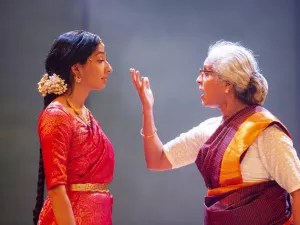
As played by Kammallaweera, and by Vaishnavi Suryaprakash in her younger incarnation, Radha is a wonderful creation: haughty and imperious, given to warmth and humour while being prone to explosions of anger. Having migrated to Australia in 1983 after the violent anti-Tamil persecution and rioting of Black July, she has focused squarely on her new surroundings and her ambitions for her defiant son. When Siddhartha meets and falls in love with Lily (Abbie-Lee Lewis), a Yolngu woman with a fierce understanding of her place in the world, it awakens a new-found desire in the youth to come to terms with his own heritage.
What most impresses here is the patient unfolding of the storytelling. The action flows backwards and forwards in time, from Colombo in 1956, when Tamil and Sinhalese people enjoyed warm relations in newly independent Sri Lanka, and on through the upheaval of the 1970s. The staging is simple, the better to focus attention on the beautifully choreographed 16-strong ensemble. There is real intensity to the final scenes, the action spilling from the stage into the auditorium, but the play is shot through with leavening humour, and many compelling characters.
To August 14, lyceum.org.uk. Birmingham Rep, August 19-27,
*****************
A NOTE from Michael Roberts, !3 August 2022:
Apart from knowing Ernest MaIntyre from Peradeniya days, I was fortunate enough to take in the playwhen it was presented in Adelaide. Let me present the feature article placed in Thuppahi after that performance … together witha few scenes therefrom and some bibliogphical references to the context reviewed by the playwright nd his actors/actresses.

Cracking Impact! The Suntharalingam Saga’s Theatrical Tour de Force
SOME REFERENCES
Matthew Westwood: “The Suntharalingam Family’s Journey: Sri Lanka to Australia,” 10 January 2019, https://thuppahis.com/2019/01/10/the-suntharalingam-familys-journey-sri-lanka-to-australia/
C. Suntharalingam: Eylom: Beginnings of the Freedom Struggle, Colombo, 1967