Site icon Thuppahi's Blog

Deciphering the KAVADI Phenomenon within Sri Lanka ….

VERITE RESEARCH in  Colombo, Item entitled “Power on Parade: Government Keeps Kavadi on the  Road”

Over the past week, Sinhala media focused on reported security concerns surrounding the kavadi segment of the 769th annual Esala Maha Perahera (procession) of the Uthpalawanna Sri Vishnu Maha Devalaya in Devinuwara (also known as Dondra in the Matara District)—see box for explanation of kavadi. The issue gained traction across the Sinhala press, television and social media. Social media narratives and conversations were monitored and analysed using specialised digital tracking tools.[1]

This week’s analysis is set out under four headings.

1. The key events that captured public attention

July 21: A shooting was reported at a house near the Uthpalawanna Sri Vishnu Maha Devalaya in Devinuwara. Police later said they suspected a link to the dispute over kavadi troupe selection.

July 25: Inspector General of Police (IGP) Priyantha Weerasooriya recommended temporarily removing the kavadi segment from the perahera (procession), citing intelligence reports about a kavadi troupe-selection dispute involving groups linked to organised crime. The police assessment warned that members of criminal groups could join the troupes and referred to the possibility of a violent clash and a drone attack. Subsequently, the Matara District Secretary Chandana Thilakarathne instructed the basnayake nilame (the lay custodian of the devalaya/shrine) to suspend the kavadi segment.

July 26: Audio recordings in circulation brought the dispute into public view. One recording, in which the speaker demanded that the excluded troupes be reinstated and threatened the basnayake nilame, was attributed by media reports to Mohamed Imran (alias Kanjipani Imran). A second, attributed to Shehan Sathsara (alias Dehi Bale Malli), opposed that demand. Both figures have been publicly associated with organised crime and narcotics networks. The basnayake nilame said the kavadi could proceed with the 25 registered troupes.

July 27: Public Security Minister Ananda Wijepala and IGP Weerasooriya met at the Matara District Secretariat, after which the government set aside the restrictions on participation and allowed all troupes that had performed in the previous year – not only the 25 registered troupes – to take part.

July 28: The kavadi segment was performed as part of the sixth perahera under a deployment of around 1,500 security personnel, including the Special Task Force.

In this week’s MPA, we examine why being selected to be in the kavadi procession matters locally, how reported links to drug networks turned a troupe-selection dispute into a security concern, and what the response meant for the government.

What is kavadi?

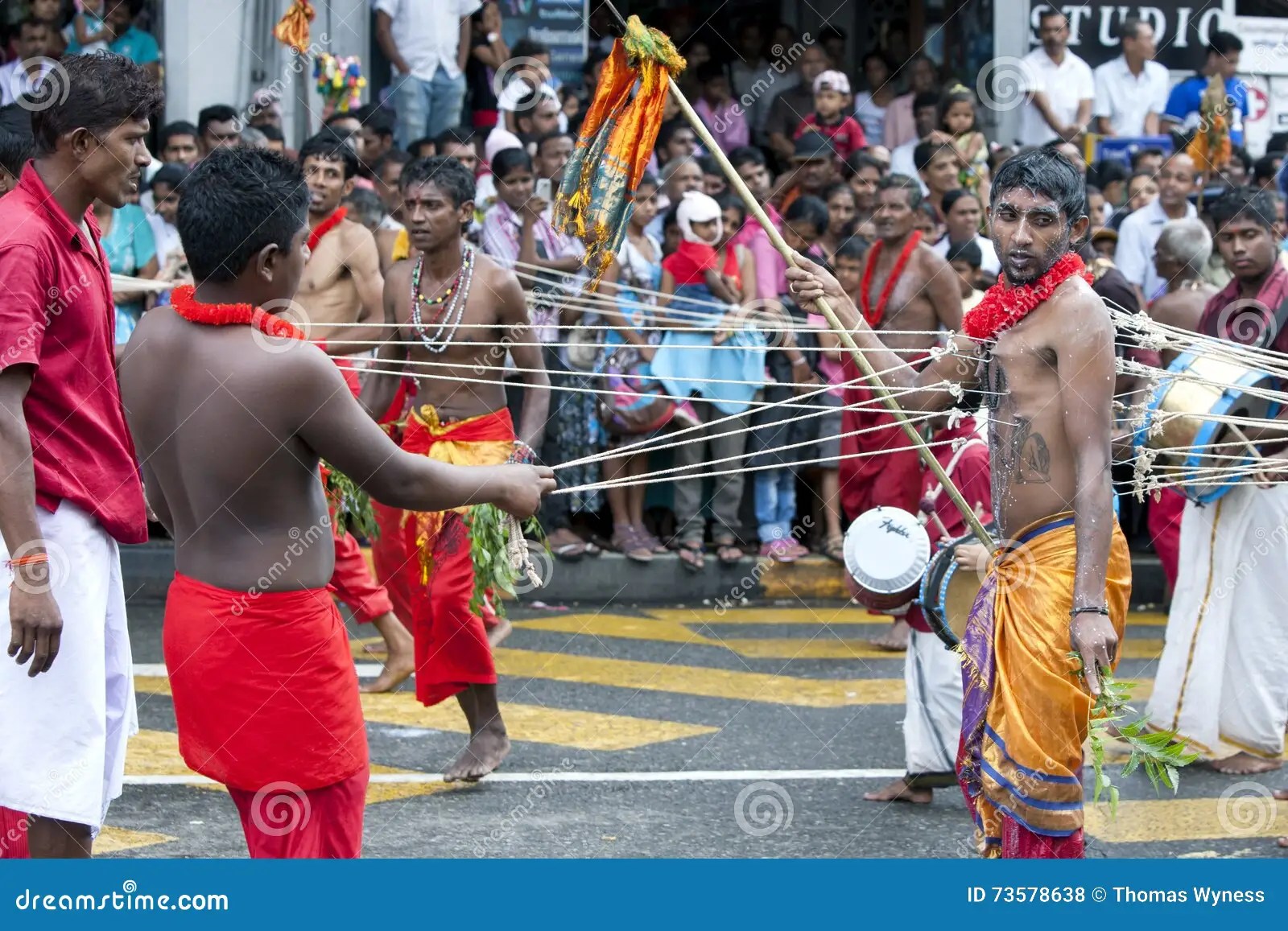
Kavadi is a devotional practice associated mainly with the Hindu deity Murugan, who is identified in Sri Lanka with Kataragama Deviyo (a deity also known as Skanda and Murugan). Devotees carry decorated structures or vessels on their shoulders while dancing in procession, often after fasting and other forms of physical discipline, including bodily piercing as part of the ritual. These physical demands are understood as expressions of devotion, penance and gratitude.

At Devinuwara, kavadi forms part of the procession of the Uthpalawanna Sri Vishnu Maha Devalaya, a shrine that houses Upulvan Deviyo (widely referred to as Sri Vishnu and counted among the four main guardian deities of Sri Lanka).

Among the coastal communities in Devinuwara, kavadi has traditionally been associated with Karava fishing families and forms part of their religious lifeIn spiritual terms, it bears some resemblance to coastal Catholic feasts, such as St Anthony’s feast at Kachchativu or Spain’s Virgen del Carmen celebrations, which similarly connect faith, the sea and community participation. By contrast, in its visual form and energy, it has similarities to Mardi Gras, celebrated with street parades, floats and costumes, most famously in New Orleans. This takes place in the kavadi through music, choreography, bodily confidence and group visibility

Evolution of kavadi

Kavadi now combines devotion with public display. Its contemporary form places greater emphasis than in the past on choreography, physical strength and competition between troupes.

Its presentation has also changed. Traditional devotional rhythms are increasingly mixed with popular Sinhala and Tamil music, played on instruments such as trumpets and saxophones. Performances take place before large crowds and are widely shared on social media. Women also participate, but much of the public imagery centres on male dancers and on displays of strength, endurance and confidence.

Click to view a kavadi dance item from the Devinuwara Perahera

Kavadi therefore remains an act of devotion while also offering a stage: troupes display masculinity and endurance, and participants and organisers earn standing, influence and privilege in the eyes of their communities.

2. Why the dispute over being selected in the kavadi procession mattered

Being selected to be in the kavadi procession carries more than religious value. It also brings public recognition to the families, neighbourhoods and sponsors linked to each troupe.

Three features explain how a dispute over troupe selection became a security concern that gained significant media attention.

First, where fishing and trafficking overlap, criminal networks gain local footholds.

Fishing is an important livelihood along the coast from Matara through Devinuwara to Gandara. Law enforcement operations have also repeatedly intercepted narcotics carried across the southern seas and brought ashore along this coast. Drug traffickers are known to exploit boats, crews, landing points and local knowledge of the sea. This can bring criminal networks into some of the same coastal spaces and relationships that sustain fishing communities.

In this context, the reported involvement of Kanjipani Imran and Dehi Bale Malli (see box) to field their own troupes in the kavadi gave the dispute the appearance of a local turf struggle between rival drug networks. This echoes cartel rivalries in Mexico and elsewhere in Latin America, where competition over drug routes can spill into struggles for territory and local influence. The similarity lies in the pattern, not the scale.

Who are Kanjipani Imran and Dehi Bale Malli?
Kanjipani Imran is the nom de guerre of an organised crime and drug-trafficking figure whom police have linked to criminal and narcotic activity and believe to be overseas. He was deported from Dubai to Sri Lanka in 2019 and released on bail in December 2022, when the court barred him from travelling overseas. He has since been reported to have left the country. Dehi Bale Malli is the nom de guerre of a drug trafficker from Devinuwara whom police have connected to a major narcotics consignment recovered from the southern seasHe is the prime suspect police named in the Devinuwara double murder of March 21, 2025, in which two individuals were shot dead near the Devinuwara Sri Vishnu Devalaya.  In October 2025, the Colombo Chief Magistrate ordered his arrest after the Police Narcotics Bureau linked him and his brother to a combined haul of more than 839 kilograms of heroin, crystal methamphetamine and hashish. Police said he was believed to be overseas.
Second, because kavadi troupes represent families or neighbourhoods, disputes over limited places in the troupe in the procession can mobilise competing local networks.

In Gandara and neighbouring areas, kavadi troupes are often organised along these lines, with participation continuing across generations. Being selected in the procession therefore brings more than the chance to perform. It gives the group prominence in one of the area’s main religious and cultural events.

For the figures named above, influence over troupe selection would offer a way to support particular groups and mobilise followers by helping them be selected in the procession. A disagreement over participation could therefore widen into a confrontation between rival local networks.

Third, competition to sponsor or influence troupes can turn the procession into a contest for local influence.

Those who finance or organise a troupe can present themselves as patrons who help a group secure participation. For figures associated with crime, this can turn illicit wealth into influence through an institution the community respects.

The dispute therefore appeared to concern more than troupe selection. It suggested a struggle over which alleged drug networks could exercise greater influence in the area. The July 21 shooting, which police suspected may have been linked to the troupe dispute, suggests that the rivalry may already have moved beyond verbal threats.

3. The Sinhala media discourse on the events

The Sinhala media discourse raised concern about the apparent reach of organised crime into respected areas of religious and community life.

Public anger was directed mainly towards the alleged criminal figures involved. The concern was not only that rival drug networks had threatened violence, but that they appeared able to influence participation in an important religious procession.

Sinhala commentary also drew attention to the ways in which involvement in a troupe — financing it, recruiting dancers, arranging transport or influencing selection — could let criminal figures present themselves as community patrons.

The wider unease was that organised crime had moved beyond narcotics routes and integrated itself into the institutions through which communities express faith, identity and belonging.

4. The impact on the government

The government had to balance two competing demands: acting on a specific security warning and allowing a highly regarded religious event to take place.

On July 25, the Matara district secretary, acting on the recommendation of the IGP, instructed the basnayake nilame to suspend the kavadi segment of the perahera. That order left the government balancing two competing demands: acting on a specific security warning to ensure safety and avoiding suspension of a long-standing and much anticipated annual religious festival.

Maintaining the suspension of the kavadi segment would have prioritised the police warning. The assessment was detailed and in writing, and it referred to the possibility of a violent clash and even a drone attack. In Sri Lanka, such warnings are viewed against the public memory of past failures to act on warnings: for instance, the 2019 Easter Sunday attacks and, more recently, the failure to respond adequately to warnings before Cyclone Ditwah.

At the same time, keeping the suspension in place would have disappointed the families and communities involved. It would also have been interpreted as a capitulation by government in the face of threats linked to criminal drug networks. The restrictions were set aside on July 27, and the kavadi proceeded the following day under heavy security.

This produced two political readings.

The criticism: Some questioned whether the scale of the security deployment was excessive. The government also came under ridicule for dispatching around 1,500 security personnel (see memes published in this issue of MPA).

The validation: The more prominent reading was that the government had prevented criminal groups from undermining the procession. The event went ahead under security, and the state remained visibly in control. This supported the wider government narrative of firm action against narcotics and organised crime.

This validation reading echoes the findings of the February 2026 Sentiment Survey by Verité Research. The survey found that 61.9 per cent of respondents believed the current government was doing a better job than previous administrations at reducing drugs and crime. This was its highest positive rating across the governance areas assessed, even above the rating for reducing corruption at 57.4 per cent and for improving public services at 51.4 per cent (see Figure 1).

Against this background, the secure completion of the procession was more likely to be read as evidence of effective handling than as evidence of failure. The government managed the immediate security risk without cancelling the kavadi. The larger test is whether it can reduce the criminal influence that made such a security operation necessary.

Exit mobile version