

Chris Bartlett and Anthony Burke, in ABCnet, 18 August 2026, where the title reads: “How Kumar Sangakkara and team restored a world heritage-listed colonial villa in Galle Fort”
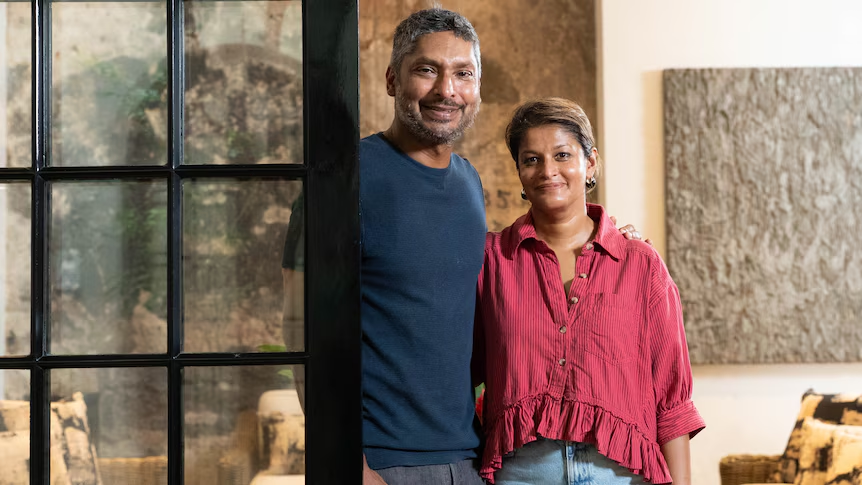
Kumar Sangakkara was often described as one of the most elegant cricketers to play the game. The Sri Lankan legend is regarded as one of the greatest wicketkeeper-batsmen, scoring more than 28,000 runs in all forms of the game, including 38 Test centuries.

Since his retirement in 2017, he’s found success off the pitch as a commentator, administrator and coach. Away from cricket, he’s thrown his talents at a passion project in the historic fortress town of Galle, on Sri Lanka’s south coast. There, Sangakkara and his wife Yehali have transformed a colonial-era townhouse into a modern family home, while keeping the unique blend of architectural styles which make Galle unique.
The couple’s passion project is an elegant statement of style and taste.
Galle Fort is a fortified town built by Portuguese and Dutch traders since the 1600s. It is World Heritage-listed and regarded as the “finest surviving example of a European-built fortified city in South and South-East Asia”, according to UNESCO.

“What you see here is the outcome of quite a few years of patience, love, passion, and frustration,” Sangakkara told Anthony Burke in the new series of Culture By Design. The couple had their hearts set on a home in Galle for years. They had their eye on the house before they bought it, having walked past it many times.
“We knew it was the one,”Sangakkara said.mWhen they bought the house in 2008, they still had never seen inside.
But when they walked in the door for the first time, they got a rude shock. “It was a complete wreck on the inside,” Sangakkara said. “We wanted to kind of say, ‘Okay, the old is the old’.”
The couple enlisted the help of architects Jeevan D’Souza and Murad Ismail and interior designer Annika Fernando. Between them, they shaped the heritage villa into something warm, personal and beautifully Sri Lankan.
They turned history into a home. The four-bedroom villa, built around 120 years ago, contains three courtyard gardens and a rooftop swimming pool. Each room is kitted out with artworks and antiques. “Wherever you walk, you can see the old house,” Sangakkara said.
“And everything new will be there, and it’s a contrast, but also about us being new entrants into the fort into an old community; how we also kind of coexist and live together is also a representation of how this house has evolved.”
A centrepiece is an impressive sculpture by Sri Lankan artist Prageeth Manohansa. “We thought it’ll be a nice piece to have in this house when we ultimately finished it,” Sangakarra said.

But there was one problem. The piece was too big to fit through any of the doors. “So we were like, ‘Okay, what do we do?’ We brought the pot in early, left it … and the house kind of restored it around the pot, so the pot saw everything that happened.”
The Sangakarras said there were many changes as the project took shape, but one constant was Annika Fernando. For her, this was a project which had real significance for Sri Lanka.”I was excited to do something in the Galle Fort I hadn’t done,” she said. “I also felt I was excited about the responsibility. I think that when you get projects like that, you’re taking on a role which is of national importance.”
Architect Murad Ismail said one of the biggest challenges with an old building was the spaces. “A way to access the spaces, they were a bit of an issue, but we had to be within the framework of the Dutch Fort and the old buildings, and I was against breaking things,” he said.m”And … Annika is of the same thought process of leaving some of the coral construction. So we wanted to expose how it was done in the past.”
The walls took on extra significance as the project evolved. “My vision for the project evolved with that,” Fernando said. “I started feeling this excitement in retaining a lot of the finishes as they were.
“Some of it happened due to moisture. Some of it just came through looking at this patina wall against the clean new walls and appreciating their beauty. I started feeling that, that was how I could bring out the heritage or the history of this new home by retaining important little features, and it became these walls.”
An essential element of the project was keeping the patina on the walls, which maintained the villa’s character.()
It was something the owners could appreciate, too. “I’ve been really lucky with this project,” said Fernando.
“It’s been recognised and featured and acknowledged for its unique style. And I mean, it’s something that really holds a lot of characteristics of my design style, merging old with new, and distressed with clean finishes.”