

Desert Wanderer, … who has an alternative title as well: “The Malacca Chokepoint: The Hegseth-Sjamsoeddin Pact and the Blueprint for A Global War Against China” ….. Note that the highlights are interventions by The Editor, Thuppahi
The United States are moving toward a global maritime strategy designed to sever China’s trade lifelines and force international commerce into a US-aligned network. By using “Freedom of Navigation” as a cover, the US aims to turn international waters into zones where it decides which ships are allowed to pass. With the Strait of Hormuz already under immense pressure, the Strait of Malacca has emerged as the next critical battleground. This waterway is the primary artery for 40% of global trade and is vital to Chinese energy security, as roughly 80% of China’s oil imports pass through this chokepoint from West Asia.

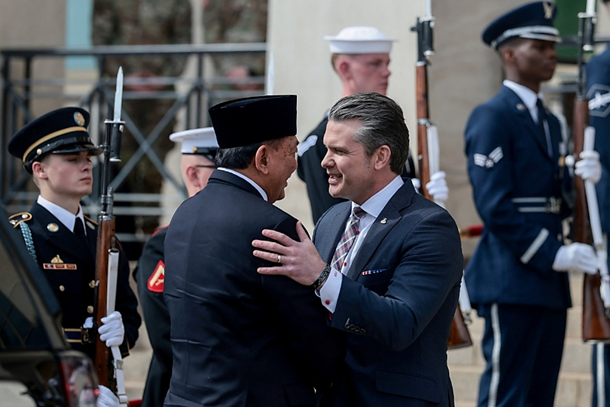
Three recent developments signal this shift in US operations. First, the US has intensified its tracking of “ghost fleet” tankers carrying sanctioned Iranian oil through Southeast Asian waters. Second, on 13 April 2026, US Defence Secretary Pete Hegseth and Indonesian Defence Minister Sjafrie Sjamsoeddin signed a Major Defence Partnership at the Pentagon. Promoted under the nefarious propaganda slogan “Peace through Strength,” this pact expands military cooperation and grants flyover rights that boost US monitoring, while creating opportunities for military strikes against Iranian and Chinese ships in the Strait. Third, the USS Miguel Keith—a massive expeditionary mobile base—transited the Strait on 18 April. This coincided with the seizure of Iranian-linked vessels nearby, signalling an aggressive enforcement posture as a preliminary step toward global war.
This secret defence deal has ignited a firestorm within the Indonesian government. The Ministry of Foreign Affairs (MFA) was caught off guard and excluded from negotiations. Alarmed by the ramifications, the MFA has demanded that the Indonesian Defence Department explain the nefarious nature of the pact. In a letter, the MFA warned that granting “blanket” overflight access could drag Indonesia into a US-Israeli led war against Iran and China. For now, the MFA has successfully paused the ratification of the pact, hoping the President will cancel it before Indonesia is ensnared in a US strategy to destroy the Chinese and Iranian economies.
The regional fallout of a Malacca blockade would be catastrophic, crippling the economies of US allies like Singapore, Japan, and South Korea. Singapore’s Foreign Minister, Vivian Balakrishnan, recently warned that the chaos in the Strait of Hormuz is a “dry run” for conflict in the Pacific. While he didn’t name the US directly, he made it clear that Singapore, Malaysia, and Indonesia want the Strait of Malacca kept open and free from interference or tolls. He reaffirmed that regional states oppose any move that violates the UN Convention on the Law of the Sea (UNCLOS), noting that closing the Strait could trigger a global escalation involving Taiwan and beyond.
China recognized this “Malacca Dilemma” twenty years ago and launched its “Escape from Malacca” strategy through the Belt and Road Initiative (BRI). By building road and rail networks across Asia and Europe, China seeks to bypass vulnerable sea routes with land corridors protected by sovereign borders. While more expensive, these routes are faster and more secure. Despite these efforts, much of the trade between Iran and China still relies on the Strait. The Hegseth-Sjamsoeddi pact risks dragging Malaysia and Singapore into a new US-led “Axis of Evil” alongside Indonesia, forcing a regional war that would destroy the global economy. This is exactly what Netanyahu and many Israelis want.
The US strategy targets the very heart of Malaysia’s sovereignty. As the Hegseth-Sjamsoeddi pact seeks to turn the Strait into a supervised corridor, Prime Minister Anwar Ibrahim has faced increasing internal pressure over trade and security deals that critics argue compromise Malaysia’s independence. Lawmakers from Anwar’s own party have expressed fear that such agreements align Malaysia too closely with American national security interests, restricting the nation’s right to maintain its neutral “active non-alignment.” If the US successfully imposes its will on the Strait, Malaysia will lose control over its most vital geographic asset, effectively becoming a satellite for American power projection. The trap has now been set, and the window for Malaysia to avoid it is narrowing.
The precedent set in the Middle East provides a grim warning. The US security umbrella in the Gulf has collapsed; despite a massive troop presence, the US failed to protect Qatar from strikes and could not prevent energy infrastructure hits in the UAE during the 2026 conflict with Iran. Gulf officials now see American cooperation as an “acute vulnerability” rather than a safeguard. This same pattern—where the US encourages escalation but offers no real protection when retaliation hits—is now being exported to Southeast Asia. If war starts, Malaysia, Indonesia, and Singapore will not be protected; they will be sacrificed to “Make America Great Again,” serving as the frontline “sitting ducks” in a conflict designed solely to serve US national interests.

The next war’s setting is being mapped at the Pentagon. The Strait of Malacca handles 40% of global trade, carrying essential cargo from nations like China and Iran through this narrow chokepoint.

Further reading
Lendon, Brad. “The US-Iran war is spilling into the Indo-Pacific. That could make it harder to end.” CNN World, 22 April 2026.
Tanamai, Yvette. “US overflight proposal sparks ministerial rift.” The Jakarta Post, 16 April 2026.
The Jakarta Post. “Indonesia, France agree to boost defense industry ties.” 15 April 2026.
Bangkok Post. “Controversy in Indonesia over US military overflight proposal.” 14 April 2026.
&&&&&&&&&&&&&&&&&&&